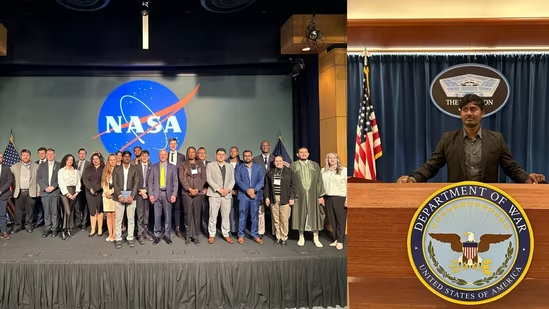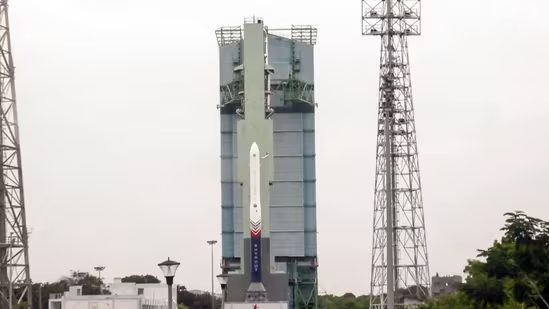
SynopsisDr. Anand Megalingam's journey from a rural Indian village to NASA-linked aerospace programs highlights resilience and innovation. Despite early struggles and a denied US visa, he founded Space Zone India, achieving breakthroughs with reusable rockets like RHUMI-H and RHUMI-1. His international recognition underscores India's growing private space sector.Dr. Anand MegalingamDr. Anand Megalingam’s journey from a small rural village in India to NASA-linked aerospace programmes has become one of the most remarkable stories emerging from India’s growing private space sector. The founder and CEO of Space Zone India, Dr. Anand has gone from walking nearly six kilometres daily to attend school to being recognised internationally for his contributions to reusable rocket technology and private aerospace innovation.Once denied a US visa while pursuing aerospace opportunities, Dr. Anand later returned to the United States after being selected by the US Department of State for a prestigious international leadership initiative. He was reportedly among only 23 experts chosen globally for the programme, which also provided advanced technical exposure through NASA-linked environments.For many, the achievement marked a professional milestone. For Dr. Anand, however, it symbolised something much deeper — resilience after rejection.Born into a farming family in rural India, his early life was defined by struggle rather than privilege. His father worked as a tractor driver to support the family, while financial hardship remained a constant reality. According to reports, young Anand walked almost six kilometres every day to reach school, a demanding routine that quietly built the endurance and discipline that would later shape his career.Unlike many global aerospace innovators, Dr. Anand did not come from elite institutions or well-funded laboratories. His educational journey was uncertain and filled with setbacks. Initially, he enrolled in Computer Science, believing it would provide a stable career path. But he reportedly struggled to connect with the field and eventually dropped out of college — a moment that could have permanently derailed his ambitions.Instead, the setback became a turning point.Determined to rebuild his future on his own terms, he shifted to Aeronautical Engineering, a field that genuinely inspired him. The decision transformed his academic journey. Dr. Anand graduated as a Gold Medalist with an exceptional 9.8 CGPA, earning one of the highest scores in his institution’s history and establishing himself as one of the country’s promising young aerospace minds.Driven by the belief that India should not merely participate in the global space race but eventually lead it, he founded Space Zone India. Reports suggest his father became one of the earliest supporters of the mission. What began with limited resources and ambitious dreams gradually evolved into one of India’s most talked-about private aerospace ventures.Under his leadership, the company achieved a major breakthrough with the RHUMI-H mission, described as India’s first reusable hybrid rocket launched from a mobile platform. The launch drew significant attention within India’s rapidly expanding private space ecosystem. Later, RHUMI-1 further strengthened the organisation’s profile, earning international recognition and positioning Space Zone India among emerging aerospace innovators in Asia.Yet even amid success, challenges continued.When his US visa application was denied years ago, many expected disappointment. Instead, Dr. Anand responded with a statement that later became closely associated with his philosophy: “Borders are for people. Innovation has no boundaries.”Years later, the same country that once denied him entry welcomed him into advanced aerospace and innovation programmes. Through the US Department of State initiative, Dr. Anand reportedly interacted with NASA scientists, aerospace experts, military officials, and Space Force commanders during an intensive month-long programme focused on advanced aerospace systems, defence applications, launch technologies, and innovation management.Reflecting on the experience after returning to India, Dr. Anand reportedly said the exposure to advanced technologies and aerospace ecosystems would help strengthen upcoming Indian missions.Today, Space Zone India is preparing for its next major milestone — the RHUMI Twin Mission, an ambitious project aiming to launch two rockets simultaneously from Chennai for the first time in India’s private aerospace history. The organisation is also expanding into reusable launch systems, satellite technologies, defence-oriented aerospace innovations, and indigenous space technologies designed to strengthen India’s long-term technological capabilities.Read More News on
Rejected by US visa, welcomed by NASA: Meet Dr. Anand Megalingam, a tractor driver's son, who built one of India’s rising space-tech cos
Dr. Anand Megalingam's journey from a rural Indian village to NASA-linked aerospace programs highlights resilience and innovation. Despite early struggles and a denied US visa, he founded Space Zone India, achieving breakthroughs with reusable rockets like RHUMI-H and RHUMI-1. His international recognition underscores India's growing private space sector.
675 words~3 min read