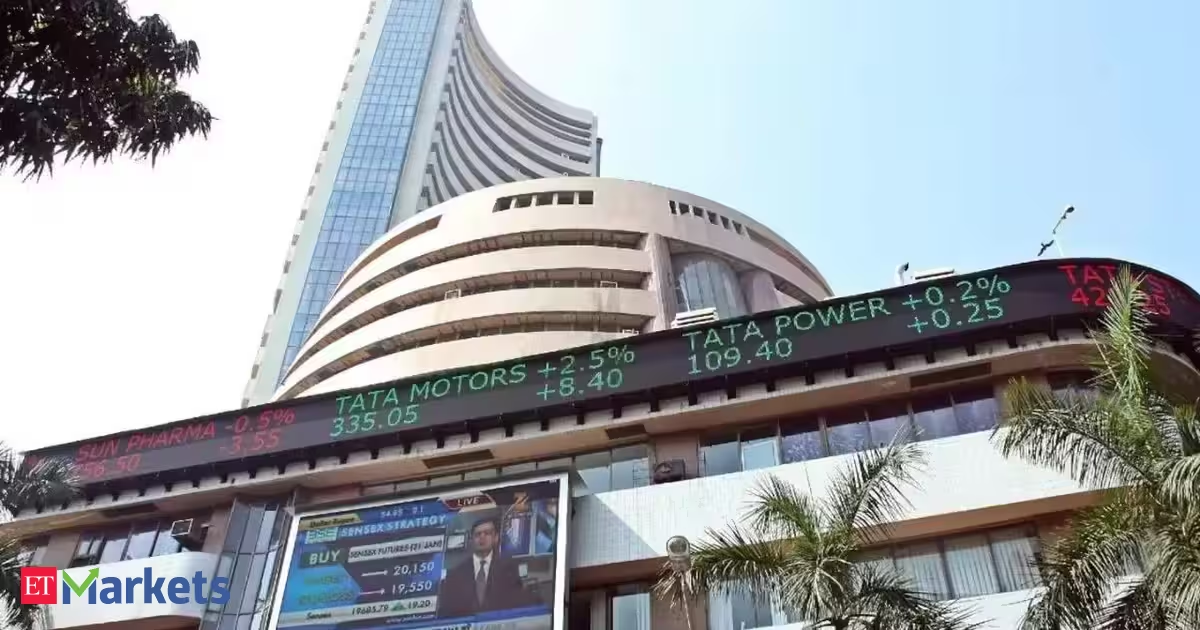
Benchmark indices Nifty and Sensex ended Friday on a weak note as the rupee hit a fresh record low against the US dollar, oil prices extended gains and global markets crashed, spooking investors. During the week, Sensex fell around 2,000 points, while Nifty 50 dropped 2%.Here are five factors that will decide market mood starting Monday:Iran war tensions simmerIranian Foreign Minister Abbas Araqchi said on Friday that Tehran has “no trust” in the United States and would engage in negotiations only if Washington showed seriousness. He added that Iran remains ready both for renewed conflict and for diplomatic solutions. Trump, meanwhile, said he was losing patience with Iran and had agreed with Chinese President Xi Jinping that Iran cannot be allowed to develop a nuclear weapon and must reopen the strait.Oil prices back at $110/bblOil prices flared up as much as 8% this week after ending the Friday session over 3% higher. The rhetoric between Washington and Tehran turned increasingly confrontational once again. Although the ceasefire remains in place, expectations of a quick reopening of the Strait of Hormuz have diminished sharply.Analysts at Morgan Stanley said the global oil market is now in “a race against time,” warning that factors limiting a sharper rise in crude prices may weaken if the Strait of Hormuz stays shut into June. Saudi Aramco CEO Amin Nasser said on Monday that disruptions to shipments through Hormuz could delay stability returning to oil markets until 2027, potentially affecting around 100 million barrels of oil supply every week.Rupee’s freefall to record lowThe Indian rupee's slide towards the psychologically crucial Rs 100 per dollar mark is no longer being viewed as an extreme possibility by market participants. For many investors, the debate has shifted from whether the rupee can touch that level to what such a move would mean for the economy, corporate earnings and stock portfolios.The rupee slipped below the crucial 96 mark on Friday, pressured by elevated crude oil prices, a strong dollar and hawkish comments from US policymakers. Forex traders said the USD/INR pair is reeling under tremendous pressure amid persistent outflows of foreign capital and weak net FDI inflows, exerting pressure on the balance of payments.Over the past year, a far bigger and more striking trend has quietly unfolded beneath the surface: the rupee has weakened against every major global currency and its steepest fall hasn’t even been against the dollar.Global cuesLast week, Korean index Kospi tanked a staggering 6% on the same day it hit a record high. The sudden reversal was driven largely by heavy selling in technology stocks and came amid broad weakness across Asia-Pacific markets. The sharp correction followed an extraordinary rally in South Korean equities that had increasingly raised concerns over concentration risks, particularly around artificial intelligence-linked stocks.U.S. stocks closed sharply lower on Friday as a sell-off in technology shares and rising Treasury yields weighed on investor sentiment following the conclusion of the summit between President Donald Trump and Chinese President Xi Jinping, which failed to deliver any major policy breakthroughs.Technology stocks, which had rallied strongly in recent sessions, came under pressure as investors booked profits. Intel tumbled more than 6%, while Advanced Micro Devices and Micron Technology lost 5.7% and 6.6%, respectively. Nvidia fell 4.4%, while Cerebras Systems, which had surged 68% in its Nasdaq debut on Thursday, declined 10% on Friday.Rising bond yieldsHigher US bond yields are often seen as a headwind for Indian markets because they increase the appeal of safer American assets relative to emerging market equities. When US Treasury yields rise, foreign institutional investors tend to pull money out of markets like India and shift capital into US bonds, leading to pressure on Indian stocks and the rupee.Rising yields also strengthen the dollar, increase global borrowing costs and reduce liquidity, which hurts risk appetite. Rate-sensitive and richly valued sectors such as IT and banking usually face the biggest impact.Markets in the coming week are expected to remain highly volatile and intensely headline-driven, with investor sentiment continuing to hinge on developments surrounding the ongoing US–Iran conflict, diplomatic negotiations and movements in global energy markets. The broader mood remains cautious, as investors weigh the possibility of a diplomatic breakthrough against the growing risk of a prolonged geopolitical and energy-driven disruption.(Disclaimer: Recommendations, suggestions, views and opinions given by the experts are their own. These do not represent the views of The Economic Times)
Will Nifty, Sensex extend losses on Monday? These 5 factors will drive D-Street action this week
Indian markets ended the week sharply lower amid a record rupee slide, surging oil prices and weak global cues. Investors remain cautious as geopolitical tensions, rising US bond yields and foreign outflows weigh on sentiment. The coming week is expected to be volatile, with macro triggers likely to dictate D-Street direction.
727 words~3 min read