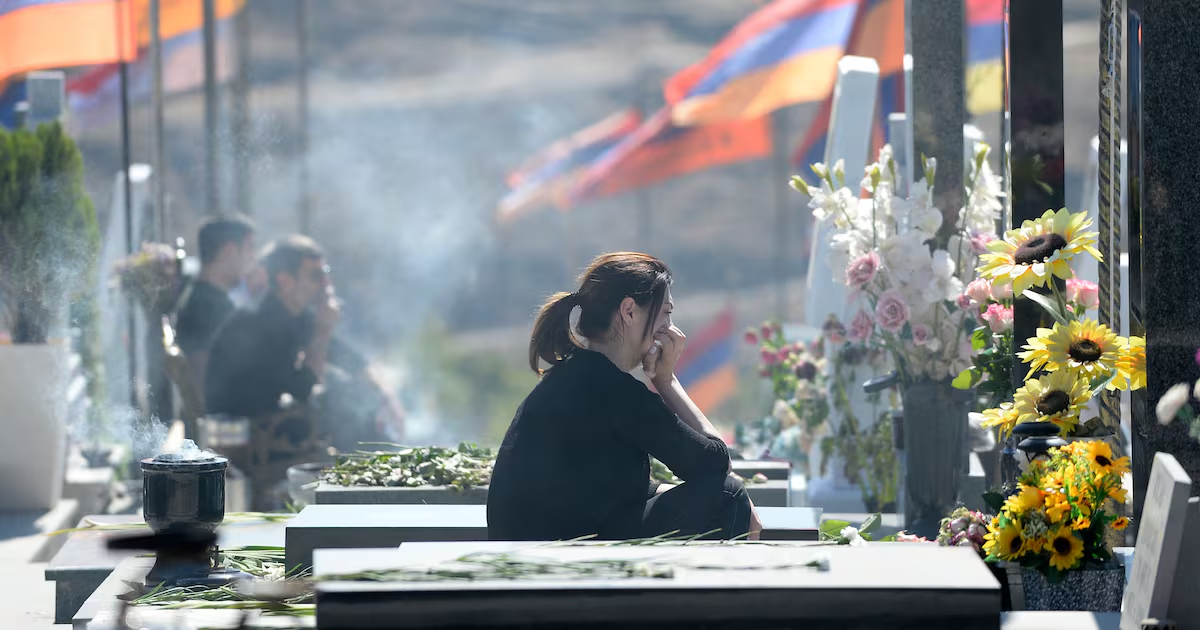
There’s a thick smell of incense in the air. It’s a Sunday morning and grieving mothers and fathers are bringing fresh flowers to the graves of sons who were killed in Armenia’s 35-year conflict with Azerbaijan. In Yerablur military cemetery, high above the Armenian capital city, Yerevan, the dates on the headstones chart a history of the fighting for the disputed mountainous region of Nagorno-Karabakh. Rows and rows of Armenian soldiers killed during the first war, which lasted from 1988 to 1994, are buried here one after the other. Walk on a little farther and you begin to pass all the graves of the men who died during a 44-day war launched by Azerbaijan in 2020. A final, lightning quick offensive from Azerbaijan in 2023 took control of the Nagorno-Karabakh region, a devastating blow to Armenia, which forced 100,000 ethnic Armenians living in the enclave to flee their homes, possibly never to return. Graves of Armenian soldiers killed in the Nagorno-Karabakh wars, in Yerablur military cemetery, Yerevan. Photograph: Jack Power One mother, Albina, explains how her 19-year-old son was killed by a grenade in the second Nagorno-Karabakh war in 2020. “This is my son,” she says, resting her hand on the tombstone and wiping away tears. He was the youngest of three boys. “Every day we come to Yerablur,” she says. The long uphill road to the military cemetery is called the Alley of Glory. Nearly all the tombstones include large pictures of the deceased in military uniform. Some show the soldiers holding Kalashnikovs or other rifles. There are a lot of young faces. Above them flutter Armenian flags flying from tall poles posted beside every second or third grave. Two brothers, both born in 1994, are buried in one plot together. The first was killed in the 2020 war and the other in 2023. Nearby a father slowly unpacks a red plastic shopping bag, taking out a brush to clean the grave of his son, a casualty in 2020. “Nineteen years old,” he says, shaking his head. Lots of the graves have small stands where families can burn incense when they visit. The father pulls out a small blowtorch to light some, before he begins carefully cleaning the headstone. A priest – Armenia is a predominantly Christian country – is leading a large group in prayer. One elderly couple is tending to the grave of their son who was killed in the first war three decades ago. He was 25 years old. His mother takes a trowel to a flower bed that borders the plot, while his father sweeps away stray leaves. They spend the entire afternoon here. A landlocked country of about three million people, Armenia is bordered by oil-rich Azerbaijan to the east, and another old foe, Turkey, to the west. It’s a cloudy day but you can still make out the snow on Mount Ararat, the huge mountain that dominates the southwestern skyline beyond the Armenian capital. Symbolically important to Armenians, the mountain lies in present-day Turkey, a daily reminder of the country’s history as a small piece on the geopolitical chessboard of the South Caucasus. An Armenian soldier fires a cannon towards Azerbaijan positions in Nagorno-Karabakh, Azerbaijan, in 2021. Photograph: Sipan Gyulumyan/Armenian Defense Ministry Press Service/PAN Photo via AP The territory was ceded in a 1920 treaty negotiated by Moscow that settled the borders of the republic of Turkey and the three then-Soviet republics of Armenia, Georgia and Azerbaijan. When the Soviet Union began to break up, rising tensions between Armenian and Azerbaijani communities led to the first Nagorno-Karabakh war.A push to unify Armenia and the large population of ethnic Armenians in the border region, internationally recognised as Azerbaijan, unleashed a surge in ethnic violence in the late 1980s that escalated into a vicious years-long conflict between the neighbouring countries. Armenian forces successfully established control of the enclave and several surrounding Azerbaijan districts before Russia brokered a ceasefire in 1994. Hundreds of thousands of Armenians and Azerbaijanis were displaced from their homes, and forces on both sides were accused of committing atrocities and massacres. Armenians in Nagorno-Karabakh set up a self-declared breakaway republic, Artsakh, which governed the enclave until 2023. The uneasy ceasefire was tested at times by clashes and skirmishes, including four days of fighting in 2016, until an attack by Azerbaijan in September 2020 saw the resumption of full-scale hostilities. Harut Mnatsakanyan (33), who fought with Artsakh and Armenian forces in the 2020 war: 'I lost my brother'. Photograph: Jack Power “In 2020, when the war started, we had our place in the line and we went there,” says Harut Mnatsakanyan (33), who fought in a local unit assisting the Armenian army, alongside his older brother. “I was born in 1992 during the first Artsakh war, so all my father’s generation was fighting,” he says. “I was married in 2016 and in 2020 I had two children when they started the war,” he says. Mnatsakanyan, a political science graduate, had worked as a senior official in a regional province in the unrecognised Artsakh administration. When he was 18 he completed two years of mandatory military service so he knew how to fight. His unit was initially posted to a northern part of the front line, but was soon redeployed to the Shushi region where the fighting was heavier. “It was the most difficult part of the war,” he explains. “We did what we needed to do.” Azerbaijan, with the support of Turkey, utilised a technological advantage on the battlefield to devastating effect, deploying waves of killer drones to push Armenian and local Artsakh forces backwards and reclaim a lot of territory lost in 1992. “We lost people, too many,” Mnatsakanyan says. “I lost my own brother.” His brother, Gurgen, had left cover to help two wounded Armenian soldiers. “After five minutes he hadn’t come back,” Mnatsakanyan recalls.So he went out after him. He found his brother, shot in the side, near the two other soldiers he had run out to help. “It was a difficult position, so nobody, and especially not an ambulance, could come,” he says. “I say: it’s my own brother. I have to save him.“He couldn’t breathe, the blood was coming into his lungs ... I could not stop the bleeding. So I dragged him, something like 800 metres, maybe one kilometre”. Mnatsakanyan managed to help his brother into the back of a military jeep. “Before we got him to the hospital we lost him. He was 30 years old, married with two children,” he says. “We lost many people that day. “It’s not a time to cry, it’s no time for emotion, or to grieve. You have to fight for you, for your country and for your friends,” he says. After Azeri forces captured the strategically important city of Shushi, a ceasefire was negotiated by Russia, which committed to station peacekeepers in the region to guarantee the truce. On the final day of the war Mnatsakanyan’s unit captured two Azerbaijani troops. “The other soldiers wanted to kill them, but we didn’t let them, because I think that you have the time for war, and also we have the time for life, for peace,” he says. When he returned home after the war, the grief properly hit. “You don’t understand many things in the moment,” he says. He thinks about his brother’s children who had lost their father and feels responsible. “I called him and asked him to join our group ... My mother tells me that he’s your big brother and it was his decision to fight,” he says. “Every day of course you remember him. I remember when I was small and he’d take me on his bicycle and go around our home, how we would swim together, play together. There’s not a day when it isn’t difficult,” Mnatsakanyan says. Irina Arakelyan, a refugee from Nagorno-Karabakh, in the Teryan cultural centre, Yerevan, Armenia. Photo: Jack Power “We cannot take flowers to his grave, his body is buried in Nagorno-Karabakh.” In September 2023, after blocking off a land route bringing supplies from Armenia to the enclave, Azerbaijan launched another attack. The offensive swept across the region, forcing the surrender and collapse of the Artsakh administration in a matter of days. The entire population of 100,000 ethnic Armenians fled, turning entire cities and villages into ghost towns. “It is very painful,” says Irina Arakelyan, a refugee from Nagorno-Karabakh who has settled in Yerevan. It was difficult to come to terms with the reality she might never be able to go back. “Accepting that fact, it would mean death,” she says. A cultural centre in Yerevan run by an artist, Lilit Melikyan, turned into a muster point for arriving refugees. Sitting in a workshop filled with traditional Armenian dresses, scarves and ceramic pots, Melikyan says the small centre had opened its doors to an earlier wave of refugees during the 2020 war. “There were a lot of people fleeing Artsakh overnight, 170 families appeared at the door asking, asking for help,” she says. Volunteers collected and sorted donations of clothes for the women and children. “All these people ... They were in their slippers and pyjamas,” she says. Vehicles carrying refugees from Nagorno-Karabakh on the road to the border village of Kornidzor, Armenia, on September 26th, 2023. Photograph: Nanna Heitmann/The New York Times
‘You have to be ready for war’: Legacy of limbo in Armenia after loss of Nagorno-Karabakh
A lightning quick offensive in 2023 saw Azerbaijan take control of the disputed region in a devastating blow to Armenia
2,193 words~10 min read