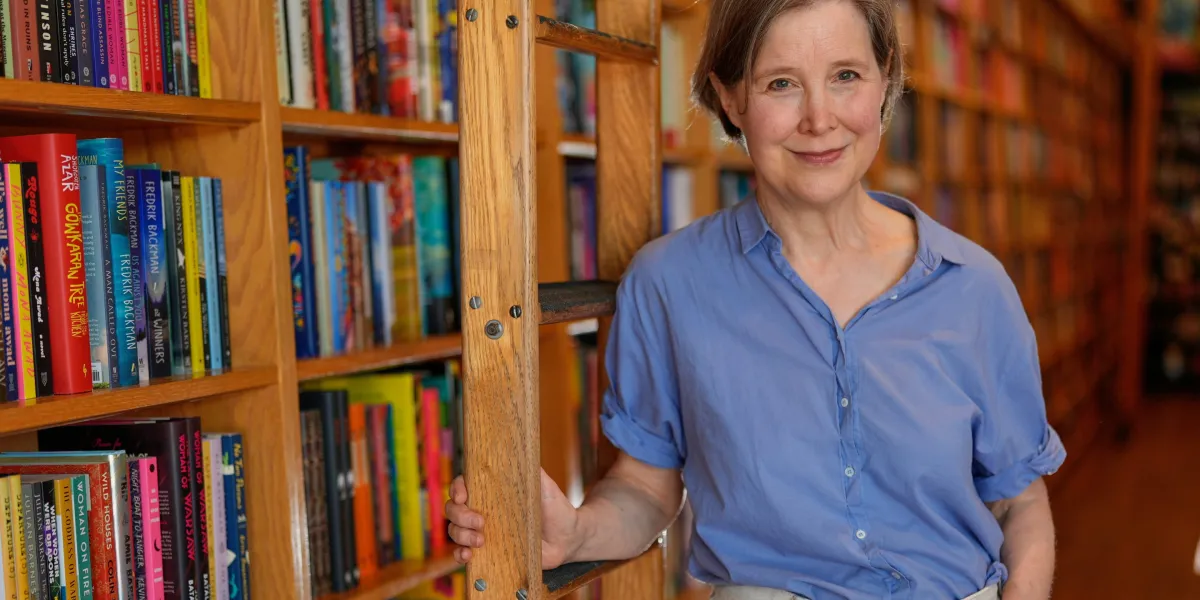
It was like any Monday morning at Seattle Central College, the community college where Stacey Levine has taught creative writing for fifteen years. Arriving at work, she sat down at her office desk—a bulletin board with lightly crumpled world maps pinned up behind her—and fired up Facebook. A friend from Elliott Bay Book Company, the well-loved local bookshop, had tagged her in a post with a link to the Pulitzer website. “I noticed there were three or four people from Seattle who were finalists,” she tells me via video call, seated at the very same office chair, nearly a year after that day in May. “That’s when I saw my name. It’s kind of sad that I found out from Facebook.”
Before being named a 2025 Pulitzer fiction finalist, Levine’s novel Mice 1961 had received only two reviews in publications of note, 3:AM Magazine and the Washington Post. Published by the small Oregon imprint Verse Chorus Press, it follows a day in the life of two reclusive sisters in an uncanny Floridian dimension at the height of Cold War hysteria. It’s a deeply weird book, a kind-of coming-of-age comedy with no easy takeaway, full of twangy dialogue that reads like an alien in a human suit going “hello fellow Earthlings.” Sentences often seem straightforward until, hilariously, they don’t, as when one character proclaims: “Miami is a paradise that starts with the sun.”