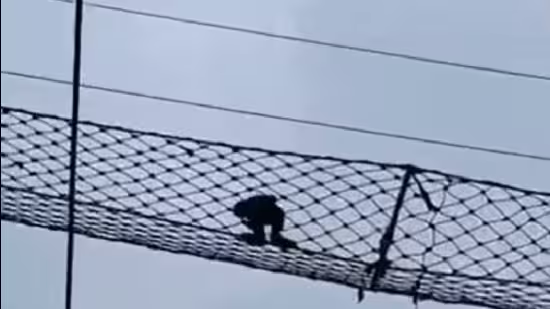
Inside Assam’s Hollongapar Gibbon Sanctuary, a male Western Hoolock Gibbon was recorded confidently swinging across a specially built canopy bridge over the Lumding–Dibrugarh railway line, marking what scientists say is the first documented case anywhere of such a structure being used over active train tracks.This is the first confirmed instance of a gibbon using such a structure in the sanctuary and the first documented case anywhere in the world of a canopy bridge being used over a railway line, scientist“This is the first confirmed instance of a gibbon using such a structure in the sanctuary and the first documented case anywhere in the world of a canopy bridge being used over a railway line,” Dehradun’s Wildlife Institute of India (WII) scientist GV Gopi, who headed the project, said.He said that five double-rope canopy bridges equipped with safety nets were installed as a mitigation measure after the electrification of the Lumding-Dibrugarh railway line that passes through the forest area. “The structures were designed to help arboreal species safely cross the railway track without descending to the ground, where they face risks from trains and predators,” he added.Linear infrastructure such as railways and roads can fragment forest habitats, posing serious threats to canopy-dwelling wildlife, Gopi said, adding that the successful use of canopy bridges demonstrates how carefully planned mitigation measures can reduce such risks.“The long-term conservation of gibbons will require careful infrastructure planning and eco-sensitive site selection, along with restoration of forest corridors to reconnect isolated populations,” he said.Expressed gratitude to the Assam forest department and partner institutions involved in the design, installation and monitoring of the canopy bridges, he said, “Incidentally, it was also Endangered Species Day.”The Western Hoolock Gibbon (Hoolock hoolock) is India’s only ape species and belongs to the family Hylobatidae, which includes the lesser apes or gibbons. It is classified as Endangered on the International Union for Conservation of Nature (IUCN) Red List and is protected under Schedule I of the Wildlife Protection Act, 1972, giving it the highest level of legal protection in India.This species is found only in the forests of Northeast India, primarily in Assam, Arunachal Pradesh, Meghalaya, and Nagaland, with small populations also occurring in Bangladesh and Myanmar. Its distribution is highly fragmented, making conservation efforts particularly challenging. It is strictly arboreal, meaning it lives entirely in trees and depends on continuous forest canopy for movement and survival.
Endangered hoolock gibbon crosses railway line using canopy bridge in Assam sanctuary
India’s only ape species, Gibbon, was recorded confidently swinging across a specially built canopy bridge over the Lumding–Dibrugarh railway line | India News
394 words~2 min read