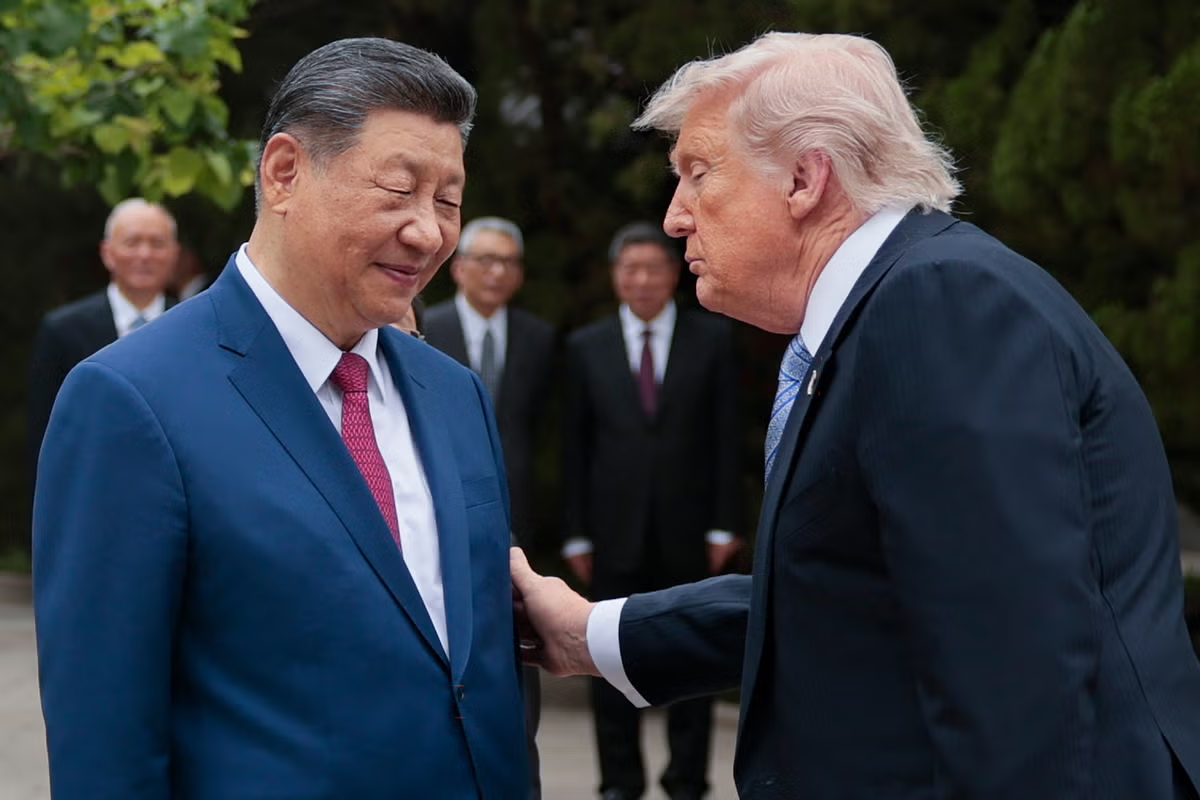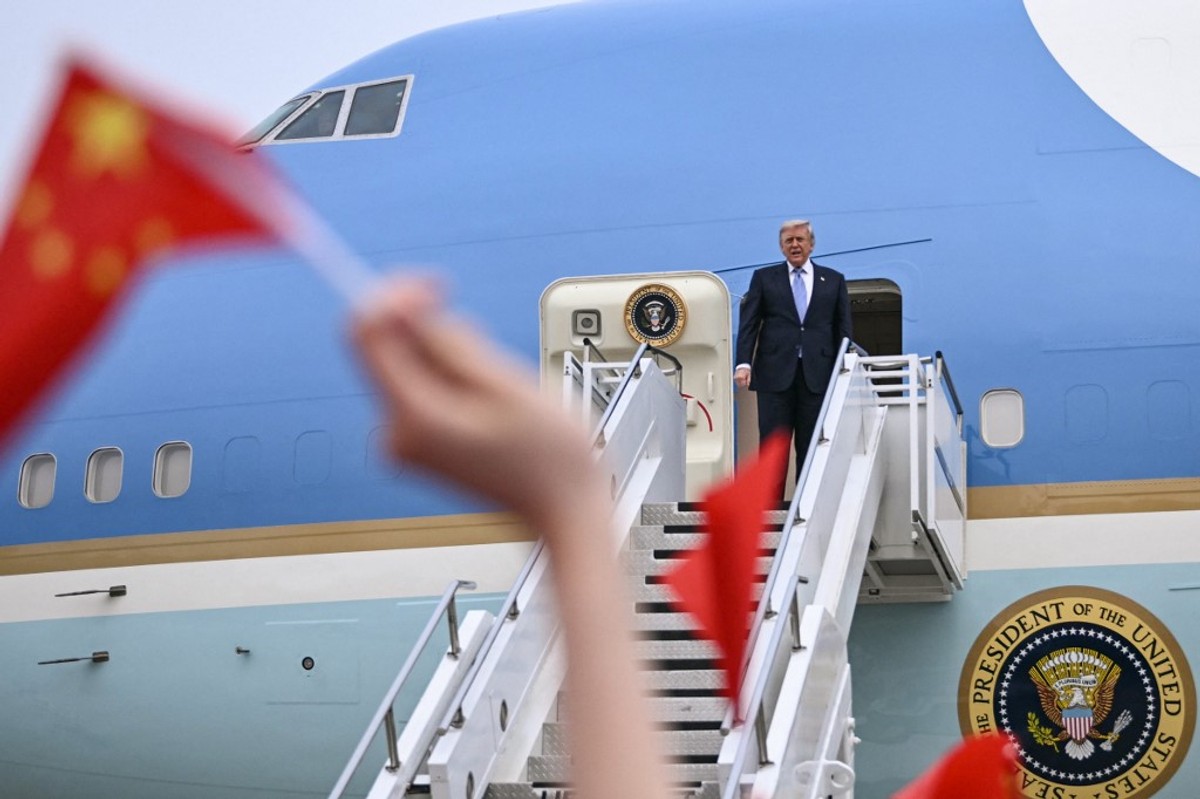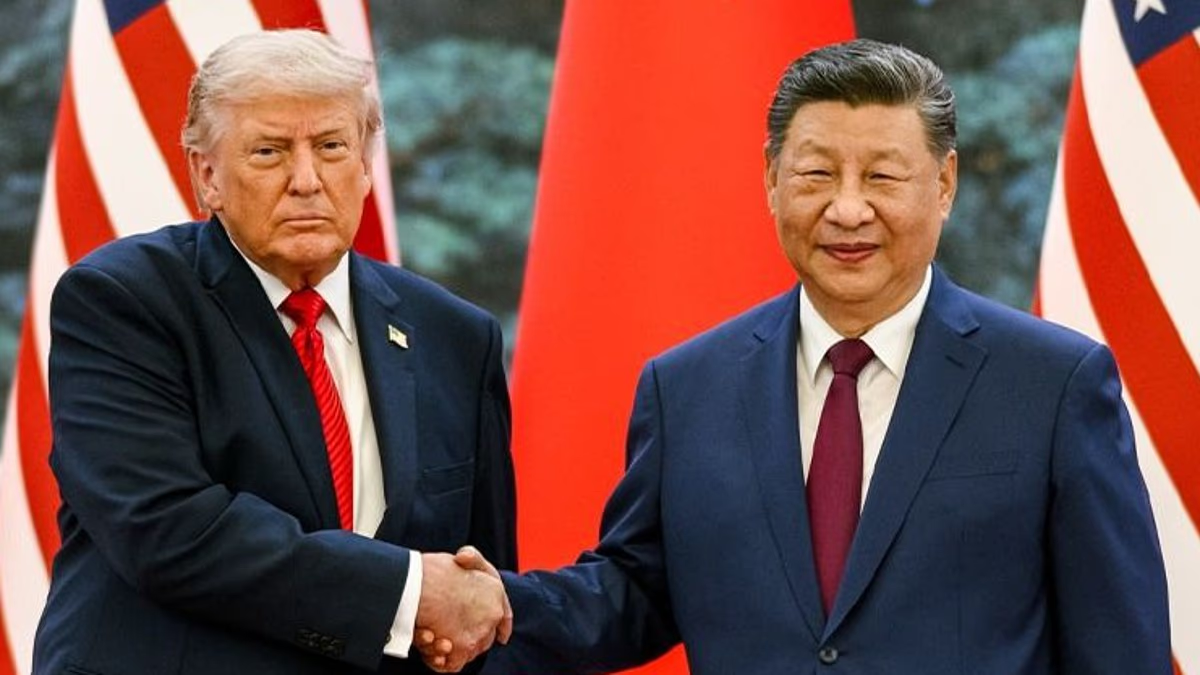
Donald Trump has warned Taiwan not to declare independence from China following the two-day summit in Beijing this week. The US President told Fox News on Friday that he's 'not looking to have somebody go independent'. He said: 'We're supposed to travel 9,500 miles (15,289km) to fight a war. I'm not looking for that. I want them to cool down. I want China to cool down.'We're not looking to have wars, and if you kept it the way it is, I think China's going to be okay with that.' Mr Trump also told reporters during his flight back to Washington that he had spoken to Chinese president Xi Jinping about Taiwan 'a lot' during the summit. But he said he had declined to answer questions about whether the US would intervene to defend the island nation in the event that China invaded. Mr Trump's warning came despite Taiwan, a democracy, demanding for the US to keep supplying it with weapons to defend itself.He added that Xi 'feels very strongly' about China's claim over the territory and 'doesn't want to see a movement for independence'. Donald Trump meets with Chinese president Xi Jinping during an official visit aimed at discussing trade and bilateral relations between the two countries. Beijing, China, May 15 Mr Trump participates in a welcome ceremony with Xi at the Great Hall of the PeopleTaiwan's president, Lai Ching-te, previously said that the island nation does not need to declare independence from China as it already sees itself as sovereign. Despite laws requiring the US to help Taiwan defend itself, Mr Trump said he had 'made no commitment either way' about the question of sovereignty. The US has long supported the island nation. In 1953, the same year the Korean War ended, then-vice president Richard Nixon declared during a visit to Taiwan that the US would support the island's development as an anti-communist military. However China has claimed sovereignty over the island and has not ruled out annexing Taiwan by force, ramping up military pressure in recent years. The Chinese government has previously labelled Lai Ching-te a 'troublemaker' and accused him of being a 'destroyer of cross-strait peace'. There is a large pro-independence sentiment in Taiwan, however most support the status quo in which Taiwan does not formally declare sovereignty or back Chinese rule. However, just hours after Mr Trump's warning, the island declared itself 'independent'. Taiwan's foreign ministry said on Saturday that the island is a 'sovereign and independent democratic nation, and is not subordinate to the People's Republic of China'. Taiwan's president Lai Ching-te (pictured) has been labelled a 'troublemaker' by China over his views on seeking formal independence It also insisted that US arms sales were part of Washington's security commitment to Taiwan, after Mr Trump flagged that he was considering the issue.The US only recognises Beijing and does not support formal Taiwanese independence but historically has stopped short of explicitly saying it opposes the island's sovereignty.Under US law, America is required to provide weapons to Taiwan for its defence, but it has been ambiguous on whether US forces would come to the island's aid in the event of Chinese annexation. Xi had begun this week's summit with a warning on Taiwan, telling Mr Trump that missteps on the sensitive issue could cause 'conflict'.Taiwan's Presidential Office said on Saturday the 'multiple reaffirmations from the US side, including President Trump and Secretary of State Marco Rubio, that the consistent US policy and position toward Taiwan remain unchanged'.Spokeswoman Karen Kuo said: 'Taiwan-US cooperation has always been demonstrated through action'Taiwan looks forward to continuing to work with the US under the firm commitments of the Taiwan Relations Act.' She added that China's escalating military threat is the 'sole destabilising factor' in the Indo-Pacific region, including the Taiwan Strait. Chinese president Xi (second from right) and Mr Trump (second from left) pose for a photo with Eric Trump (right) and his spouse Lara (left) at the Temple of Heaven during the two-day summit in BeijingMr Trump said he spoke to Xi about Taiwan 'a lot' during his visit to China While her statement made no mention of whether Mr Lai and Mr Trump would speak, a senior Taiwan security official said the implication from the US President was 'quite clear'.'The party with whom arms sales are to be discussed is Taiwan, not Beijing,' the official said, speaking on condition of anonymity given the sensitivity of the matter.Despite a lack of formal diplomatic ties, the US is the most important international backer for Taiwan. Ahead of the summit, Mr Trump had said he would speak to Xi about US arms sales to Taiwan, a departure from Washington's previous insistence that it would not consult Beijing on the matter.Taiwan's parliament recently approved a $25billion defence spending bill that will be used for US weapons.Lawmakers have said the funds will cover nearly $9billion of the $11.1billion arms package announced by Washington in December and a second phase of arms sales - not yet approved by the US - worth more than $15billion.Speaking to reporters on Friday en route to Washington, Trump said on arms sales: 'I'll make a determination over the next fairly short period of time.'Taiwan's foreign ministry said arms were 'not only a US security commitment to Taiwan clearly stipulated in the Taiwan Relations Act, but also a form of joint deterrence against regional threats'.Speaking to reporters in Taipei on Saturday, Taiwan's deputy foreign minister Chen Ming-chi declined to comment on the second arms package because it has yet to be made public, saying Taiwan would continue to communicate with the US to understand the situation from Washington's side.Taiwan's government has been stymied by the opposition-controlled parliament in trying to pass $40billion in extra defence spending. Earlier this month it approved two-thirds of what the government wanted but specified it was for US arms.US Republican and Democratic lawmakers have strongly urged the Trump administration to continue with weapons sales.Kuo Yu-ren, of the Institute for Policy Research, a Taiwanese think tank, said Mr Trump might delay approving the new package until after late September when he has invited Xi to visit the US.Mr Trump appeared to suggest to reporters that he would speak with Taiwan's president about the proposed sale. He said: 'I have to speak to the person that's running Taiwan'.Asked about that possibility, Mr Chen said Taiwan still needed to try to understand the 'true intent' of Mr Trump's remarks.China has never renounced the use of force to bring Taiwan under its control and has rebuffed repeated offers of talks from Mr Lai, whom it has said is a 'separatist'.Mr Lai's spokesperson reiterated the government's long-standing position that the Republic of China, Taiwan's formal name, is a 'sovereign, independent democratic country'.'This is self-evident, and Beijing's claims are therefore without merit,' Ms Kuo said.China's military, which operates around Taiwan almost daily, kept up the pressure while Mr Trump was in Beijing on Thursday and Friday.Shen Yu-chung, a deputy minister at Taiwan's China-policymaking Mainland Affairs Council, said China has long sought to use pressure to push for talks and military force to push for 'unification'.'That has always been the basic tone of its Taiwan policy,' he said, standing next to Mr Chen.
Trump warns Taiwan not to declare itself independent from China
The US President told Fox News on Friday that he's 'not looking to have somebody go independent'.
1,200 words~5 min read