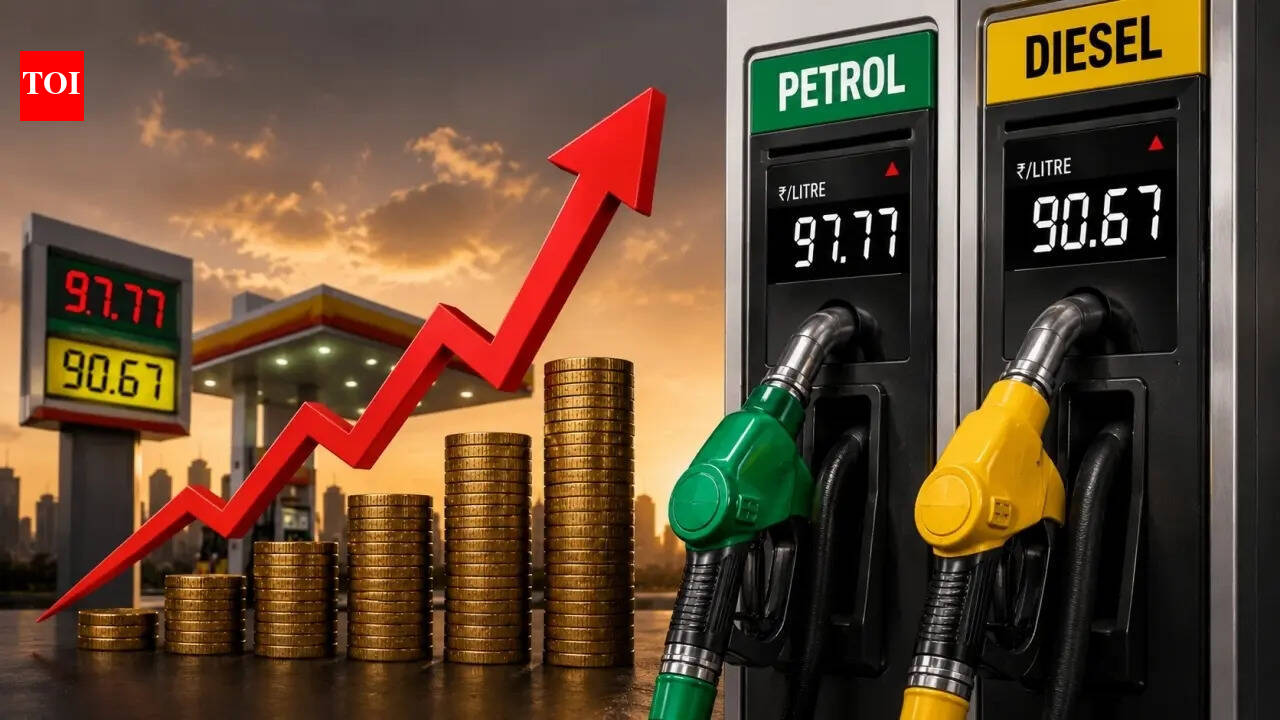
The government on Friday raised the prices of petrol and diesel by Rs 3 per litre after state-run oil companies faced mounting losses due to a sharp rise in global crude oil prices triggered by the ongoing West Asia conflict. India has kept its petrol and diesel prices unchanged for four years- ever since the Russia-Ukraine conflict started. According to experts and economists, the recent hike in petrol and diesel prices may only mark the beginning of a staggered increase in fuel rates, reports TOI. If the Middle East crisis persists and global crude oil prices remain above $100 per barrel, fuel prices could continue to rise in the coming days.ALSO READ: Why is a video of Donald Trump looking at Xi Jinping’s notebook going viral online? Know the truth behind itDrawing on historical trends, Radhika Rao, Executive Director and Senior Economist at DBS Bank, suggests that further hikes are likely. “Back in 2022, the increases in pump prices were staggered. This time around, given the sharp rally in global crude prices and limited signs of an imminent end to the conflict, we could see one or two additional modest increases, taking the cumulative increase to around 10%,” she tells TOI.Petrol, diesel hike soon?Madan Sabnavis, Chief Economist at Bank of Baroda, also agrees that the current Rs 3 per litre hike in petrol and diesel prices is only the beginning, aimed at offsetting losses faced by oil marketing companies (OMCs). “This may not be the sole hike, and we could expect more in the coming days depending on the evolving conditions. Having small hikes has a better impact on consumer sentiment,” Sabnavis explains.He further adds, “Also the OMCs can track global developments and movement of prices before going in for subsequent hikes as they have a bearing on inflation which in turn will affect policy decisions too.”Experts say the continuation of price hikes will largely depend on the duration of the US-Iran conflict, the status of the Strait of Hormuz, and the overall trajectory of global crude oil prices.Ranen Banerjee, Partner and Leader, Economic Advisory Services at PwC India, views the current hike as only a partial pass-through of costs. “The future actions will be dependent on how long the conflict continues and the crude prices trend. If it remains at current levels, then there could be more staggered increases,” he says.Sachchidanand Shukla, Group Chief Economist at L&T, also highlights the pressure on the system. He tells TOI, “If global crude and LPG prices remain elevated for elongated periods, the government will have to further raise petrol and diesel prices along with providing some support to OMCs on LPG.”“The Rs 3 per litre price hike is a staggered response to the near 3-month old West Asia crisis. It will provide some relief to OMCs who are incurring gross marketing margin loss of Rs 15-20 per litre on sale of petrol and diesel,” he adds.According to a PTI report, the Rs 3 per litre hike is only about one-tenth of what is needed to fully cover the losses being faced by OMCs due to elevated crude oil prices. The government has already attempted to ease the burden by reducing excise duties, but that has not been enough to offset the impact of crude staying above $100. The overall outlook remains clear: if current conditions persist, further increases in petrol and diesel prices may be only a matter of time.Petrol, diesel prices todayAfter the hike, petrol is now retailing at Rs 97.7 per litre in Delhi. The rates for Mumbai, Kolkata, and Chennai are Rs 106.68, Rs 108.74, and Rs 103.67 respectively. Diesel in Delhi costs Rs 90.67, while in Mumbai, Kolkata and Chennai it costs Rs 93.14, Rs 95.13 and Rs 95.25 respectively. CityPetrol (₹/L)Diesel (₹/L)Delhi103.9492.47Mumbai109.9894.14Kolkata104.6790.82Chennai101.4093.04Bengaluru105.2591.45Hyderabad107.3995.63The rates vary across cities depending on the state level taxes - value-added taxes. Petrol and diesel do not come under GST so the tax rates are not uniform across the country. The price hike comes 16 days after the conclusion of assembly elections in Assam, Kerala, Tamil Nadu, and West Bengal. Fuel rates had remained unchanged during the election period, even as international crude oil prices saw a sharp rise.
Will petrol and diesel prices rise again? Fuel hike may be just the first of several increases, say experts
Petrol, Diesel price today: Fuel prices have been increased by Rs 3 per litre as state-run oil companies face mounting losses due to rising global crude oil prices. Experts predict this hike is the beginning of staggered increases, with further modest rises likely if the West Asia conflict persists and crude oil remains above $100 per barrel.
695 words~3 min read