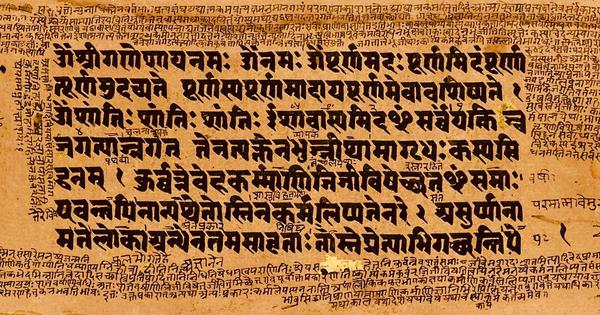
Everything, all that moves in the world is covered by the lord; so through renunciation find enjoyment. Do not desire (the wealth of another) for whose is wealth? One who lords (rules) is known as Īt, whose true form is Īśā. The lord of all, the supreme lord, is the supreme self. Being the self of all creatures, he rules all by being the inner controller. In its own form it covers all. What is this? This is all that moves on the planet earth. The fragrance of sandalwood or incense is corrupted by contact with moisture. Just as this corrupted fragrance is overcome by rubbing the pieces of wood together, thus all duality, the effect of ignorance such as whatever moves, the ideas of doership, enjoyership, modifications such as name, form, and actions will break down and be cast away by means of contemplation of the supreme, true form of the self. There is no point hankering after wealth since wealth belongs only to the self. In the ultimate analysis wealth is unreal. The intent of this text is that so far as the knower of the supreme self is concerned the self is to be guarded by means of resolute devotion to the self and renunciation of the threefold desire (for sons, wealth, and worlds). The next verse is directed at those unable to cognise themselves due to mental attachment to the non self.By doing works (karma) here one ought to wish to live a hundred years. For a person who wants to live thus, there is no other way but this, through which karma may not attach to you. If one wishes to live to be a hundred years old then one ought to do so by means of performing karma such as the Agnihotra sacrifice which are recommended by the scriptures. By following this method inauspicious karma will not cling to a person.Indeed, the worlds where devils reside are covered in blinding darkness. To them go those people, after death, who kill the self. Those who are covered in ignorance go to worlds of blinding darkness after death. How do such people kill the eternal self? Due to the defect of ignorance such persons conceal the true eternal nature of self which is free from death and decay. Due to this ignorance, they are subject to birth and death.It is one unmoving and swifter than the mind. The senses cannot reach it since it is always ahead of them. Though standing yet it outruns those who run. In it the all-pervading air enables all activities (water stands for all activities). In his commentary, Śaṅkarācārya points out that there is no contradiction in saying it is unmoving, yet swifter than the mind. This is so since this is possible from the viewpoint of conditioned and unconditioned states of being. In its own unconditional aspect, it is unmoving. In its conditional aspect as apparently limited by the mind, the reflection of self, consciousness is said to be swifter than even the mind. The self is beyond the senses.That moves and is stationary, that is far away and close, that is internal to all of this and that is external to all of this. While the self is in itself unmoving, it appears to move. It seems to be far away since it is unattainable by the ignorant, even in a million years. It is very close to those with knowledge. It is inside of all this. The commentary mentions the Bṛhadāraṇyaka Upaniṣad that states that “Self is within all” meaning the self is within this entire world comprising name, form, and various activities. It is also outside of all this since it is all pervasive. The person who sees all and every being in the self only and who sees the self in all beings, he therefore does not feel any hatred. The seeker of liberation who sees all beings, from those that are unmanifested to those that are immobile, in the self, as not different from the self, and who sees the self in all beings, such a person feels no hatred. This is so since a person feels hatred only if the person sees something as evil and other than oneself. However, where a person sees only the self as an unending entity, then there is no other and hence no other to hate or be averse to.To one who knows all beings become the self only, to such a person who has seen the oneness, what delusion, what sorrow can there be? Similarly, the person who knows the supreme reality and who thus sees all beings in the self, then what delusion, what sorrow can there be? For delusion and sorrow occurs only to those who do not know the seed of desires and actions. Delusion and sorrow are the result of ignorance.He is all pervasive, resplendent without body, invincible, sinewless, untainted by sin and pure. He is all-knowing, wise, self existent, who exceeds all existence (and) who has duly allotted objects, through the eternal years. The self is all pervasive like ether. The words used in this verse, invincible and sinewless, imply the negation of the gross body with respect to the self; similarly untainted by sin, all knowing implies a negation of the causal body for the self. The self is the seer of all.Śaṅkarācārya in his commentary points out that the Īśa Upaniṣad spells out the Vedic paths. The first verse outlines devotion to knowledge after forsaking desire. In the second verse emphasizes the importance of the path of duty.Those who worship (follow the path of) ignorance enter into blinding darkness and those who take delight in knowledge enter into greater darkness than that. The worshippers of ignorance enter into great darkness. Śaṅkarācārya in his commentary explains the second line as pertaining to those who give up performing rites and good deeds, etc., and only pursue knowledge. The aim of this verse seems to be to enjoin humility in the pursuit of knowledge.It is said that surely different is the result of vidyā and different indeed is the consequence of avidyā. So has been heard from the wise men who have explained this to us.Excerpted with permission from The Upanisads, translated from the Sanskrit by Nachiketa Jha, Aleph Book Company.
‘The self is all pervasive like ether’: A new translation of the Isa Upanisad for the modern reader
An excerpt from ‘The Upanisads’, translated from the Sanskrit by Nachiketa Jha.
1,057 words~5 min read