Support CleanTechnica's work through a Substack subscription or on Stripe.
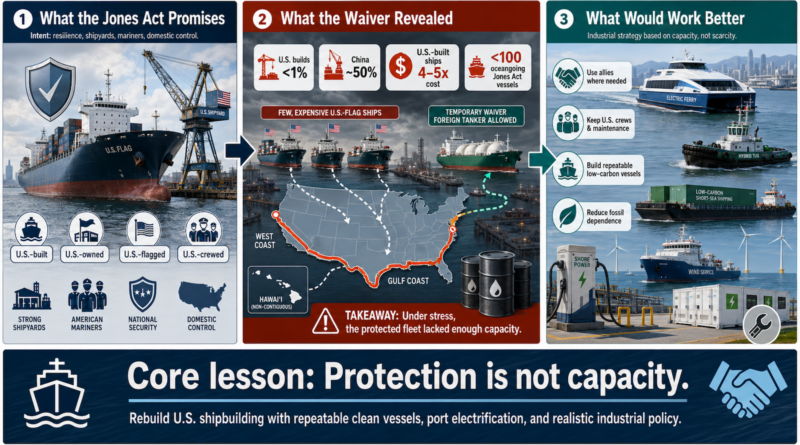
The Trump administration’s Jones Act waiver is a small policy exception with a much larger lesson. The same administration that says it wants to restore American maritime dominance, rebuild domestic shipbuilding, counter China’s industrial scale, and make U.S. logistics more secure also waived parts of the law usually treated as the foundation of that domestic maritime system. Foreign vessels were allowed to move selected cargoes between U.S. ports because the protected American fleet could not provide enough capacity at the right time, in the right places, at acceptable cost. The waiver does not undermine the case for rebuilding American shipbuilding. It undermines the case for pretending the Jones Act is, by itself, a shipbuilding strategy.
The Jones Act is simple in its core requirement and complex in its effects. Cargo moved by water between U.S. points must generally travel on vessels that are U.S.-built, U.S.-owned, U.S.-flagged, and U.S.-crewed. The stated purpose is resilience. The law is meant to preserve domestic shipbuilding, trained merchant mariners, control over domestic logistics, and sealift capacity in wartime or crisis. Those are serious goals. The issue is not that the United States should be indifferent to maritime capacity. The issue is that national security cannot be measured by legal exclusion alone. It has to be measured by available ships, trained crews, productive yards, repair capacity, cost, and the ability to move cargo when the system is under stress.