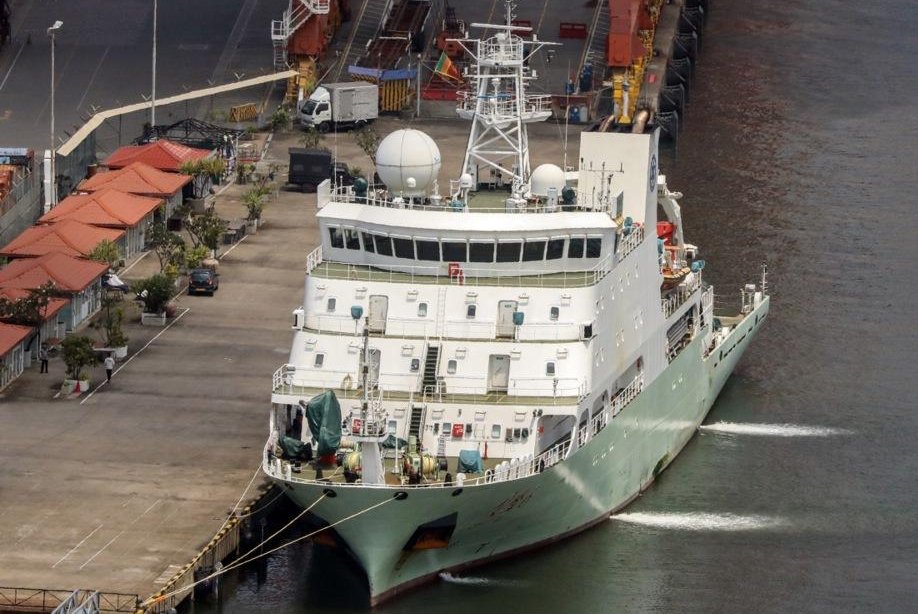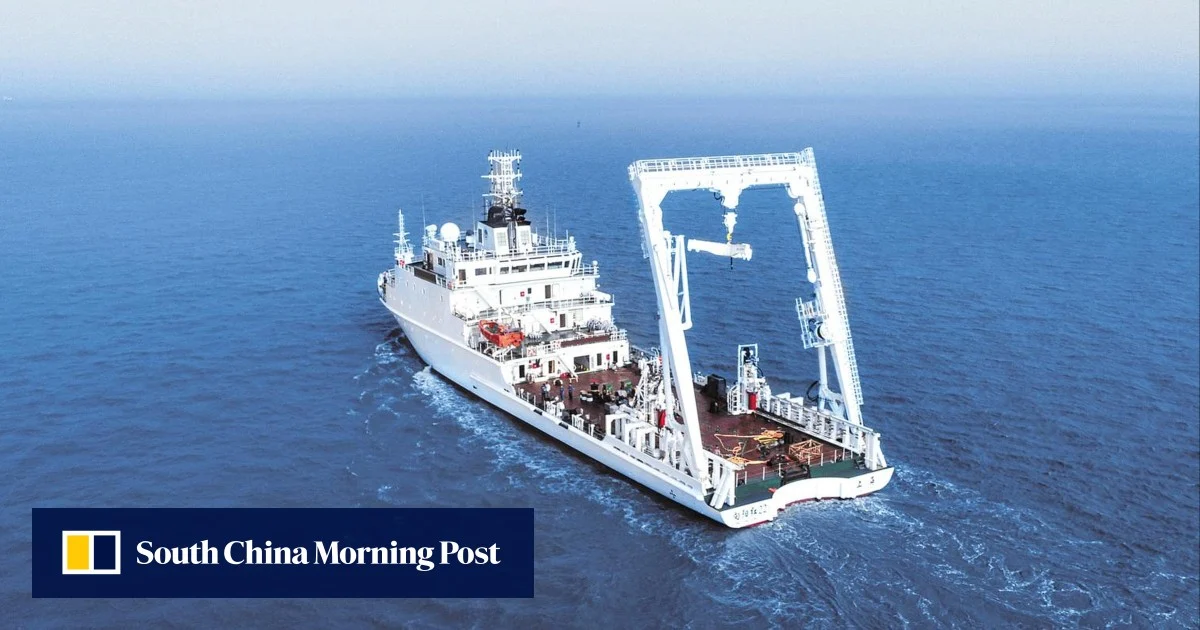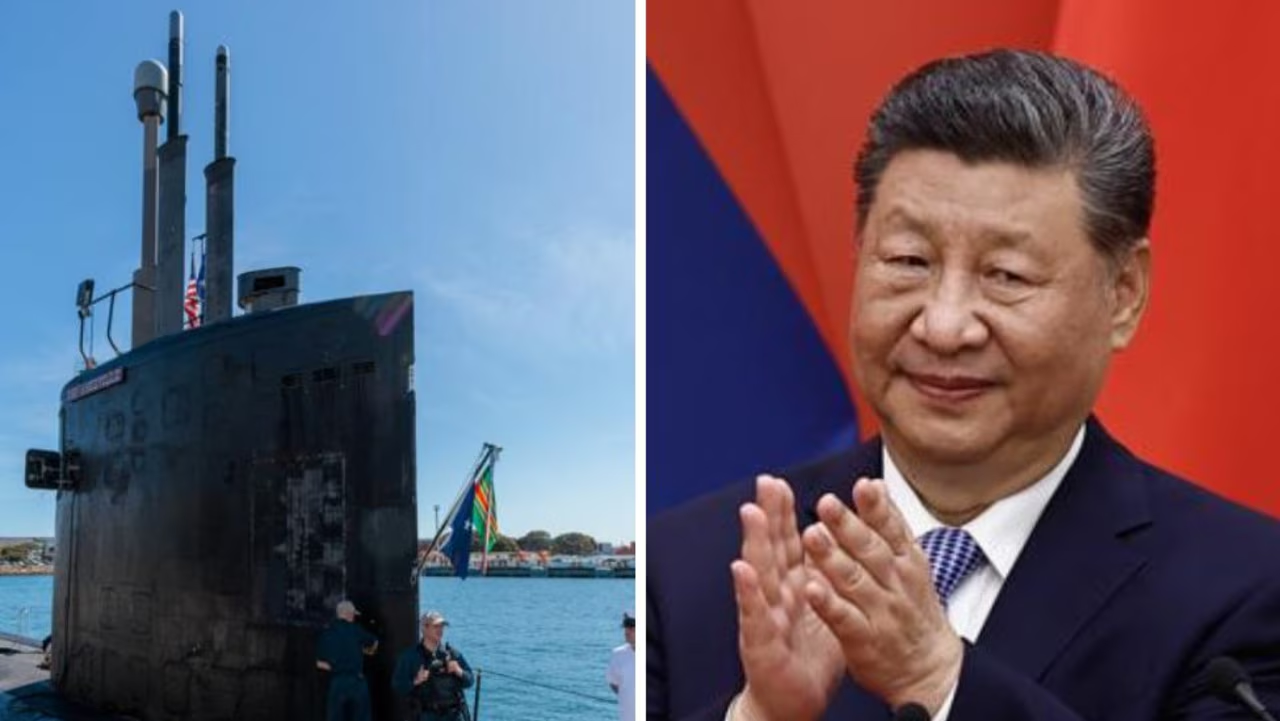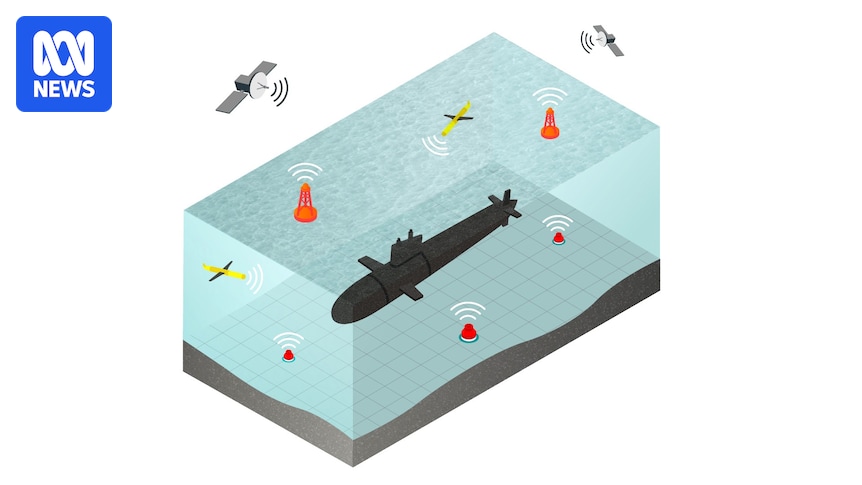
The discovery of a Chinese undersea monitoring device in a strategic Indonesian waterway last month came as little surprise to maritime defence experts.However, some argue it has real implications for Australia's defence strategy.China has long been pushing to develop its sub-surface awareness capabilities, with one of the major initiatives known as the Transparent Ocean Program.Naval strategist Jennifer Parker said China saw the United States' undersea warfare capabilities — especially its submarines and its ability to detect Chinese ones — as a strategic disadvantage it needed to address."So China has been working on enhancing their undersea domain awareness — their ability to understand what's happening in the water column and also to detect submarines," she said.The 3.7-metre torpedo-shaped object was picked up by a fisherman near the Lombok Strait, one of the few routes deep enough for submarines to transit between Australian waters and the South China Sea without surfacing.Marcus Hellyer, head of research at Strategic Analysis Australia, said the broader Chinese effort was initially focused on the waters near China in an "anti-access area denial strategy" as Beijing sought to detect US and allied nuclear submarines deployed to help during a potential conflict over Taiwan.But now Beijing has transformed its naval forces into a "blue-water navy" capable of sustaining operations across open oceans."That means they need to have information about the undersea domain further from home," Dr Hellyer said.A map published in 2019 by the Ocean University of China showing locations of deployed observation buoys, with a concentration in the Luzon Strait between Taiwan and the Philippines. (Supplied: Ocean University of China)China's plan to make the ocean transparentRyan Martinson, from the US Naval War College's China Maritime Studies Institute, said the "deep sea domain" had been a research priority for China at least since President Xi Jinping came to power. "The Transparent Ocean Project is an outgrowth of China's top-level interest in developing deep-sea knowledge and capabilities," Professor Martinson said. "Aside from the national security implications, Beijing wants to be able to exploit marine resources in deep-sea areas, especially seabed minerals in high seas areas."Chinese oceanographer Wu Lixin first outlined the Transparent Ocean Program in 2014, calling for the creation of a real-time three-dimensional observation system in the "two oceans and one sea" — a reference to the western Pacific, Indian Ocean and South China Sea.Professor Wu proposed a four-layer network that would include satellites, unmanned surface vessels, autonomous underwater vehicles and a seabed observation network.The layers would be linked by a "Deep Blue Brain" with artificial intelligence processing and managing the information.The Chinese research vessel Dong Fang Hong 3 has reportedly been involved in sea-floor mapping under the Transparent Ocean Program. (Reuters: China News Service)Professor Wu and colleagues provided an update on the program in a paper in 2020, saying breakthroughs had been made in research and development and more than 100 surface buoys and sub-surface moorings had been deployed in the "two oceans and one sea".The program has also been linked to wide-scale ocean floor mapping. Professor Wu and China's Ministry of Foreign Affairs did not respond to the ABC's request for comment.Professor Martinson said the Transparent Ocean Program was a "massive effort" to "develop exquisite real-time knowledge of the marine environment".Ocean research's military applications According to Professor Wu, the data obtained through the Transparent Ocean Program would benefit research into areas such as weather prediction and climate change.However, many analysts argue that under China's "military-civil fusion" policy, it would also be used by the People's Liberation Army Navy."A close reading of [Professor] Wu's writings/speeches clearly indicates that this project is driven, at least in large part, by a desire to apply this knowledge of the dynamic ocean to naval operations, especially submarine and anti-submarine warfare," Professor Martinson said.Military analysts Peter Singer and Tye Graham argue that Transparent Ocean's ultimate goal is to create an "invisible net" that challenges the ability of US and allied submarines to manoeuvre and hide.They point to People's Liberation Army (PLA) theorists who have called for the development of a "maritime adaptive kill web" described by Dr Singer and Mr Graham as a "resilient, mesh-style network that offers multiple paths from sensor to shooter and promises instant bypasses for any node failures"."A mature Transparent Ocean system is designed to automate this flow at scale," they write.The Indonesian Navy took the device to the Mataram naval base on Lombok for further investigation. (Supplied: North Lombok Police/Republika)Device's true purpose still unclearDr Singer told the ABC that the discovery of the monitoring device in the Lombok Strait "shows the extent of both China's reach and its undersea ambitions".However, which Chinese entity installed it and why remains unclear.At the time it was found early last month, the Indonesian Navy said the device would be taken to the Mataram naval base on Lombok for further investigation.The Indonesian Navy did not respond to the ABC's requests for an update this week.Beijing dismissed concerns last month, saying it did not have specific details on the matter but there was "no need for excessive interpretation or suspicion"."Based on international practice, it is not unusual for marine research equipment to drift into the territorial waters of other countries due to malfunctions or other reasons," a Ministry of Foreign Affairs spokesperson told the ABC.The device was brought ashore at Gili Trawangan in the Lombok Strait after being discovered by a fisherman. (AFP)Maritime defence analyst HI Sutton identified the device as a Deep-Sea Real-Time Transmission Mooring System with sensors able to gather information about its surroundings, including temperature, depth, current and sound.Professor Martinson said the device appeared to be in use by one of China's civilian marine scientific research organisations.However, he said the data it collected indirectly contributed to Chinese undersea warfare capabilities by contributing knowledge on what the People's Liberation Army Navy called the "ocean battlespace environment". Ms Parker, who worked in Australia's Department of Defence for more than 20 years, said variables such as water temperature and salinity were critical when trying to detect submarines."All of these things give you an indication of how effective your sonars might be and how far sound might travel," she said.The Fujian is the newest of China's three aircraft carriers and the first to be home designed and built. (Supplied: Xinhua News Agency via AP)China's blue-water navyAs the Chinese navy has grown in size and capability, Beijing has sought to deploy it further afield, Dr Hellyer said."What the Chinese are doing is using their SSNs [nuclear submarines] to operate further offshore to complicate the US's ability to intervene militarily in the Western Pacific," he said."It's very hard for the US to send reinforcements to Japan or to Taiwan or the Philippines if they have to get through Chinese SSNs lurking off Guam or Hawaii or even, theoretically, now places like San Diego or Los Angeles or Seattle." He said China could be surveying the Lombok Strait either to target US and Australian submarines coming up into the South China Sea or because it wants to send its own submarines or underwater drones south."That device and the place where it was found simply reinforces the fact that China's maritime power is expanding at a rapid rate," he said.The Chinese research vessel Tan Suo Yi Hao sailed along Australia's south coast last year. (Supplied: Chinese Government)Could Chinese sensors be in Australian waters?It's unclear how far China's sensor networks have been established.Dr Hellyer said it was possible the Chinese oceanographic vessels that had visited Australian waters last year had deployed monitoring devices."The ocean is a big place," he said. "If they're floating on the surface, you would hope maybe they would be detected."Ms Parker said China would "love" to install such devices around Australian submarine bases in key channels, but doing so would be "quite risky".She said it was plausible that a research team could drop smaller glider-style drones overboard, but installing a device like the one found near the Lombok Strait would be much more obvious.The vessels that visited last year would not have had the opportunity, she said."It's quite an operation and it's the kind of thing that we should be able to spot them doing, basically," she said.She said a big part of detecting submarines was determining whether they were even at sea or not, and that could be done through cheaper, more low-tech methods than acoustic sensors."You can do that through buying an apartment, putting a telescope on the balcony and staring at [the Fremantle shipping channel] Gage Roads as submarines sail in and out," she said.Under the AUKUS arrangement, Australia is set to buy several nuclear-powered Virginia-class submarines from the US in the 2030s. (Reuters: Brian Snyder)Implications for Australia's defence strategyDr Singer said the Transparent Ocean strategy did not "mean the end of submarines", but it did "change the environment they must navigate"."They will not have all the same advantages of stealth they had in generations past," he said."As a result, they will need to be able to deploy new types of technologies, such as being a mothership for all sorts of drones."Dr Hellyer, who previously worked for Melbourne defence drone manufacturer C2 Robotics, said China's advances in sub-surface maritime domain awareness and drone technology had serious implications for Australia's military procurement strategy — particularly the AUKUS program to acquire nuclear submarines.He said there was debate about whether, in the next 20 years, detection technologies would become so sophisticated they would even be able to spot nuclear subs in open water. "I do think our investment program is fundamentally skewed and we keep putting our money into these traditional systems," he said."I do think we need to be rebalancing the investment and spending a lot more on drones across all the domains, not just the undersea domain, but the surface maritime domain, the land domain and the air domain." He said the AUKUS submarines would not be "an answer to all of our prayers"."I think we'll be extremely vulnerable because, as we are seeing again and again around the world, if you can see something, you can target it and you can hit it."China has a growing fleet of nuclear submarines in its navy. (Reuters)Ms Parker said China's rapid investment in undersea surveillance and nuclear submarines showed the underwater domain would be central to future conflict."That's why Australia's ability to operate effectively underwater, including through nuclear-powered submarines, is so important," she said."Undersea drones like Ghost Shark and Speartooth will be important, but they complement rather than replace crewed submarines."Crewed platforms still provide the range of missions, endurance and independent decision-making needed in a crisis."Australia's Department of Defence was contacted for comment.The department's 2026 Integrated Investment Program is understood to include $5 billion to $7 billion in undersea warfare and uncrewed maritime systems and $62 billion to $77 billion in surface maritime capabilities over the next decade.
Chinese undersea device found near Bali may be part of something bigger
The discovery of a Chinese undersea monitoring device in a strategic Indonesian waterway last month "shows the extent of both China's reach and its undersea ambitions" and has implications for Australia's defence strategy, say experts.
1,792 words~8 min read