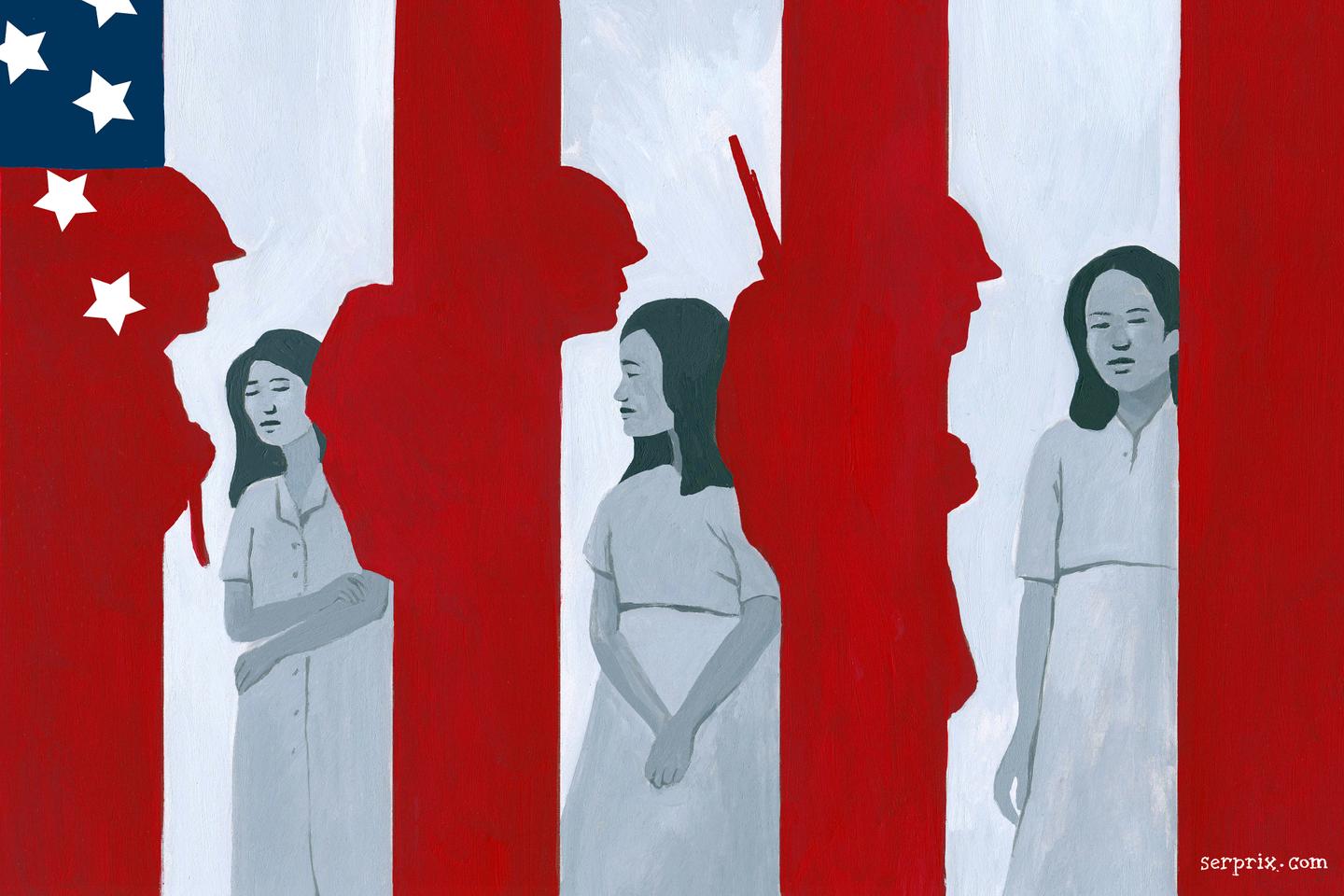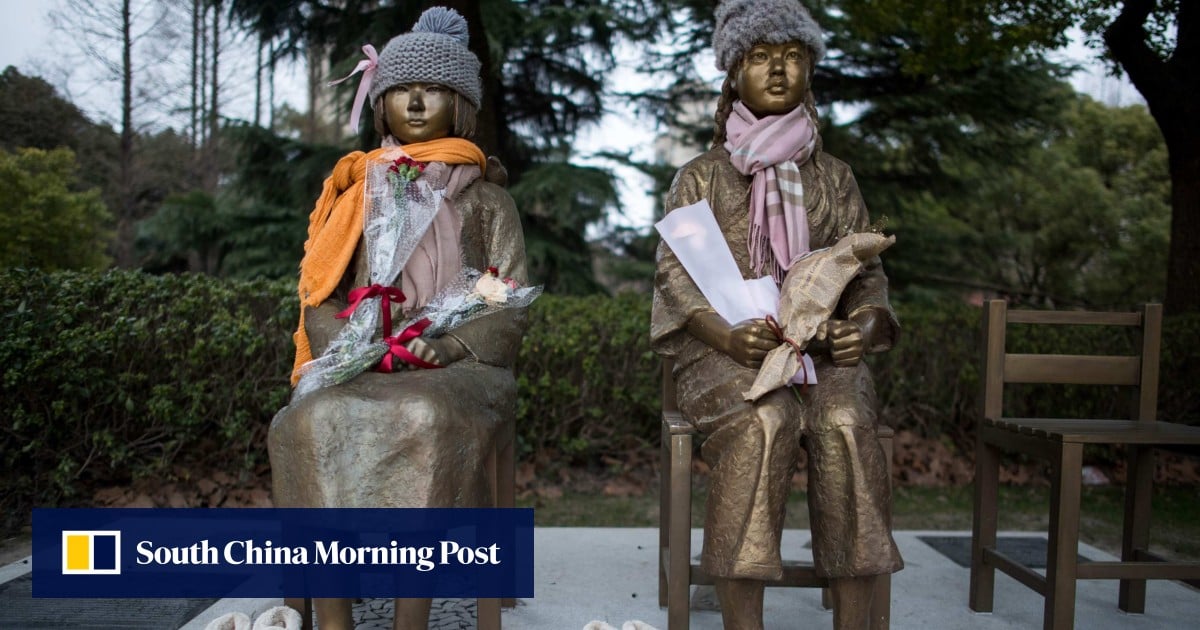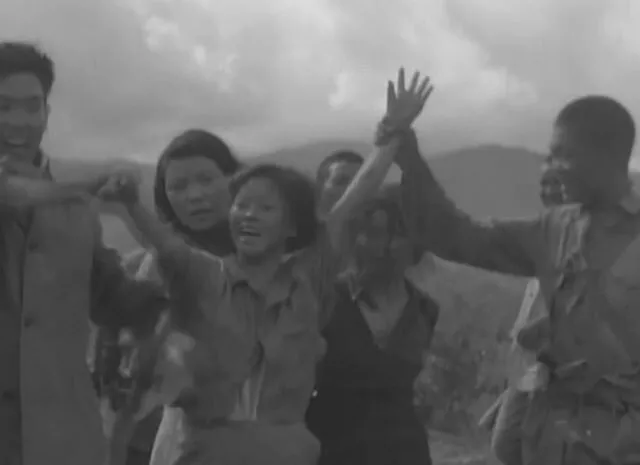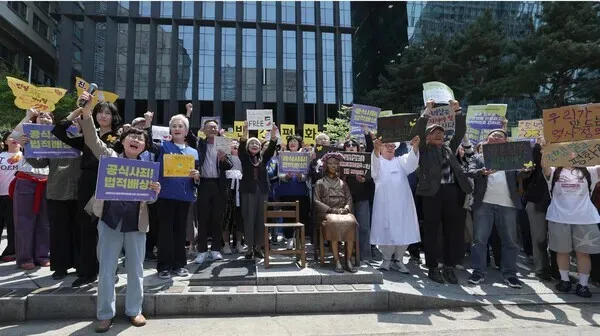
By Yang Hyun-ah, professor emeritus of social theory at Seoul National UniversityModernity is said to have been born from the standardization of time and space. In 1884, the sprawling, unexplored regions and times of the world became entrapped by a single system of measurement devised by the Royal Observatory in Greenwich, London. However, according to postmodernism, which emerged in the 1960s, time is not simply a linear thing that flows in one direction from the past to the future — the past is recalled to the here-and-now and rewrites the present. Postmodernists criticized the standardization of space-time, accusing it of entailing oppression and exclusion. Today, I wish to examine Japan’s wartime sexual slavery system, victims of which are also often referred to as “comfort women,” in the context of multilayered space-times. #Space-time 1: On April 10, 2026, South Korean President Lee Jae Myung posted the following on X: “The forced mobilization of comfort women, massacres of Jews, and wartime killings are no different.” The Israeli Foreign Ministry responded immediately, criticizing the comment for downplaying the Holocaust of Jews during WWII, but this comment is monumental in that it placed the “comfort women” issue in the same category as genocide. That is, it viewed the wartime sexual slavery system from a completely universal perspective, as it should be viewed. Indeed, to the women living in Korea under Japan’s colonial rule, that system exhibited many of the aspects associated with genocide: the systematic mobilization of police, soldiers, and civilians; forced deployment to the vast Asia-Pacific, where Japan was waging war; beatings and torture; genital mutilation; and reproductive violence. It was masterful of Lee to label the human rights abuses against “comfort women” not merely as sexual violence but as “forced mobilization.” #Space-time 2: The Women’s International War Crimes Tribunal on Japan’s Military Sexual Slavery was held Dec. 8-12, 2000, in Tokyo, Japan. Around ten Asian countries participated in the tribunal. As a people’s tribunal, it lacked the authority to enforce its recommendations, but we should give this court its due, as it stood at the forefront of contemporary international criminal law, human rights, and the legal principles governing wartime violence to compile historic evidence to teach the world a history lesson. The tribunal concluded that the crimes committed under Japan’s military sexual slavery system constituted “crimes against humanity,” and held Japanese Emperor Hirohito, along with the highest-ranking officials and military commanders of the time, personally responsible for the crimes. It also found the Japanese government culpable at the state level. Much like how Iranian children were massacred in a war that was not theirs to fight, an estimated 80,000 to 200,000 Korean girls and women who never had an ounce of agency in the happenings of WWII, were dragged from their homes to become sex slaves, according to research by Chung Chin-sung in 2024. The fate of only a tiny handful of survivors became known; the experiences of the rest of those women have remained unknown for over 80 years. Most of the Korean victims mobilized at the time were 16 or 17 years old. Where did all of those young women go? Crimes against humanity, like the Holocaust, are criminal acts committed as part of widespread or systematic attacks against civilians, regardless of whether they occur during war or peace. Such offenses are considered crimes based on the legal logic that they constitute acts contrary to humanity and human dignity. As such, any determination of such crimes must find universality within specificity, and remedies for victims must be righteous. The Rome Statute of the International Criminal Court stipulates that murder, extermination, enslavement, deportation or forcible transfer of population, torture, rape, sexual slavery, and persecution against any identifiable group, constitute crimes against humanity. #Space-time 3 & 4 & 5: In August 2011, the Constitutional Court of Korea ruled that the South Korean government’s failure to take diplomatic action to resolve the “comfort women” issue, despite the fact that the victims retained the right to claim compensation under Korea and Japan’s 1965 Treaty on Basic Relations, was unconstitutional. This ruling is viewed as a postcolonial decision that explicitly acknowledges the ongoing impact of illegal acts committed during the colonial period and the responsibility of the South Korean government, effectively declaring that the obligation for redressing the harm suffered by the victims of the Japanese military’s sexual slavery system lies not only with Japan but also with Korea. Following negotiations between South Korea and Japan, the foreign ministers of the two countries declared that they reached an agreement on the “comfort women” issue in December 2015, but many of the Korean survivors balked at the deal and filed a lawsuit against the Japanese government seeking damages. The plaintiff victims at the Seoul Central District Court and the Seoul High Court won their cases in January 2021 and November 2023, respectively, overcoming the principle of state immunity under customary international law, according to litigation whitepapers by Minbyun - Lawyers for a Democratic Society. #Space-time 6: The barricade surrounding the Statue of Peace in front of the old Embassy of Japan in Seoul was removed on May 6, 2026. This barricade was installed at the request of the Korean Council for the Justice and Remembrance for the Issues of Military Sexual Slavery by Japan, which has led over 1,700 weekly Wednesday Demonstrations, after various far-right organizations denied that there ever was a Japanese sexual slavery system and attempted to maim the statue itself. With 150 statues in South Korea and 35 in nine countries abroad, as of 2025, the Statue of Peace can be described as a collective symbol that resonates with people around the world. The French sociologist Émile Durkheim once defined the laws and rules of a community as the manifestations of the collective consciousness; the Statue of Peace can be viewed as a manifestation of the Korean collective consciousness representing unresolved colonial oppression and violence against women. At the same time, it is a symbol that could potentially constrain that consciousness. #Space-time 7: Is the Japanese military’s sexual slavery system confined to the past? To 80 years ago? Should the issue also encompass the time from the 2000s, when victims began to take steps toward justice, to today? Is this a problem unique to Korea, or is it something that could take place anywhere else in the world? It is a widely known fact that victims of the Japanese military’s sexual slavery system are not only found in Korea, but are present in Taiwan, China, Japan, Indonesia, the Netherlands, Malaysia, the Philippines, East Timor, and other Pacific islands. The nature of the suffering of each region’s victims and the processes by which such suffering was addressed are similar but also exhibit different characteristics. As such, South Korea’s predominance in the rhetoric surrounding “comfort women” has been criticized as attempting to treat the suffering of Koreans as being the absolute standard. I wish to finish this piece by mentioning the ceremony that takes place in front of the Arirang Monument on Okinawa’s Miyako Island every early September. The residents of Miyako Island remember that most of the victims were Korean women and sing the traditional Korean folk song, the Arirang, during their memorial ceremony, but the monument displays writing in more than 10 different languages — the languages of the countries to which the “comfort women” victims belonged. I believe that the residents of Miyako Island are truly citizens of the world and Asians who embody the value of universal human rights. Is it not time to erect symbols commemorating the “comfort women” victims from the 10-odd countries outside of Korea next to the Statue of Peace? Is it not time to place symbols representing the deaths of the innocent elementary school students of Iran? When Koreans represent the young victims of sexual slavery as both Koreans and citizens of the world, the “comfort women” issue will be remembered by humanity as the most delicate but persistent crime against humanity.
[Column] Rethinking how we represent ‘comfort women’ victims
The Japanese military’s sexual slavery system isn’t confined to the past, nor is it to Korea
1,326 words~6 min read