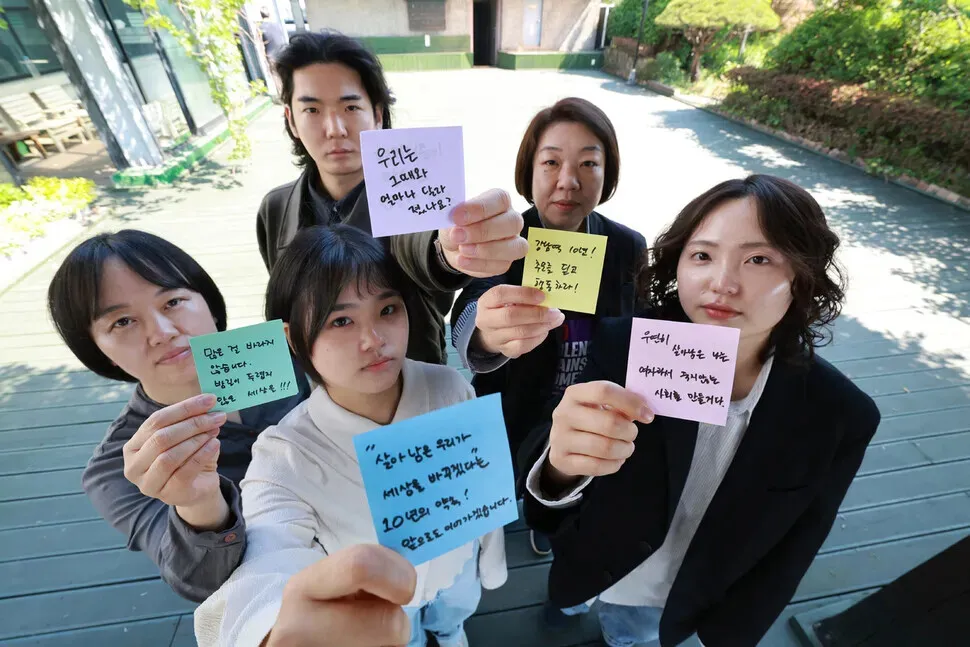
Participants in a Hankyoreh roundtable on the Gangnam Station femicide organized with Feminist Yeondae hold up sticky notes with questions and resolutions about the decade that has passed since the 2016 case that sparked a major movement against violence against women. Front row left to right: Ham Song-hwa, Cho Hye-won, Choi Yoon-yi; Back row left to right: Lee Han, Park Ji-a. (Jung Yong-il/Hankyoreh)
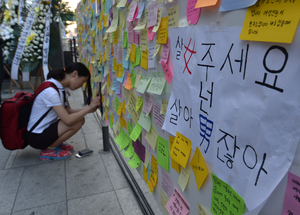
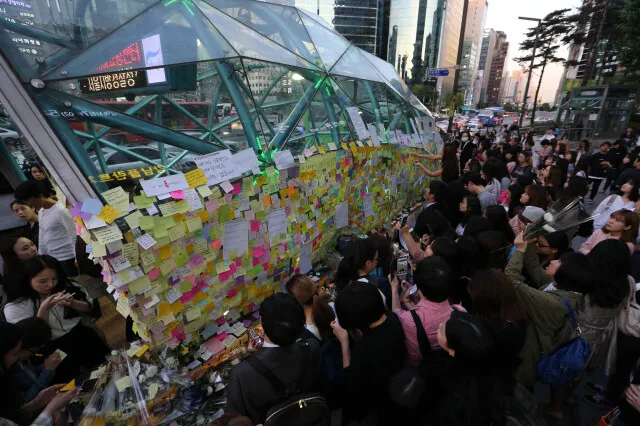
On May 17, 2016, a 23-year-old woman was murdered by a 34-year-old man she had never met in a public restroom at a bar near Gangnam Station in Seoul. Asked why he did it, the perpetrator said, “Women have always ignored me.” He ignored the six men who had entered the restroom before and targeted the woman as she came in.This incident ignited mass outrage among women in Korea. Many took to the streets and mourned the victim by plastering Gangnam Station with tens of thousands of sticky notes with messages such as “Your death is my death” and “She was murdered simply for being a woman.” The infamous murder became a rallying cry for women to unite against and protest gender-based violence, spanning the #MeToo movement, condemnation of “molka” (illegal filming using hidden cameras), prosecution of stalking, and the investigation into the Telegram Nth Room case in which dozens of women and minors were blackmailed into producing sexually explicit material. Gangnam Station case still relevant todayTen years later, on May 5 at 12:10 am, a 24-year-old man killed a 17-year-old high school girl he saw walking down the street in Gwangju. “I was planning to kill myself because life was no fun, but I did what I did after seeing her and acted on impulse,” he said.Ten years have passed since the Gangnam Station murder, but women continue to be killed or injured on the streets, at school and even at home. According to data from the Supreme Prosecutors’ Office, women have accounted for 80% of violent crime victims since the Gangnam Station murder.In 2016, the percentage of female victims of violent crimes — murder, robbery, sexual assault, arson, and others — remained in the 80% range at 83.6%, dipped into the 70% range in 2022 to 2023, only to rebound to 80.3% in 2024. On May 5, the Hankyoreh spoke with five people ranging in age from their 20s to 50s — some introduced to the world of feminism by the Gangnam murder case, others longtime feminist activists — to discuss what has changed, and what has not, in the decade since that brutal killing. The past 10 years has been marked by persistent misogyny and gender-based violence, from power-based sexual violence cases to the Nth Room, deepfake sex crimes and stalking cases. “After seeing the news that a high school girl was murdered in Gwangju, I immediately thought of what happened at Gangnam Station,” said Ham Song-hwa, 49, the director of Unni’s Small Library, which is affiliated with the Seoul Women’s Association. “It made me realize that nothing has changed.” Choi Yoon-yi, 30, who said that the Gangnam Station murder had been the catalyst for her interest in feminism, said that the two incidents were “very similar in how the aggressors were motivated by hate.” “Rather than confronting their own issues, they tried to deal with them by targeting people who were weaker and more vulnerable,” she said. “The government is at fault for neglecting these circumstances and allowing these two cases, which are basically mirror images of one another, to occur.” Cho Hye-won, 26, who calls herself part of a “generation” of young Korean women turned on to feminism by the 2016 femicide, said, “The murder in Gwangju is yet another reminder that anywhere women go, violence against them follows.” Defunct countermeasures Whenever an incident of this nature occurred, the government was quick to announce comprehensive countermeasures. Yet instead of declining, gender-based violence has persisted in Korea. On June 1, 2016, in the wake of the woman’s murder in Gangnam, the government unveiled a series of measures aimed at preventing hate crimes against women in a meeting of ministers responsible for law and order. The measures included the establishment of a police crime prevention assessment team, efforts to install emergency bells, the expansion of CCTV coverage in crime-prone areas, and the expansion of the scope of new buildings required to install separate restrooms for men and women. Critics say that such measures only address the symptoms of the problem rather than the underlying cause of gender-based violence. “Gender-based violence also happens in family homes and hotels. Placing emergency bells and installing CCTVs in restrooms because of one incident will not help keep women safe,” said Lee Han, 35, the director of the organization Feminism with Him. “What’s really important is changing the way the offenders think [about women]. The problem is that there are no fundamental measures for addressing that issue,” he said. After the Gangnam murder case, numerous women’s organizations called for similar offenses to be classified by law as “misogynistic hate crimes,” and demanded efforts be made to investigate and map the scale of such crimes in the country. The Framework Act on Prevention of Violence Against Women, enacted in 2018, defines “violence against women” as including domestic violence, sexual violence, sex trafficking, sexual harassment and persistent harassment, intimate partner violence, and violence using information and communication networks. However, the act itself does not include a separate category for hate crimes based on misogyny. There have been increasing calls for a separate classification of misogynistic hate crimes and for comprehensive investigations of such crimes following the 2023 assault of a part-time convenience store worker in Jinju, South Gyeongsang Province, who was attacked by a belligerent man who saw her short hair and assumed she was a feminist. A petition to create such a classification was submitted to the National Assembly’s Gender Equality and Family Committee in 2024, but failed to pass the petition review subcommittee in 2025. “Women have to go to work, walk down the streets at night, and meet people out in the world. However, their safety in these spaces that they occupy daily has not been addressed or treated as a serious issue,” said Park Ji-ah, 50, the co-director of Feminist Yeondae, a coalition of feminists seeking solutions to gender-based violence.“We cannot expect thorough measures to be put in place if people do not recognize that gender discrimination exists structurally in society, and that such discrimination manifests as violence against women,” she said. “Laws on deepfake sex crimes were enacted only when victims of such crimes came forward to report their suffering, and for the past 10 years, we have seen a pattern where measures are introduced only after a woman has already died. Take how anti-stalking measures were reviewed only after a woman was killed by her stalker in Namyangju,” Park stressed. Strong backlash complicates efforts to find solution to gender-based violence Still, some things have changed over the past 10 years. The 2018 #MeToo movement in Korea became the catalyst for many women to speak out about their personal experiences with sexual assault. The protests against illegal spycam filming in Seoul’s Hyehwa District the same year demonstrated that women were no longer going to keep silent in the face of injustice. In 2019, the abortion ban was struck down. However, the more progress feminism achieved, the harsher the backlash became. Cho, who chaired the human rights committee of her university’s student council in 2022, talked of how she experienced doxxing and online abuse on Everytime, an anonymous online forum for university students, after issuing a message of solidarity supporting a feminist professor who had been targeted by online commenters. Because of that message, Cho was summoned to the student council’s steering committee and endured a two-hour ideological screening. In the end, she was dismissed from her position on the human rights committee and subjected to disciplinary action. Ham shared about experiencing resistance to feminism among young people in her own family. “One day, my son told me that feminism was a ‘bad thing.’ When I told my nephews and nieces that I would send them merchandise with feminist slogans, they said that such items would ‘make them targets,’” she said. The planned site for the 10th anniversary memorial event for the Gangnam murder case, organized by Feminist Yeondae, was also usurped by anti-feminist groups. “Instead of the location we’ve always used, we’re going to have to hold the 10th anniversary event on the road in front of it. On the day we had to apply for a rally permit, people calling themselves ‘meninists’ were waiting from the early hours of the morning to reserve that venue,” Park said. The gradual decline in gender equality education is also a form of backlash, Lee opined. “Related educational events increased significantly following the Nth Room incident, but started to disappear once interest also declined. It is no surprise that deepfake sex crimes have become so rampant, considering that education on preventing online sex crimes has also declined. These examples showcase how uninterested politicians are in addressing these issues. This kind of backlash is scarier than the overt kind,” he said. “South Korea lacks a proper gender equality curriculum. What we do have is violence prevention education and sex education, but we need a more comprehensive education on gender equality,” he added. While violence prevention education on the four major types of violence — sexual harassment, sexual violence, prostitution and domestic violence — is legally required, there are no regulations regarding gender equality education. Choi noted the importance of having politicians who identify as feminists. “While we have made much progress when it comes to women’s rights, women are still vulnerable and face a wide variety of discrimination in the workplace. It would be reassuring to know that there were people who would speak up on those issues and make bills that could resolve them,” she said. Cho, for her part, stressed the need to establish a “baseline understanding in society that violence against women is unacceptable.”While speaking about the recent tragedy in Gwangju, Lee noted that beyond the Gangnam case, the ever-growing number of femicides in the country is in part a “problem committed by young men, or isolated men who are sick of their lives.” “We need to look at who is causing this problem. The reason men become isolated is because of the limits of traditional masculinity that tells them they have to hold everything in, even when they are struggling,” he said. “We need to start thinking about how we can change this masculinity.” Returning to Gangnam StationAll five of the participants in the Hankyoreh’s roundtable agreed that the 10th anniversary of the Gangnam Station murder is the time to take action on persistent gender-based violence. “In order to ensure that my two kids can live in a world without rampant gender-based violence, I hope that more people come and join us at the memorial today, and in our fight tomorrow,” said Ham. On Sunday, May 17, Feminist Yeondae will host an event marking the 10th anniversary of the Gangnam Station femicide alongside 122 women’s rights groups. By Son Ji-min and Park Chan-hee, staff reportersPlease direct questions or comments to [english@hani.co.kr]