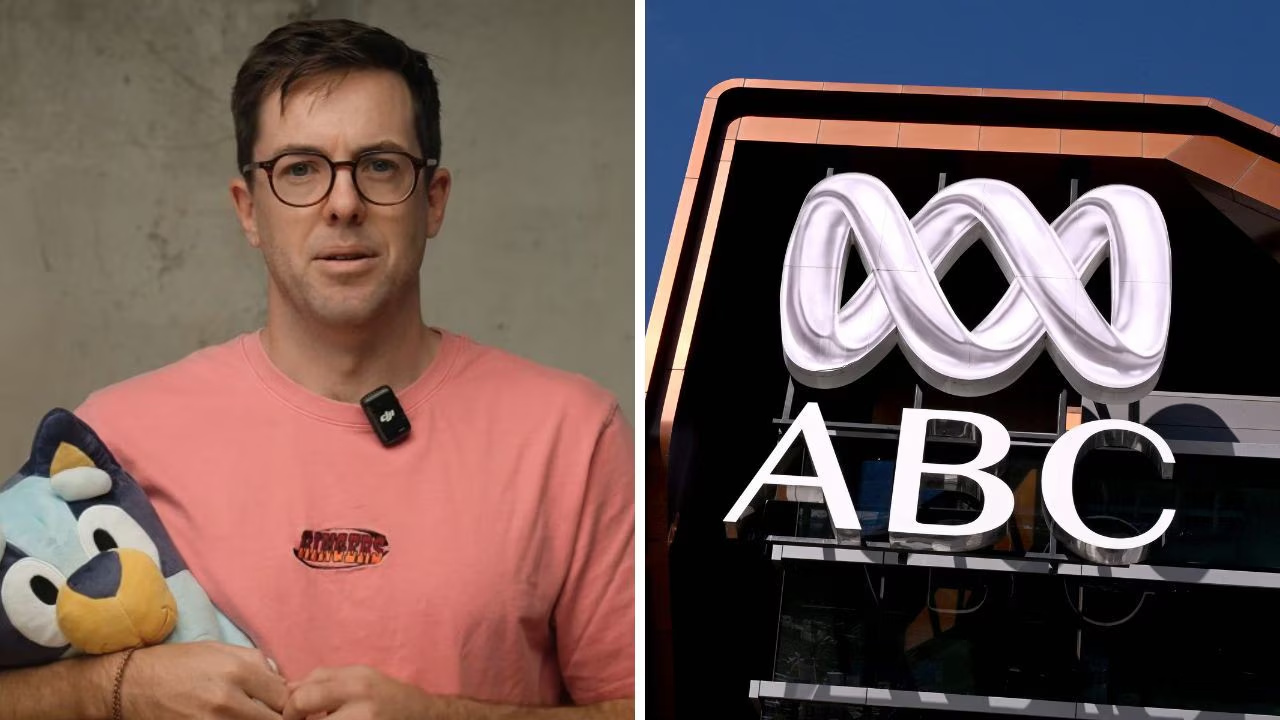
A leading entrepreneur has slammed the ABC’s bungling of overseas rights for the hit children’s show Bluey, arguing the deal has cost the public broadcaster up to $2.5 billion a year.Bluey was co-commissioned by the ABC and its British public service equivalent the BBC in 2017. The ABC paid the majority of funding in exchange for broadcasting rights here, while its British counterpart paid 30 per cent of production costs and scored global distribution and commercial rights. The beloved cartoon about a Blue Heeler puppy has since become a staple for children and parents across 140 countries, including the United States, where it is the most-streamed show with Americans tuning in to watch 45.2 billion minutes of it last year. But the ABC has come under scrutiny for signing off on the deal that handed overseas rights to the BBC, despite the show being created by Australian animator Joe Brumm and produced by the Brisbane-based Ludo Studio. “The merchandise deal alone is worth billions, and Australia makes zero dollars from it,” said Charlie Gearside, co-founder of digital health start-up Eucalyptus, which was recently acquired by US company Hims & Hers for $A1.6 billion.In a video shared to social media this week, Mr Gearside described the arrangement as “one of the all-time s***test deals in history”.The entrepreneur said every time he watched Bluey with his young son, “all I can think about is the jobs and the wage growth that we left on the table, in a room in ABC headquarters in Ultimo”.He estimated Bluey could be bringing in as much as $A2.5 billion for the BBC each year — more than double the ABC’s annual budget.Moreover, the broadcaster “didn’t even try” to negotiate a merchandise deal, with a freedom of information request failing to find any emails between the ABC, Joe Brumm or Ludo Studios on the subject around the time that the show was being commissioned. “We’re acting like we’re incredibly proud of Bluey’s success, which we are, but it’s also super embarrassing,” he said.Mr Gearside called the mistake an “Australian story” that wasn’t limited to the ABC, pointing to solar panels as another example of an Aussie invention that was commercialised overseas. “We invent world-class stuff here in Australia and then we hand the value to someone else.”His comments revived a debate that has resurfaced periodically ever since Bluey’s launch almost nine years ago. In response, Aussies drew comparison to the nation’s long-term gas export deals, with one asking, “is Australia even capable of making a good deal?”Cameron Murray, chief economist at Fresh Economic Thinking, lamented that Bluey royalties could have “funded the ABC twice over”. “Instead, we just gave them away to the BBC in a dud deal. Now the BBC is rolling in cash.”How much does the BBC make from Bluey?Bluey royalties and merchandise – everything from plush toys to pool floats – are sold in 50 countries and have become a major driver of revenues for the BBC’s commercial arm, which raked in a record £2.2 billion in FY 2024/25, or $A4.1 billion. That cash is expected to keep flowing as the brand expands, with a CGI feature film slated for global release in 2027.Though the BBC hasn’t explicitly said how much money it makes from Bluey, an executive has described the show as a “really, really big chunk” of global retail sales.A conservative estimate attributing 25 per cent of last year’s sales to Bluey suggests the brand generates roughly $A1 billion per year — but it could be much more than that. For context, the ABC receives $A1.2 billion in funding from the federal government annually. Ben Eltham, lecturer in the School of Media, Film and Journalism at Monash University, agreed that the public broadcaster had botched the agreement. “The ABC signed a very bad deal,” Mr Eltham told news.com.au.“We don’t know why, exactly, but Joe Brumm is a smart guy; probably the ABC didn’t have enough leverage on him or wasn’t prepared to pay overs to get some stake in back-end merch. “It’s turned out to be a really bad outcome for the ABC, but it’s important to remember no one realised that Bluey would be a massive hit.”It was “inherently uncertain” whether a TV show would become a global phenomenon, Mr Eltham said, adding that there was “probably a warehouse full of unsold Bananas in Pyjamas (merchandise) somewhere”.“The debate over Bluey misses the point to some degree, which is that the ABC is not set up to be a global screen studio. “I don’t think you want the ABC devoting itself to chasing long-odds merch riches just because they missed this one jackpot.”Mr Eltham said as the public broadcaster, the ABC should “stick to its core purpose of educating, informing and entertaining Australians”.Professor Gary Mortimer, an expert in retail marketing and consumer behaviour at QUT Business School, said it was unclear how the Bluey brand had become so popular.“It could be because it’s been driven by a childhood audience, and that childhood audience may have been looking for something new,” Prof Mortimer said. “When my kids were young it was Teletubbies, then it was the Wiggles; and maybe Bluey is the next evolution of childhood entertainment.” “I guess it was just an oversight,” he said of the ABC’s failure to clinch a merchandising agreement.“Maybe at the time, the decision makers saw it as being a great kids’ cartoon but didn’t acknowledge or foresee the growth in popularity.”ABC Managing Director Hugh Marks has talked openly about regrets over the loss of revenue from Bluey. “We’ve spoken a lot about Bluey since I arrived (at the ABC), and we can all look back as to what happened in that particular situation,” Mr Marks told the Screen Forever conference this week, according to industry website Mumbrella. “There are always reasons why things happen. But that’s probably $300 million of income that’s going to the UK. If it was coming to Australia, (it) actually would change a lot of the people’s lives in this room.”Mr Marks said he was focused on preventing other Australian intellectual property from being monetised overseas. “ … The point for me now is, how do we get the industry to a position where we can keep more of that income, more of that activity in our ecosystem, in Australia, rather than outsourcing it internationally?”An ABC spokesperson said when the broadcaster co-commissioned Bluey, the “focus for the ABC was acquiring rights for Australian audiences as cost effectively as possible and with minimal risk”.“With hindsight, a different commercial decision would have been made,” the spokesperson said.“Bluey is an integral and much-loved ABC program for our audiences, especially children.”
‘Super embarrassing’: ABC’s Bluey blunder costs broadcaster billions of dollars in lost royalties
A leading entrepreneur has slammed the ABC’s bungling of overseas rights for the hit children’s show Bluey, arguing the deal has cost the public broadcaster up to $2.5 billion a year.
1,105 words~5 min read