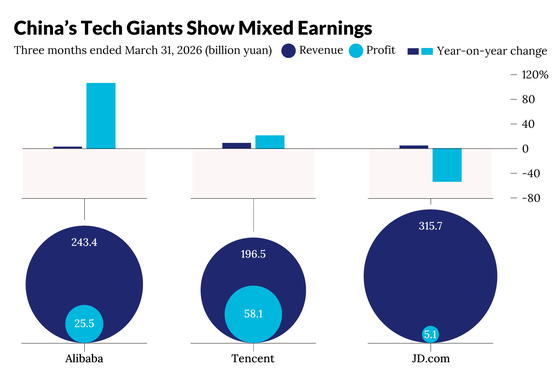
1. China's tech giants' latest quarterly results indicate that heavy investments in AI and new initiatives have pressured profits.[para. 1]2. Alibaba reported net profit more than doubling to 25.5 billion yuan ($3.7 billion) for the three months ended March, aided by a low base and one-time gains; however, non-GAAP net income dropped sharply to 86 million yuan from 29.8 billion yuan in 2025, missing expectations of over 15 billion yuan, while revenue rose 3% to 243.4 billion yuan.[para. 2]3. Tencent's operating profit metric grew 9% year-on-year in Q1, but would have risen 17% without new AI products and services costs; revenue increased 9% to 196.5 billion yuan.[para. 3]4. JD.com's net profit attributable to shareholders fell 53% to 5.1 billion yuan in Q1, on revenue of 315.7 billion yuan.[para. 4]5. Weaker earnings stem from ramped-up spending on AI, cloud, and user acquisition amid rival competition, weak demand, and subsidy wars in instant retail.[para. 5]6. Investors worry about spending yielding growth: Alibaba's US shares rebounded 8.2% Thursday after dipping premarket, boosted by exec comments on instant retail and AI; Tencent's HK shares down 24% from peak as AI hype cools.[para. 6]7. Alibaba's free cash flow turned negative due to cloud/AI infrastructure, Qwen app acquisition, and Taobao Instant Commerce subsidies.[para. 7]8. Tencent accelerated AI spending and launches amid OpenClaw rise, releasing enterprise OpenClaw and WeChat integration tool, unusual for its 1B+ user super app.[para. 8]9. Tencent's R&D spend rose to 22.5 billion yuan from 18.9 billion yuan; marketing surged for AI apps, including 1 billion yuan Yuanbao chatbot giveaway during Lunar New Year.[para. 9]10. JD.com's new businesses (food delivery, overseas) reported 10.4 billion yuan operating loss, up from 1.3 billion yuan prior year.[para. 10]11. New segment loss margin widened to 164.9% from 23.1%, driven by overseas push; Joybuy launched March 16 in UK, Germany, Netherlands, France, Belgium, Luxembourg.[para. 11]12. CEO Xu Ran calls international business a long-term priority, with rising investments but improving profitability via volume growth.[para. 12]13. JD.com cut food delivery subsidies further, achieving largest loss reduction since launch.[para. 13](The chart visualizes Q1 2026 yoy changes: Alibaba revenue +3% (243.4B), profit -99%; Tencent revenue +9% (196.5B), profit +9%; JD revenue +3%? (315.7B), profit -53%; source: company reports).[para. 2][para. 3][para. 4]AI generated, for reference only
Spending on AI, New Businesses Eats Into Profits of China’s Tech Giants
Alibaba, Tencent and JD.com ramped up investments in artificial intelligence, cloud infrastructure and overseas expansion in the first quarter, squeezing the companies’ bottom lines
372 words~2 min read