A conversation with artist Alex Schaefer
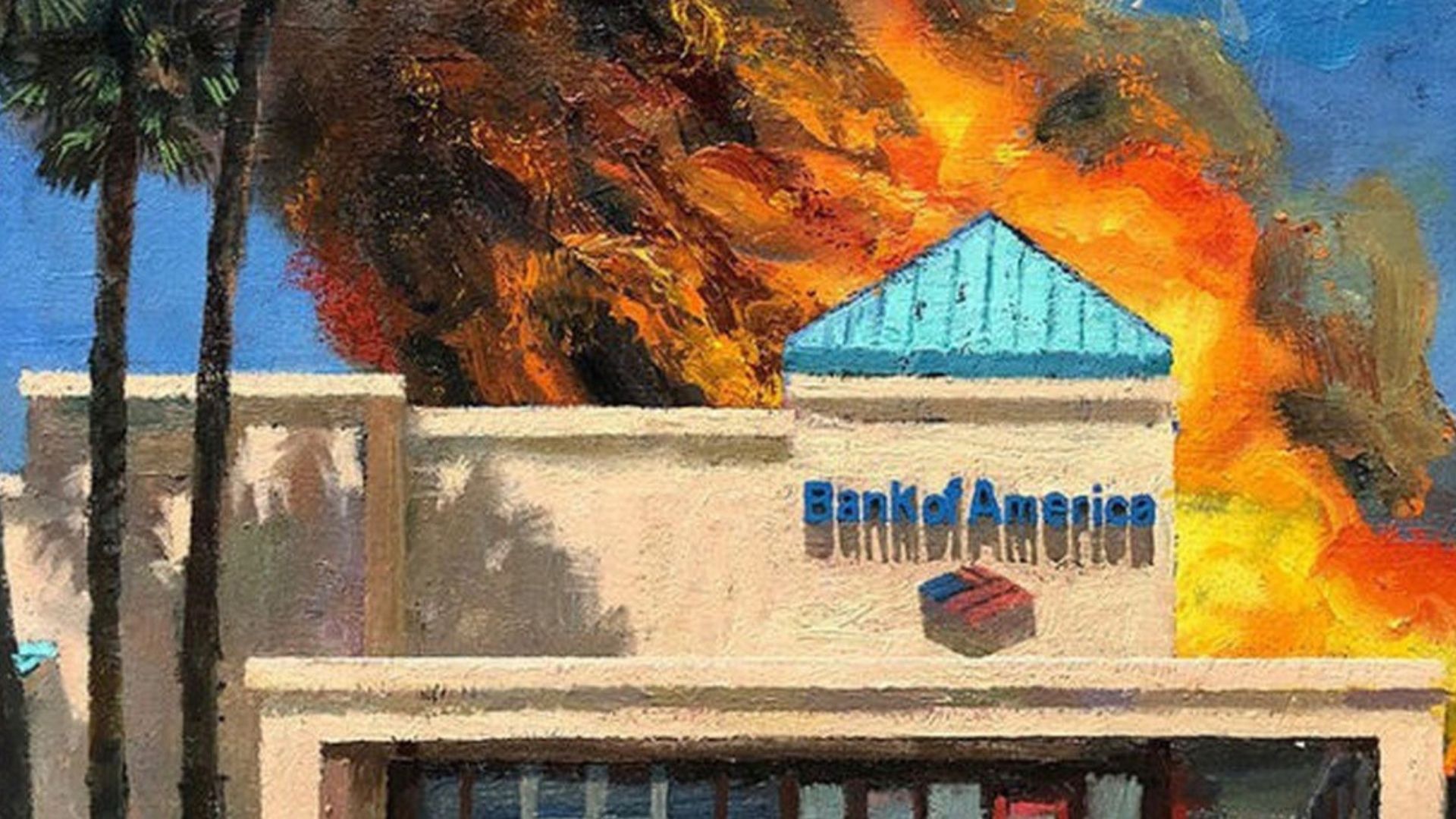
Revolutions leave behind artifacts. In the summer of 2011, a painter named Alex Schaefer set up an easel on a sidewalk in Van Nuys, California, and began painting the Chase Bank branch across the street. In his mind, the building was on fire — flames pouring from the windows, black smoke rising over the palm trees, the Chase logo still legible through the heat. He worked en plein air, the way the Impressionists had worked the Seine and the hay fields, except the subject was a branch of the largest bank in America three years after it had been bailed out with public money. A passerby called the police. When the artwork sold on eBay for $25,200 to a German collector, Schaefer did the only logical thing and painted more.
The artworks gathered in Relics of a Revolution at Bitcoin 2026 trace a lineage of dissent that connects street-level protest to the birth of Bitcoin itself — a Tokyo sidewalk in the snow with Kolin Burges, a Los Angeles overpass under wheat paste with Mear One, a botched police raid in Ohio answered with songs and a flag suit with Afroman. Schaefer’s Banks on Fire paintings belong to that same lineage, and they arrive with an art-historical pedigree that sharpens the point. Art critics have drawn the obvious line to Ed Ruscha’s Los Angeles County Museum on Fire (1965–68), the painting that put a cultural institution up in flames and hung it back on the museum’s own wall. Schaefer swapped the museum for the bank, the oil-crisis era for the bailout era, and took the painting out of the studio and onto the sidewalk in front of the building itself — a fact that earned him questioning by LAPD officers who wanted to know if he was a terrorist planning to follow through on his canvases. “Some might say the banks are the terrorists,” he told them. In July 2012 he was arrested outside a downtown Chase branch for chalking the word “Crooks” next to the logo, and spent twelve hours in jail on a misdemeanor vandalism charge.