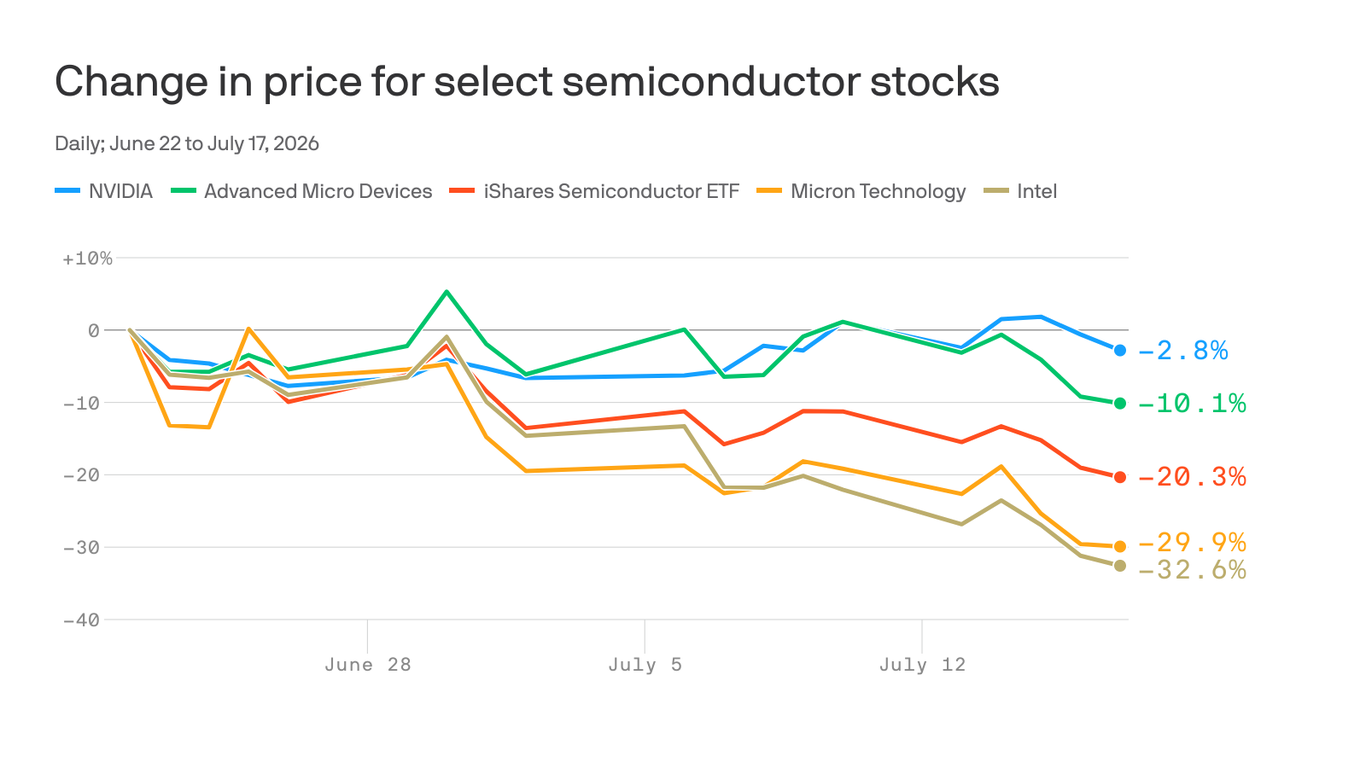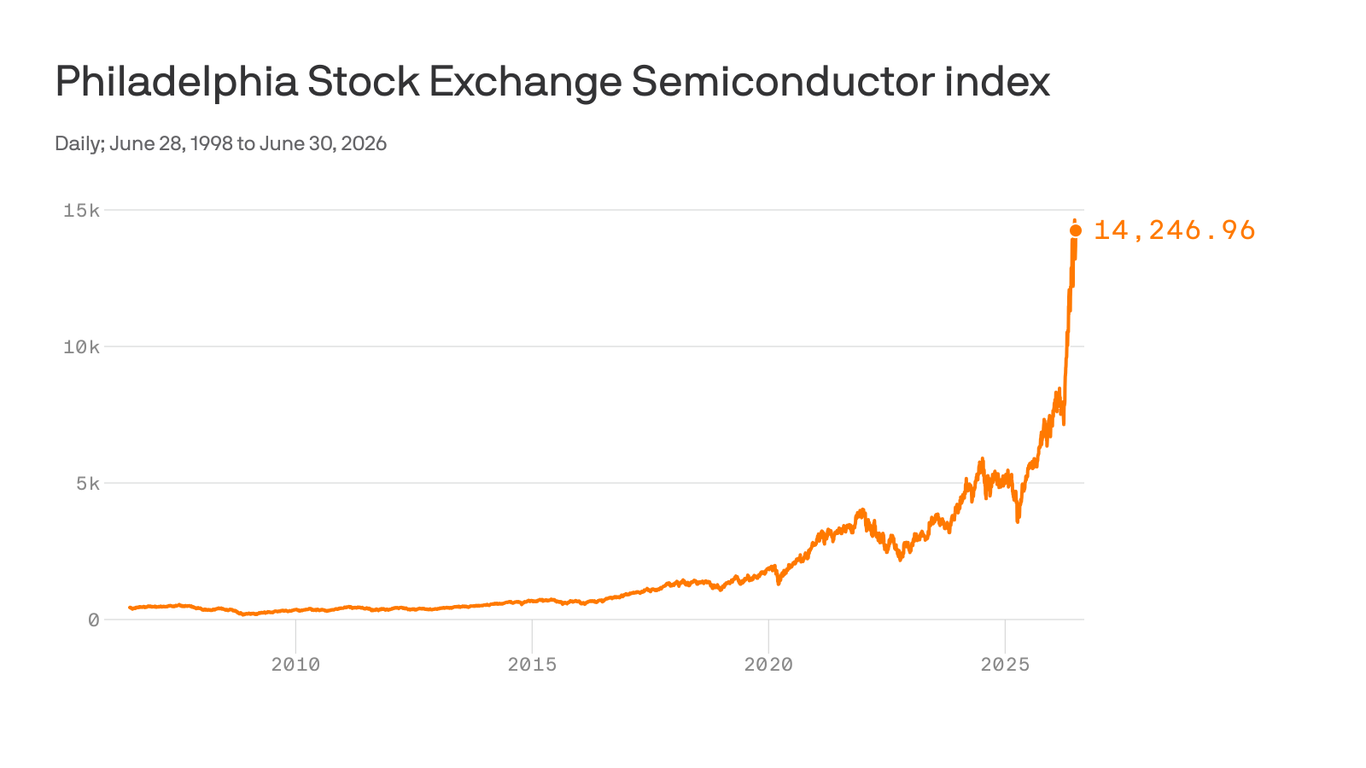
The NASDAQ and S&P indexes have been hitting one record high after another, despite the uncertainty that’s surrounding the war in the Middle East. That’s thanks, of course, to the AI boom. And that has mainly meant chipmakers, with NVIDIA at top of the list. But its competitors — Intel, Micron, AMD, and Qualcomm — have been on an absolute tear for the last month or so, too, and they led stock gains again today.All of those numbers going up have encouraged a slew of retail investors to pile into the chip market, according to research from JP Morgan. And that could be a sign that this boom is headed for a bust.What started as a frenzy for NVIDIA processors has rippled through almost every layer of the computing supply chain as demand for AI has ballooned. “The word I hear a lot is parabolic. Just stock prices going straight up,” said Jay Goldberg, senior analyst at Seaport Research.Goldberg points to the Philadelphia Semiconductor Index of chip designers and manufacturers. It’s up more than 50% in the last 6 weeks. And that’s giving him flashbacks of the dot-com boom.“Every time you start to hear people saying, ‘This time is different. This is a new economy,’” Goldberg said. “I think it's right to sort of be cautious.”Add a rush of retail investors once prices are soaring and the warning lights really start blinking, said William Quinn, an economic historian at Queen’s University Belfast. He said retail investors tend to be later and less informed than institutional investors.“So they're buying because of the hype or because the price has gone up, and they're extrapolating that into the future,” Quinn said. “Then the prices can lose all connection to what these assets are actually worth.”He said bubbles are often preceded by innovations that make it easier for retail investors to buy and sell assets, like the rise of E-Trade in the dot-com boom and Robinhood today. “These trading apps are just the next iteration of that,” Quinn said. “So now you don't even have to get out of bed to buy and sell these assets.”But the business fundamentals of chip companies are much stronger than those of the dot-coms during the boom, argues Stacy Rasgon, senior analyst at Bernstein Research. “The driver of this, like, so far, has actually, surprisingly, been earnings. It hasn't necessarily been irrational,” Rasgon said. Unlike Pets.com, chipmakers are reporting massive revenues and Big Tech has signaled ever-greater spending.Whether that growth is sustainable is the key question, said Jed Ellerbroek, a portfolio manager at Argent Capital. He said anything from the effects of the war to lackluster returns on investment could slow the data center boom.“There is just so much riding on this AI buildout. That, in itself, is a risk factor for the market,” Ellerbroek said. But for now, the chips are still up.Short of a large correction, increasing involvement of retail investors could create more volatility in chip stocks, said Ben Bajarin, CEO and principal analyst at Creative Strategies."Historically the semiconductor industry has been highly cyclical," he said. "It's one of the main reasons why, really, only deep institutional investors have largely been involved."Unlike institutional investors, who understand the industry's ebbs and flows, retail investors may flee at the first sign of trouble — even if the underlying fundamentals remain strong."It's capital getting out of the market because they're spooked," Bajarin said. "And that's where people are just overly sensitive to what might spook uneducated investors — people who just think, 'I buy this stock, it goes up, that's easy money,' but will pull out en masse at the signs of any trouble."That risk is amplified for retail investors in leveraged exchange-traded funds, like the increasingly popular SOXL, which tracks the Philadelphia Semiconductor Index but magnifies gains and losses three times over. And in an era of instant information, Bajarin warned, a selloff could cascade faster than anyone expects."At the sign of one little thing, and how fast information travels — particularly on X today — it does spook people," he said. "And once somebody gets spooked, everybody pulls the market out."
Retail investors' shift towards AI chip stocks could signal an end to the boom
It’s reminiscent of the dot-com bubble to at least one investment advisor.
685 words~3 min read