Support CleanTechnica's work through a Substack subscription or on Stripe.
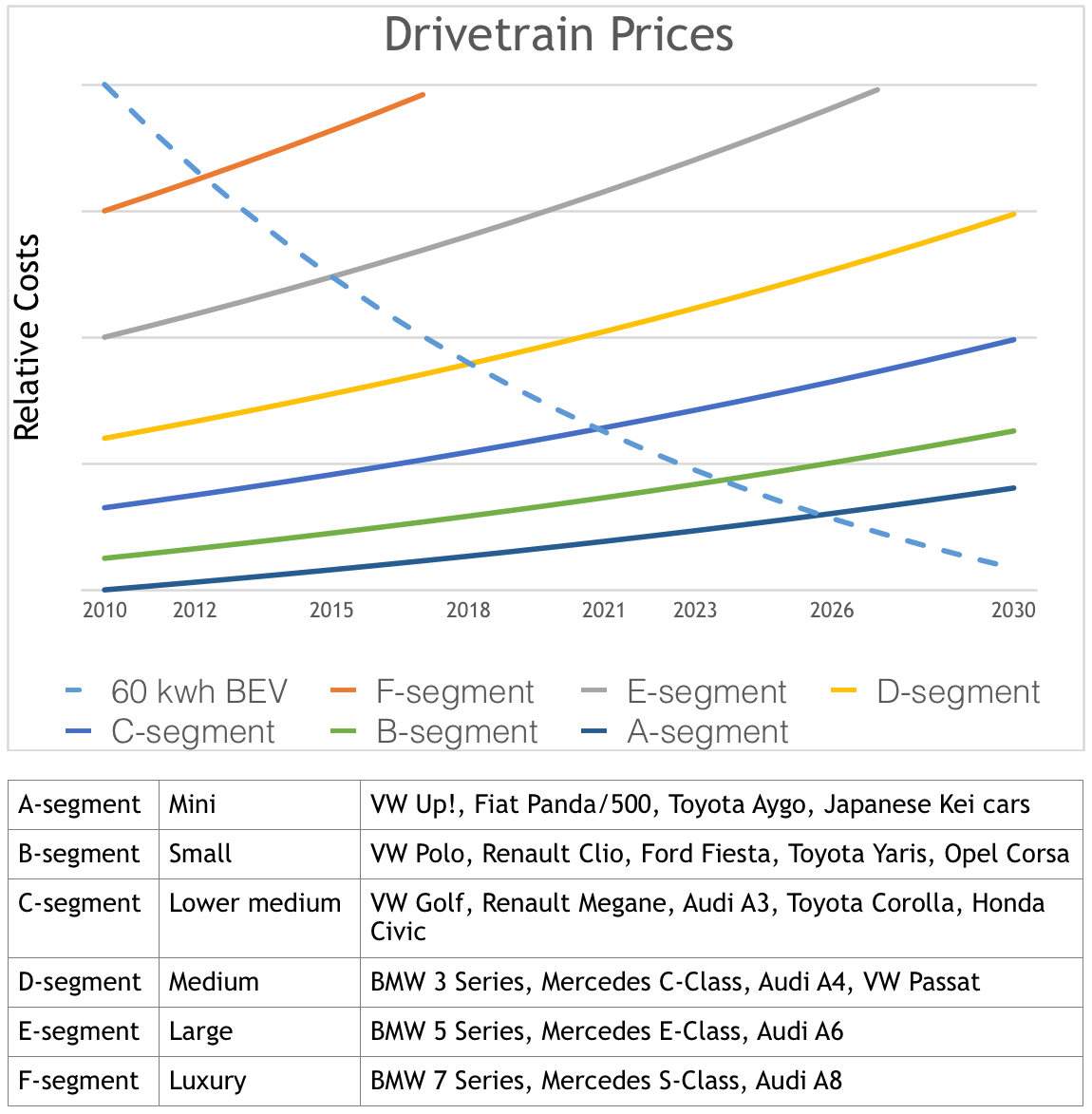
Back in 2019, I read an article on this very site regarding the Osborne effect and the upcoming risks it represented for the auto industry. It remains one of my favorite articles of all time, and it had this very interesting chart that put into perspective what had been the promise for EVs since the beginning of that decade: that they would, one day, be as affordable as ICEVs:
Back then, this was little more than a dream. Sure, the Model 3 was being produced in full swing by then, but at some $37,000, it remained expensive, more so if we remember than in those days a Toyota Corolla could be purchased by $23,000. Sure, the US, Europe, and China had very generous incentive schemes, but that was of little relevance for us natives of developing nations, where EVs remained a very expensive rarity. I remember well that here in Colombia a Renault Zoe with the 40 kWh battery would cost exactly three times as much as the comparable Renault Sandero, while being much less useful overall. Sales back then were counted in the dozens, with the total tally for the country well below a thousand for an entire year.
But the tide has changed. Thanks to hyper-affordable Chinese EVs, many markets around the world have started to see more and more accessible electric vehicles; in some, thanks to a combination between competition and policy, EVs can already be found at cheaper prices than their direct combustion competition.