In brief
Quantum computers cannot break Bitcoin today, but progress is accelerating.
New research suggests fewer resources may be needed to crack encryption.
The real challenge, experts say, is upgrading before it’s needed.
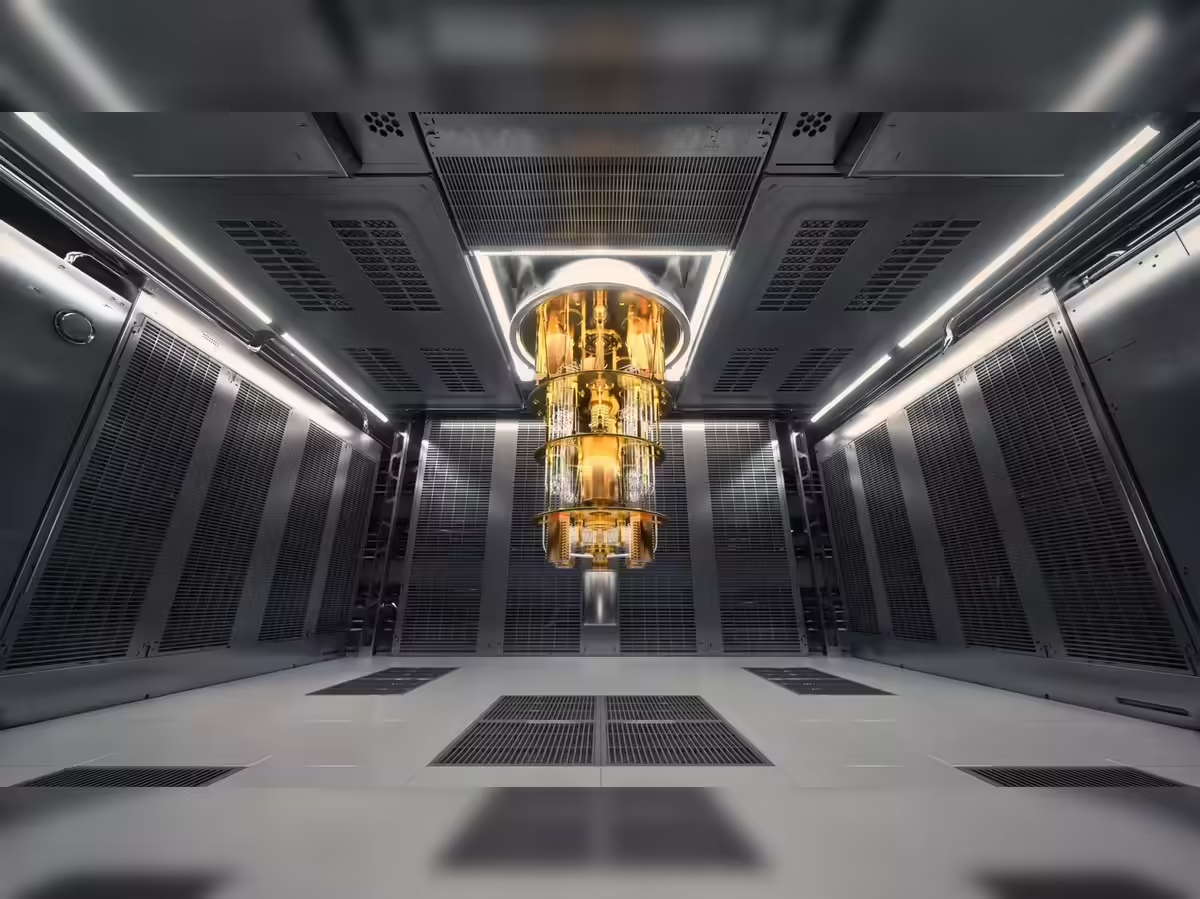
Two new research papers—one from Google and another from Caltech researchers at startup Oratomic—have revived a long-running question in crypto. What happens when quantum computing becomes powerful enough to break modern cryptography?Researchers warned this week that advances in the field could threaten the cryptographic systems underpinning cryptocurrencies and other digital infrastructure sooner than expected, showing that future machines may be able to break elliptic curve cryptography with fewer qubits and computational steps than previously believed. Caltech put the number at just 10,000-20,000 qubits.Both papers suggest the resources required to do so may be lower than earlier estimates, shortening timelines many assumed were comfortably distant.In response to the findings, Bitcoin security researcher Justin Drake this week suggested there is at least a 10% chance that a quantum computer capable of breaking cryptography could emerge by 2032.Quantum computers and “Q-Day”Quantum computers operate differently from classical machines. Instead of bits that are either 0 or 1, they use qubits, which can exist in multiple states simultaneously. That property allows them to run certain algorithms—most notably Shor’s algorithm—that could, in theory, solve the mathematical problems underpinning modern encryption far more efficiently than today’s computers.Those mathematical problems underpin Bitcoin, Ethereum and much of the internet. Systems based on elliptic curve cryptography are designed to be easy to verify but extremely difficult to reverse. A sufficiently powerful quantum computer could change that, deriving private keys from public ones and potentially exposing funds, identities and encrypted communications.The moment when that becomes possible is often referred to as “Q-Day.”For now, that moment remains hypothetical. “No such computer exists today,” Alex Thorn, head of firmwide research at Galaxy Digital, told Decrypt. “What this Google research shows is that the distance between today and that eventual ‘Q-day’ may be easier to traverse than previously thought.”He pointed out that Google researcher Craig Gidney gave a 10% chance that a quantum machine capable of breaking cryptography will be built by 2030—a probability similar to that of Drake’s.Gidney caveated this by adding that a “10% risk is unacceptably high here, so I'm very in favor of transitioning to quantum-safe cryptography by 2029… Yes this means I 90% expect to be made fun of in 2030. Oh well.”