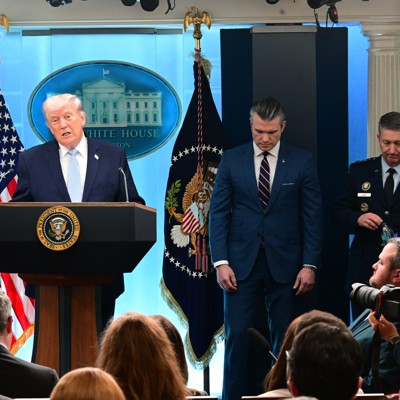
U.S. President Donald Trump and Defense Secretary Pete Hegseth speak to reporters at the White House on April 6, 2026.
Kyle Mazza/Anadolu via Getty Images
May 1, 2026, marked the 60th day of Operation Epic Fury in Iran – a symbolically significant date designating when a president who has mounted unilateral military operations must receive Congressional approval or wind it down. However, the complex history of the War Powers Resolution clock demonstrates it is a toothless milestone.The Trump administration signaled on April 30, 2026, that it would ignore that deadline, set by the War Powers Resolution. Defense Secretary Pete Hegseth testified before the Senate Armed Services Committee that “we are in a cease-fire right now, which my understanding is that the 60-day clock pauses or stops in a cease-fire. That’s our understanding, so you know.” Sen. Tim Kaine of Virginia, a Democrat, responded that the 60-day threshold poses a “legal question” and “constitutional concerns.” This is not the first time presidents and members of Congress have sparred on the meaning of the War Powers Resolution. What happens next will play out through regular politics, because the conflict is not a matter of simple legal interpretation.In the U.S. Constitution, Congress and the president share war powers. In the shadow of political struggles in the final years of the Vietnam War, Congress passed the War Powers Resolution in 1973 to “insure that the collective judgment of both the Congress and the President will apply to the introduction of United States Armed Forces into hostilities.” A crucial section of the resolution reasserts legislators’ role, and makes clear that the constitutional power of the president to make war is subject to, or exercised with, the following conditions: a Congressional declaration of war; specific statutory authorization; or a national emergency created by attack upon the United States, its territories or possessions or its armed forces.For new military campaigns that do not meet these criteria, the resolution included a 60-day clock that begins when a president reports the action to congressional leadership within 48 hours of the action beginning.The clock can be expanded to up to 90 days upon presidential determination and certification of “unavoidable military necessity respecting the safety of United States Armed Forces” related to removal of troops.After 60 to 90 days, the resolution originally said this type of unilateral military action would be terminated automatically unless both chambers of Congress approved some form of legislative authorization. Congress could also choose to terminate an unauthorized military operation any time before the 60 days with a concurrent resolution, which doesn’t require a president’s signature – essentially, a “legislative veto.”And to make sure the president couldn’t stretch the definition of congressional approval, the resolution said neither existing treaties nor new budget appropriations could substitute for legislative authorization of a military action.Since 1973, actions by all three branches across a variety of political and policy landscapes have undermined its intents and procedures. Veto, vetoedIn 1983, the Supreme Court declared various kinds of legislative vetoes unconstitutional, which led Congress to reinterpret its War Powers Resolution procedures and powers and effectively amend its processes to expedite any joint resolution or bill that “requires the removal of U.S. armed forces from hostilities outside the United States.”Now, if members want to stop a presidential military campaign already in progress, they must act affirmatively and pass a disapproval resolution, which a president could veto like any other bill. Congress has sent only one such disapproval – to President Donald Trump in his first term – which he vetoed. Congress did not have the two-thirds required in the Constitution to override. Both chambers of Congress now have to vote twice, once to disapprove a military action and then again to overcome a likely veto, to stop something it never approved in the first place.