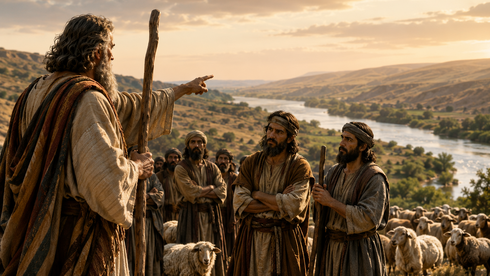
Nachshon’s leap into the sea offers a model of Jewish leadership rooted in courage, initiative and shared national responsibility; Just as Moses' prayers did not part the sea until Nachshon moved, today’s stormy 'sea' requires the initiative of our leadersMichael Eisenberg|Parashat Bamidbar, the fourth book of the Torah, begins with the meticulous organization of the camp - outlining the tribes, their leaders, their flags, the structure of the encampments, and a census of those fit for military service. Nachshon the son of Aminadav, the head of the tribe of Judah, camps the eastern side of the formation alongside the tribes of Issachar and Zebulun. Whenever the nation sets out on their journey, this group moves first.On the surface, Nachshon’s story does not appear to be a grand personal narrative; rather, it seems to be an orderly public role. Consequently, he is almost always listed alongside his counterparts from other tribes. This remains true in the following portion regarding the prince’s offerings for the dedication of the Tabernacle. Even when mentioned alone, it is often in passing, such as being noted as the brother of Elisheva (Aaron's wife) or appearing within the genealogy of the House of David in the Book of Ruth.Despite this seemingly administrative presence, the sources view Nachshon as an admired figure who embodies the spirit of "breaking through" and pioneering. This characteristic is rooted in his lineage; the Davidic dynasty begins with Peretz, who was named, as the Hebrew name suggests, for "bursting forth" at birth.1 View gallery Nachshon Ben Amidav jumps first into the Red Sea (Photo: ChatGPT)Nachshon, and the tribe of Judah behind him, serves as the "spearhead" in the journey toward the Land of Israel. This role and positioning alongside Zebulun the seafaring entrepreneurs and Issachar, the logistical backbone of the economy (see the final chapter of my book “The Tree of Life and Prosperity”) represents a unique combination of military leadership, commercial initiative, and logistical capability. Furthermore, as the brother-in-law of Aaron the High Priest, Nachshon serves as the link between the military leadership of Judah and the spiritual leadership of the Priesthood.The text suggests that Nachshon is not merely "one of the princes," but the leader from whom the entire camp begins. Although Reuben was the firstborn son, Nachshon was the first to bring an offering at the consecration of the altar and tabernacle, because the order of offerings was determined by the order of the journey rather than the order of birth. Priority and proximity to the holy are determined by one's degree of initiative and willingness to bear the burden. This is not a matter of status, privilege or factors beyond a person's control; it is an acknowledgment that it is far more difficult to be the one who walks at the head. As Haim Sturman famously and tragically eulogized in 1935: "Those who go first, fall."The Sages explained that Nachshon's worthiness for leadership was proven at the Red Sea. While the Egyptians pursued them, the tribes hesitated, each saying, "I will not be the first to go down into the sea." Nachshon jumped in first. Regarding this action, the Sages apply the verse: "Save me, O God, for the waters have come up to drown my soul". And they also added to the description of the event that during this crisis, Moses was deep in prayer but God said to him: "My beloved ones are drowning in the sea, and you are lengthening your prayer?!" When Moses asked what he should do, God replied: "Speak to the children of Israel, and let them march forward!". Meaning: you shall all follow Nachshon. Another Midrash describes the Children of Israel at that same time, arguing among themselves. One faction said: "Let us fall into the sea and commit suicide. The other said: "Let us return to Egypt.: The third offered: "Let us wage war" (though it was a hopeless struggle). And some of them said: "Let us cry out (pray)."These four responses represent various forms of helplessness. Nachshon brooked none of them. He did not break in the face of the future, nor did he return to the past. He did the only thing the moment required: “‘go forward!” He did not jump into the sea to die, but to advance to the other side, believing, insisting and pushing that the path must open.This narrative offers a sharp comparison to contemporary events. Recently, dark and extreme rhetoric has emerged from certain Rabbinic leadership figures, such as Rabbi Yaakov Hanania, who lamented a student who enlisted in the IDF as if he were delivering a eulogy at a funeral. He wished the student would fail or commit grievous sins. He cursed those who fall in defense of the nation and demanded that students inform on someone who is contemplating a similar move in order to "save" him from "Nachshon-like thoughts." This behavior exhibits classic tactics of a cult.In the face of the question of Haredi partnership in the security of the nation, current Haredi leadership seems to be adopting the mindsets of the four factions at the sea. The suicidal voice of despair: "We will die and not enlist," essentially echoing the suicidal faction on the Sea of Reeds, and hoping that the entire state collapse with them. Some suggest a retreat to Exile, seeking to return to the patterns of a century ago in Europe, where the nation was defenseless and tragically burned in furnaces. The voice of war: Waging war against the state itself rather than for its existence; choosing isolation over responsibility. The voice of “holiness”: Positioning Torah and prayer as a total replacement for the "Nachshon-like" real world action.Just as Moses' prayers did not part the sea until Nachshon moved, today’s stormy "sea" requires the initiative of those who lead the camp. The critique here is not directed at Torah study or holiness, but at their transformation into a refuge against the command to move forward. Nachshon teaches us that a Torah that cannot walk at the head of the camp risks becoming a Torah that merely explains why the sea cannot be crossed. Such a path leads to a dead end rather than the dedication of a Tabernacle in the heart of the camp, as featured in the next Torah portion. To those who are hesitating: do not descend into the depths of shame or fear any man. The only question that matters is whether we are part of the four defeatist factions, and if not - how deeply we stepped into the waters.
Parashat Bamidbar: What Nachshon teaches about faith, action and national responsibility
Nachshon’s leap into the sea offers a model of Jewish leadership rooted in courage, initiative and shared national responsibility; Just as Moses' prayers did not part the sea until Nachshon moved, today’s stormy 'sea' requires the initiative of our leaders
1,087 words~5 min read