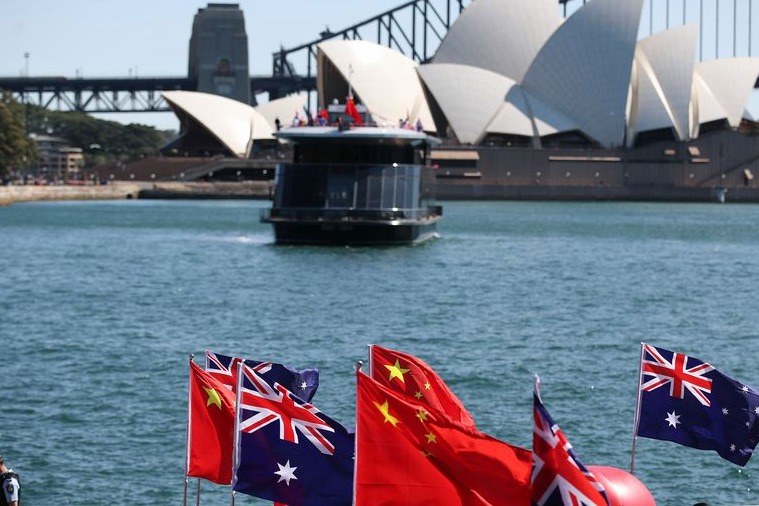
China is surging in popularity among Australian travellers.The latest official data out this week from the Australian Bureau of Statistics showed trips to China were up 16.5 per cent in the 12 months to March, with 716,140 Aussies visiting the Asian nation.It is among the fastest-growing international destinations, alongside Vietnam at 17 per cent and Japan at 14.4 per cent.Looking at the March data alone, the first monthly data released since the US and Israel launched its joint attack on Iran on February 28, China saw a bigger increase than any other major overseas holiday spot.Outbound travel from Australia to China was up 31.2 per cent in March 2026 compared to March 2025.Singapore was also a standout in March, up 20.6 per cent.Australian Travel Industry Association chief executive Dean Long described it as “significant movement in a single month”.“It’s too early to call it a definitive trend, and there are other factors feeding those numbers including strong underlying demand, and continued route recovery, but Australians have shown consistently that when one pathway gets complicated, they find another,” he told news.com.au.“The demand is there. It doesn’t disappear; it redirects. We’ll be watching the April and May data closely.”The top international destinations that Australian travellers returned home from in March were New Zealand, Indonesia, Japan, Vietnam and then China.Mr Long said the data clearly showed “Asia-Pacific is where Australians want to be right now”.Reason for China’s Aussie tourism boomIt is likely there will be an increase in travellers using Asian-based airlines that don’t fly via the Middle East to get to Europe this year, making China an attractive stopover. But the country is also a popular destination on its own.Australian tour operator Wendy Wu Tours, which originally launched with tours to China before expanding throughout Asia, told news.com.au it had seen a more than 100 per cent increase in bookings to China in the first four months of this year compared to the same period last year.Founder Wendy Wu said China’s visa-free policy and an increase in Chinese airlines flying to Australia had helped boost those numbers.“China offers strong value, especially for travellers looking at group or tailor-made touring compared to Europe and North America,” she said.“There’s also a clear shift in mindset, with Australian travellers increasingly acting on their curiosity of China.“The rapid advancement in technology, infrastructure, transport and the positive shift in sentiment China is now seeing globally, is shaping it as a unique holiday destination.“It appeals to travellers looking for more meaningful cultural and historical experiences that go beyond simply ticking off landmarks.”Classic routes including Beijing, Xi’an and Shanghai continue to be at the top of the list for customers of Wendy Wu Tours, along with Guilin and Yangshuo.However, Ms Wu said there was growing interest in some of the more underrated or emerging regions.“Places like Chongqing, Zhangjiajie and the stunning Jiuzhaigou Valley are resonating strongly with travellers looking for something a bit different, offering incredible scenery and a truly immersive view of China, beyond the traditional routes,” she said, adding that they needed to add capacity to their newest ‘China Uncovered’ itinerary that launched in March to keep up with demand.China introduced a 30-day visa-free policy in 2024 and has extended that to at least December 31, 2026.Dr Xin Jin, an expert in visitor economy and behaviour from Griffith University, told news.com.au last year the visa-free policy had a positive impact beyond simply the savings travellers made on visa costs.“The policy signals openness and accessibility, which encourages travel,” she said. “Internationally, relaxed visa regimes have repeatedly proven effective in stimulating visitation.”Adam Schwab, co-founder and CEO of Melbourne-based travel company Luxury Escapes, agreed China was “definitely on the up” and not far behind trending destinations Vietnam and Japan, which were “going gangbusters”.He said the company’s internal data showed hotel bookings in China were up around 43 per cent in the first three months of the year compared to the same period a year ago.Warning on spending in ChinaTristan Dakin, Australian country manager for money transfer business Wise, said the Aussie dollar is up around 6 per cent year-on-year against the Chinese yuan and is tracking close to five-year highs.But while that means better value on the ground for Aussie travellers, Mr Dakin warns that it’s not like spending at home.“While cash is still accepted and foreign-issued Visa and MasterCard cards can be used in some places, acceptance can be inconsistent outside major tourist areas,” he said.“Instead, mobile payment platforms such as Alipay and WeChat Pay, which allow people to pay via QR codes, dominate everyday transactions, especially across transport, restaurants and smaller retailers.”Mr Dakin said that with Alipay, tourists can download the international version of the app before leaving Australia and link their card to spend like a local on the ground.He advised linking a low-fee travel card like the company’s own Wise card rather than major bank debit and credit cards, if they apply inflated exchange rates or add additional international transaction fees.“One thing to keep in mind is that Alipay charges foreign users a 3 per cent fee on transactions over 200 CNY (around A$41),” he explained. “To avoid unnecessary charges, travellers may want to keep purchases below that threshold where possible or split larger payments across multiple transactions.”Chinese travel to Australia picks up steamInbound travel from mainland China to Australia is also increasing.Chinese visitors were only second to Kiwis in the month of March, with the number of trips they made down under that month up 23.3 per cent on the same month last year.However, unlike Australian visits to China surging above pre-pandemic levels, Chinese travellers have been slow to return to Australia after Covid.Chinese visitation to Australia is still well below the numbers seen in 2019.In the March before the pandemic, there were 124,370 visitors from China, compared to 87,560 in March 2026. That is down almost 30 per cent.Tourism & Transport Forum chief executive Margy Osmond explained to news.com.au last year that the slow recovery of Chinese visitors to Australia could be attributed to China’s big push for domestic tourism and people changing the way they want to travel, like ditching the once hugely popular large tour groups.“China put a huge focus on rebuilding its domestic travel market after the pandemic, which meant long-haul destinations like Australia had to work a lot harder to be front of mind,” Ms Osmond said.When they do come to Australia, she said they were choosing to come as independent travellers or in smaller premium groups, and the challenge for the Australian tourism industry was to adapt to that shift.In February, inbound travel from China had surged a whopping 79.5 per cent on the same month last year, which Mr Long described as “extraordinary” and “a major economic signal for the travel industry”.For the full year to March 2026, inbound travel from China grew 21.4 per cent.Read related topics:China
China surges in popularity among Australian travellers amid Middle East conflict
China is surging in popularity among Australian travellers.
1,140 words~5 min read