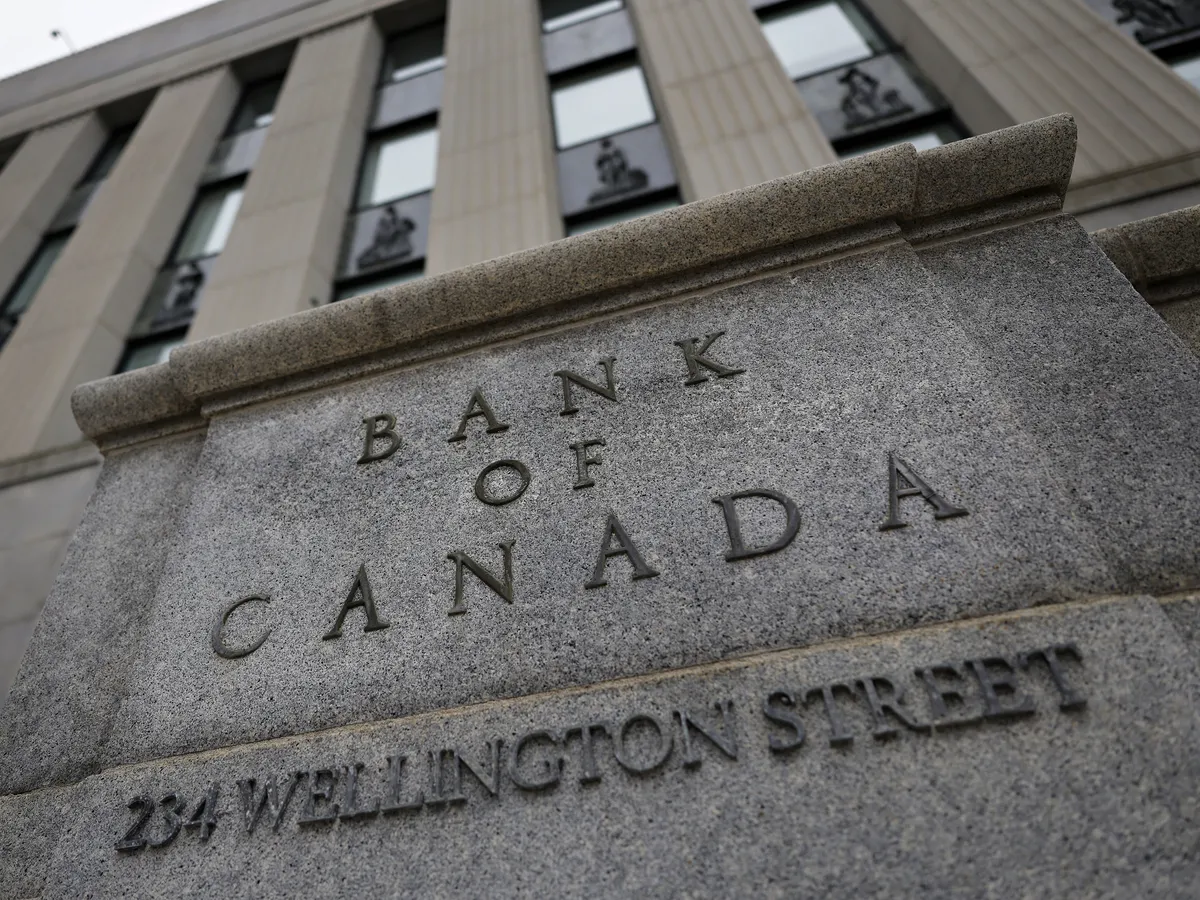
Skip to Content News Archives Economy Energy Oil & Gas Renewables Electric Vehicles Mining Commodities Agriculture Real Estate Mortgages Mortgage Rates Finance Banking Insurance Fintech Cryptocurrency Work Wealth Smart Money Wealth Management Investor Personal Finance Family Finance Retirement Taxes High Net Worth FP Comment Executive Women Puzzmo Newsletters Financial Times Business Essentials More Innovation Information Technology FP500 Podcasts Small Business Lives Told Tails Told Shopping Financial Post Store Obituaries Place a Notice Advertising Advertising With Us Advertising Solutions Postmedia Ad Manager Sponsorship Requests Classifieds Place a Classifieds ad Working Profile Settings My Subscriptions Saved Articles My Offers Newsletters Customer Service FAQ News Economy Energy Mining Real Estate Finance Work Wealth Investor FP Comment Executive Women Puzzmo Newsletters Financial Times Business Essentials HomeFinanceCryptocurrencyFintechCanada doesn’t need a digital loonie to maintain sovereignty from the U.S. — it needs digital competitionAlex Tapscott: A Canadian central bank digital dollar would be less useful than private-sector alternatives already in developmentLast updated 3 days ago You can save this article by registering for free here. Or sign-in if you have an account.A yield-bearing, private-sector built Canadian stablecoin could be a key differentiator, driving demand for Canada’s currency in the competitive foreign exchange market. Photo by Peter J. Thompson/National PostWith the rapid innovation in payments and the rise of United States-dollar-backed stablecoins, many in government assume they must respond with a state-run central bank digital currency alternative. In Canada, that assumption is unfounded.Subscribe now to read the latest news in your city and across Canada.Exclusive articles from Barbara Shecter, Joe O'Connor, Gabriel Friedman, and others.Daily content from Financial Times, the world's leading global business publication.Unlimited online access to read articles from Financial Post, National Post and 15 news sites across Canada with one account.National Post ePaper, an electronic replica of the print edition to view on any device, share and comment on.Daily puzzles, including the New York Times Crossword.Subscribe now to read the latest news in your city and across Canada.Exclusive articles from Barbara Shecter, Joe O'Connor, Gabriel Friedman and others.Daily content from Financial Times, the world's leading global business publication.Unlimited online access to read articles from Financial Post, National Post and 15 news sites across Canada with one account.National Post ePaper, an electronic replica of the print edition to view on any device, share and comment on.Daily puzzles, including the New York Times Crossword.Create an account or sign in to continue with your reading experience.Access articles from across Canada with one account.Share your thoughts and join the conversation in the comments.Enjoy additional articles per month.Get email updates from your favourite authors.Create an account or sign in to continue with your reading experience.Access articles from across Canada with one accountShare your thoughts and join the conversation in the commentsEnjoy additional articles per monthGet email updates from your favourite authorsSign In or Create an AccountorWhile most opponents of CBDCs focus on privacy issues and government overreach — they oppose money as a new form of surveillance technology, as it has become in a few digitally advanced states — the more prosaic but no less essential problem is that a Canadian digital dollar would simply arrive too late and prove less useful than private-sector alternatives already in development. In fact, Canada has already seen the launch of a stablecoin from a regulated financial institution in the private sector: Tetra Digital Group’s CADD.In a world of open, programmable financial networks such as Ethereum, a state-run system risks looking less like the future of money and more like digital wallpaper.Breaking business news, incisive views, must-reads and market signals. Weekdays by 9 a.m.By signing up you consent to receive the above newsletter from Postmedia Network Inc.A welcome email is on its way. If you don't see it, please check your junk folder.The next issue of Posthaste will soon be in your inbox.We encountered an issue signing you up. Please try againIt’s certainly possible, as advocates suggest, that a CBDC would reduce friction in the system and drive efficiencies for banks and businesses. But implicit in that view is that governments and incumbents — such as the country’s largest banks — should control the next generation of financial infrastructure.The history of innovation, however, teaches us that it is new entrants and new ideas that stimulate an economy.Moreover, CBDCs would do little to address policymakers’ main concern: preserving Canada’s monetary sovereignty in a world of rapidly evolving digital finance led by the U.S.In fact, by the time Canada designs, tests and deploys its own digital currency, the market will have moved on. Stablecoins — most notably Circle Internet Group Inc.’s USDC — backed one-to-one by U.S. dollars, are already scaling globally. In Canada, they are a popular asset on fintech platforms such as Wealthsimple and Shakepay, and they are embedded in payments, trading and decentralized finance around the world.Canadians have never thought much of the idea that the U.S. dollar might replace the Canadian dollar in day-to-day transactions, as it has replaced the local currency in countries such as Argentina. But the world is a flat place. Information already moves instantly, globally and peer-to-peer. Now, money and other digital assets do, too, with blockchain technology.Given the Trump administration’s aggression towards Canada, the issue warrants closer attention.The good news is we already have a plan and policy framework to address this.In March, embedded in Bill C15, was the Stablecoin Act, landmark legislation to establish a comprehensive framework for stablecoins in Canada.The new law creates a registration regime for issuers, mandates at-par redemption and places oversight with the Bank of Canada.The stated goal is to “promote safe innovation and competition in the financial sector” and protect consumers. A sensible equilibrium of clarity, competition and consumption will lead to better outcomes for Canada.The United States has already made its choice. With the passage of last year’s Genius Act, it has created a clear regulatory framework for private stablecoin issuers, and the results speak for themselves. Growing at a rapid pace, U.S. dollar stablecoins have surpassed US$300 billion in circulating supply globally. They are available in almost every country on Earth. European policymakers are already warning that U.S. stablecoins could threaten monetary sovereignty in Europe.So, what is the opening for Canada? It is not to challenge the U.S. dollar head-on. That would be unrealistic. The opportunity is to adopt provably good ideas and implement them pragmatically at home. That means embracing the model already embedded in the Stablecoin Act and empowering Canadian fintechs like Tetra Trust, which recently became the first regulated financial institution in Canada to launch a stablecoin, CADD.If we get this right, the benefits to Canada could be significant. We could future-proof our financial system, for starters. Our economy is increasingly digital, and our money and market should be, too. More competition means better outcomes for consumers who are already subject to hefty fees. According to a recent study, Canadians pay $250 more per person in banking fees compared with consumers in other countries.What about the risks? South of the border, large financial institutions have warned that widespread stablecoin adoption could move deposits from the traditional banking system to digital platforms, harming community banks in particular, and potentially even undermining financial stability. So far, the data tells us that is not happening. If anything, the opposite has been true: Since 2020, stablecoins have grown from $5 billion to $300 billion. In the same period, U.S. community bank deposits increased $1.9 trillion to $2.3 trillion.There would be other issues to resolve in Canada as well. Our fragmented regulatory architecture creates uncertainty and securities regulators will likely push to maintain oversight, particularly where stablecoins intersect with trading and financial assets.The Stablecoin Act left many implementation details to be ironed out in new regulations, which, according to the Bank of Canada, may not arrive until 2027. The act is by no means perfect. It forbids issuers from paying interest, a clause that aligns with the U.S. Genius Act, but that ought to be reconsidered. A yield-bearing Canadian stablecoin could be a key differentiator, driving demand for Canada’s currency in the competitive foreign exchange market.Ultimately, what matters is managing risk so that innovation can scale and Canadians can reap the rewards. Canada has already laid the groundwork. What we need now is execution, and a willingness to trust that the best way to future-proof the financial system is to empower the market rather than the government.Canada doesn’t need a state-run digital currency. It needs a regulatory environment that lets private sector innovators build their own.Alex Tapscott is the CEO and managing partner of CMCC Global Capital Markets, and the author of Web3 Join the Conversation This website uses cookies to personalize your content (including ads), and allows us to analyze our traffic. Read more about cookies here. By continuing to use our site, you agree to our Terms of Use and Privacy Policy.
Canada doesn’t need a digital loonie to maintain sovereignty from the U.S. — it needs digital competition
Alex Tapscott: A Canadian central bank digital dollar would be less useful than private-sector alternatives already in development. Read on
1,464 words~7 min read