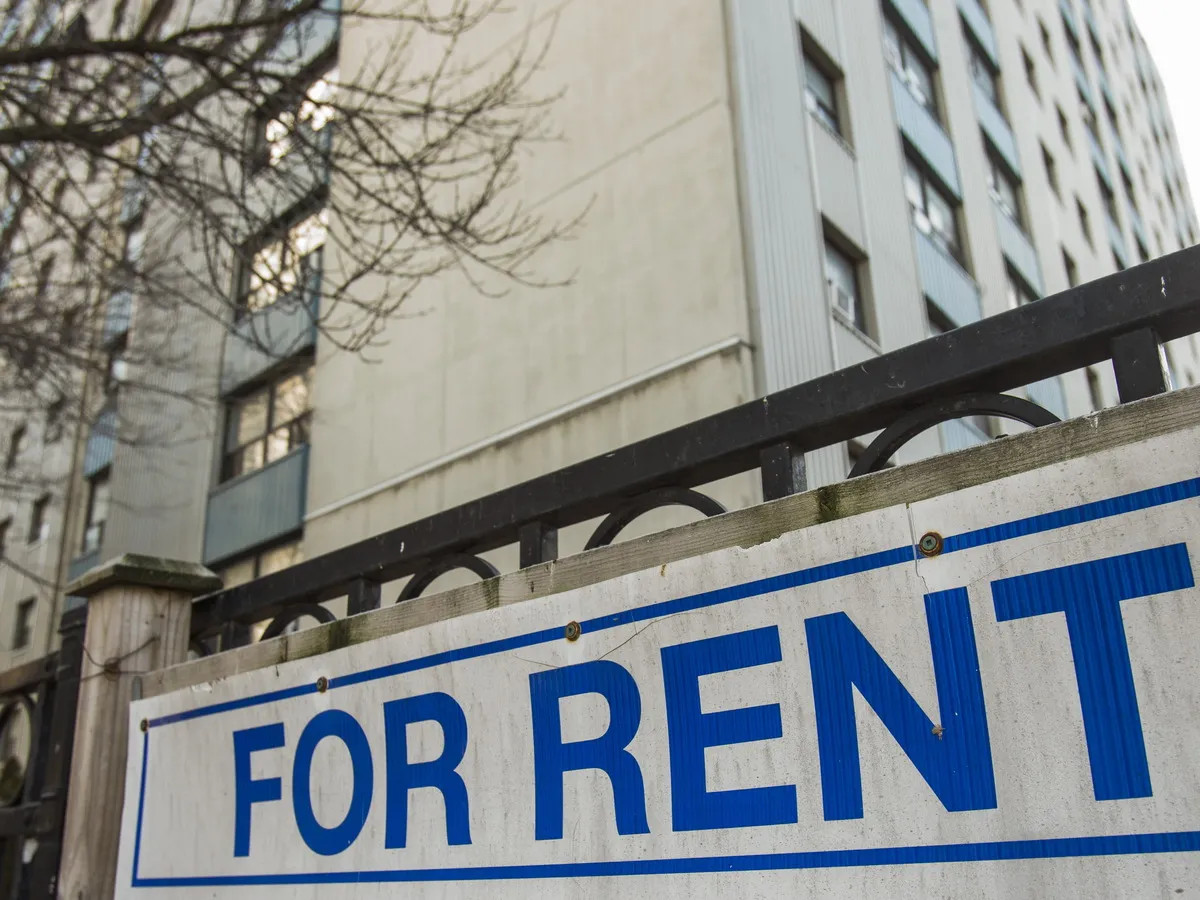
Skip to Content News Archives Economy Energy Oil & Gas Renewables Electric Vehicles Mining Commodities Agriculture Real Estate Mortgages Mortgage Rates Finance Banking Insurance Fintech Cryptocurrency Work Wealth Smart Money Wealth Management Investor Personal Finance Family Finance Retirement Taxes High Net Worth FP Comment Executive Women Puzzmo Newsletters Financial Times Business Essentials More Innovation Information Technology FP500 Podcasts Small Business Lives Told Tails Told Shopping Financial Post Store Obituaries Place a Notice Advertising Advertising With Us Advertising Solutions Postmedia Ad Manager Sponsorship Requests Classifieds Place a Classifieds ad Working Profile Settings My Subscriptions Saved Articles My Offers Newsletters Customer Service FAQ News Economy Energy Mining Real Estate Finance Work Wealth Investor FP Comment Executive Women Puzzmo Newsletters Financial Times Business Essentials HomePersonal FinanceYoung MoneyReal EstateGarry Marr: Falling rents are the incentive millennials need to finally move outThe softer the market gets, the more millennials will move out. And they shouldLast updated 2 days ago You can save this article by registering for free here. Or sign-in if you have an account.Apartments for rent near Parliament Street and Bloor Street East in Toronto, Ont. Photo by Ernest Doroszuk/Toronto Sun/Postmedia filesReviews and recommendations are unbiased and products are independently selected. Postmedia may earn an affiliate commission from purchases made through links on this page.With rising costs keeping more millennials living with their parents, could falling rents be the boost they need to leave the family home?Subscribe now to read the latest news in your city and across Canada.Exclusive articles from Barbara Shecter, Joe O'Connor, Gabriel Friedman, and others.Daily content from Financial Times, the world's leading global business publication.Unlimited online access to read articles from Financial Post, National Post and 15 news sites across Canada with one account.National Post ePaper, an electronic replica of the print edition to view on any device, share and comment on.Daily puzzles, including the New York Times Crossword.Subscribe now to read the latest news in your city and across Canada.Exclusive articles from Barbara Shecter, Joe O'Connor, Gabriel Friedman and others.Daily content from Financial Times, the world's leading global business publication.Unlimited online access to read articles from Financial Post, National Post and 15 news sites across Canada with one account.National Post ePaper, an electronic replica of the print edition to view on any device, share and comment on.Daily puzzles, including the New York Times Crossword.Create an account or sign in to continue with your reading experience.Access articles from across Canada with one account.Share your thoughts and join the conversation in the comments.Enjoy additional articles per month.Get email updates from your favourite authors.Create an account or sign in to continue with your reading experience.Access articles from across Canada with one accountShare your thoughts and join the conversation in the commentsEnjoy additional articles per monthGet email updates from your favourite authorsSign In or Create an AccountorThe latest data from Statistics Canada, released this month, found that in 2021, the share of millennials aged 25 to 39 living with parents was 16.3 per cent, compared with 8.2 per cent of boomers of the same age in 1991. The federal agency said the trend has occurred gradually and is common among the large cities studied.“This steady shift cannot simply be attributed to more recent affordability challenges in some of Canada’s largest cities. Later family formation and longer educational careers, partly associated with life stretching, have likely played into this phenomenon, as have distinctive cultural patterns across different demographic groups,” said Statistics Canada, in its study.Get the latest headlines, breaking news and columns.By signing up you consent to receive the above newsletter from Postmedia Network Inc.A welcome email is on its way. If you don't see it, please check your junk folder.The next issue of Top Stories will soon be in your inbox.We encountered an issue signing you up. Please try againFor years, prices had risen steeply in Canada’s largest cities, for rent and for owning. And there was a pandemic thrown into the middle of it, which made living in a spacious home far more attractive than a starter condominium or a cramped rental unit.But now, market conditions might be favourable to earlier launches for young Canadians.Staying in the family home to save for one of your own makes sense financially. Your parents have the empty rooms, and they are probably never going to downsize until they face mobility issues. But there is an interim solution that Canadians have used for decades and may again make more sense: renting.Though renting has become ridiculously expensive in most parts of the country, with apartment construction reaching levels not seen in decades and some pauses in immigration already underway, some cracks are appearing and driving rents down.Asking rents have dropped year over year for 19 months across all apartment types in Canada, reaching $2,027 in April, according to online rental marketplace rentals.ca. That’s a steep decline from a peak of $2,188 reached in April 2024, but since hitting a low of $1,662 in April 2021 during COVID-19, average rents are still up 21.9 percent.Ben Myers, president and owner of Bullpen Research & Consulting Inc., published a recent report that showed some softening in the higher end of the market he studied. This effect has made its way across the market, he added.“It is having an impact on the lower end of the market. There is filtering going on,” said Myers. “Someone who had $2,500 to spend might have been able to afford a 500-square-foot apartment, and now maybe they can look at a 650-square-foot apartment in a building five years newer.”Myers said that type of decline works its way down to even the bottom of the market. Still, a key issue is the employment picture, so renters feel comfortable making big life decisions such as signing a lease.“It does drive people staying longer with mom and dad or delaying kids because they can’t afford the housing,” he said.Adrian Rocca, the founder and chief executive of rental provider Fitzrovia, said the biggest question of whether young people will move out is the rent-to-income levels. He added that the condo market with smaller units has also not lent itself to long-term living.Fitzrovia has created more two- and three-bedroom units geared to longer-term commitments, and Rocca said this has happened as rents have essentially fallen by 21 per cent from the peak.“People know us for brand new stuff, but we have a billion dollars of older assets that have (been renovated) and are affordable,” Rocca said, adding that up to 25 per cent of the renter market can afford to live in one of his buildings based on 30 per cent of shelter costs to income. “The affordability has never been better.”Rocca added that even with house prices falling, from a national average peak of about $825,000 in February 2022 to the current $673,000, it is about 25 per cent to 30 per cent cheaper to rent in his portfolio than to own a home.Statistics Canada said that, even after accounting for those living with their parents, millennials had a home ownership rate of 49.9 per cent, compared with Gen-Xers at 56.2 per cent and baby boomers at 55.9 per cent when they were aged 25 to 39 years.“It’s always been cheaper to rent but the perception is you are paying someone else’s mortgage,” he said. “There is a stigma around renting, but not as strong as it used to be.”Giacomo Ladas, of rentals.ca, said the idea of renting as a “waste of money” is still ingrained in millennials, but much of the reluctance to move still rests simply on affordability.Affordability affects younger renters beyond millennials, as well as rental prices in different markets.“Youth unemployment is still much higher than the average unemployment rate, and many renters are younger,” he said. “In provinces with higher unemployment, we are seeing rents fall, and in provinces with stronger wage growth, we see rents higher.”People are also simply “doubling up” in large part due to affordability, according to a CIBC study.“Doubling up is the most common response to deteriorating housing affordability, but also can be seen as shadow demand ready to be utilized in an environment of improved affordability,” said Benjamin Tal, deputy chief economist with CIBC, in a report issued in late 2025.The report found that the number of housing arrangements that can be described as doubling up had reached above 17 per cent of the population by the end of 2021.Tal said in the report the economic impact of the softening in housing costs should reduce doubling-up in many cities. “This in turn could absorb new affordable supply coming to the market, reducing the pressure on vacancy rates, while potentially establishing a floor for rent of units that are at the more affordable end of the rental market,” he said.Like many, I’m indebted to my parents forever, including a little financially, but I never wanted to live at home forever; I recognize it was a safety net I was lucky to have.The softer the market gets, the more millennials will move out. And they should. It took me until 26, including one bounce back after a job loss at 28, but it eventually took. Don’t give up, parents or kids. Join the Conversation This website uses cookies to personalize your content (including ads), and allows us to analyze our traffic. Read more about cookies here. By continuing to use our site, you agree to our Terms of Use and Privacy Policy.
Garry Marr: Falling rents are the incentive millennials need to finally move out
With rising costs keeping more millennials living with their parents, could falling rents be the boost they need to move out? Find out more.
1,561 words~7 min read