Academia
While Indonesia's headline GDP suggests an economic triumph, a deeper look at GNP reveals a hollow growth, where wealth flows outward rather than into households. The country’s impressive statistics are failing to move the needle for the middle class and the informal workers who anchor the economy.
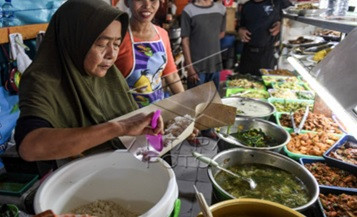
A food vendor serves customers in Jakarta on Feb. 22, 2024, at her ‘warteg’, a food stall specializing in the cuisine of Tegal, Central Java. (Antara/Muhammad Adimaja)
Indonesia's economy grew at a steady 5.2 percent through 2025 and into early 2026. On paper, that is a success story. Yet in practice, millions of Indonesians aren't buying it, because they aren't feeling it.Household budgets remain tight, the middle class has stopped expanding, and a quiet frustration is building between what the macroeconomic data says and what people actually experience at the market, at the fuel pump and at the end of the month.
This is not a uniquely Indonesian problem. The United States posted roughly 2 percent growth in the first quarter of 2026, yet Americans remain consumed by anxieties over housing costs, grocery bills and a softening job market.