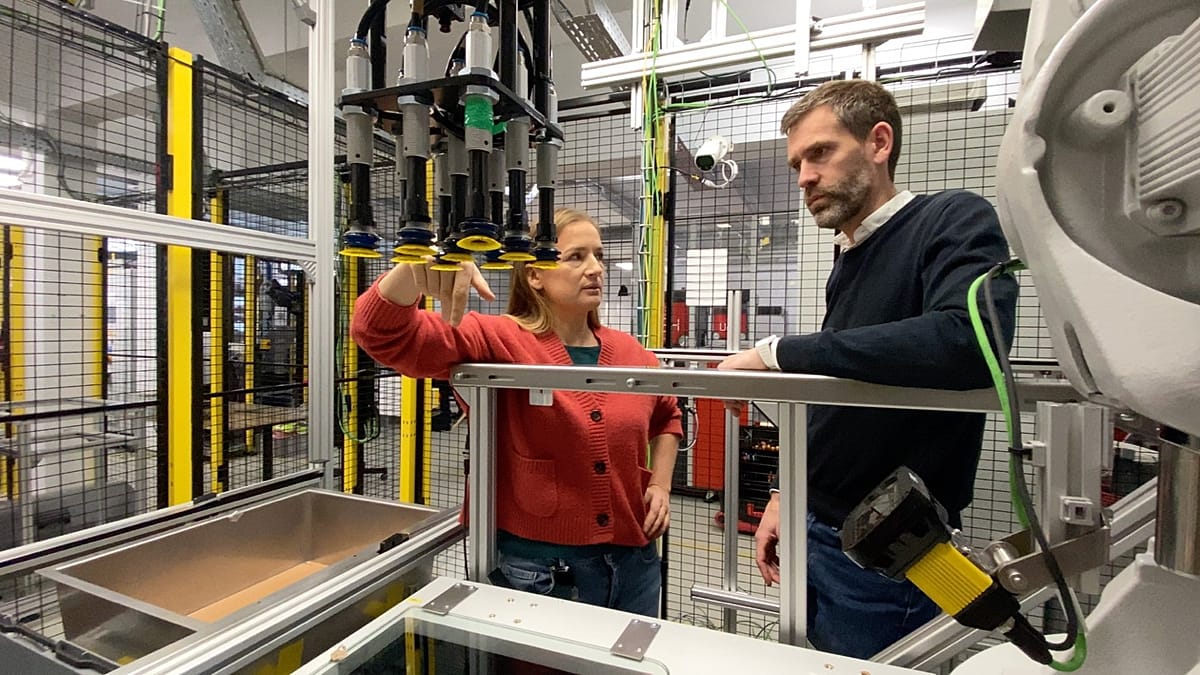
AI-driven robots currently in operation in a huge e-commerce warehouse near Berlin have been designed to handle over 600 units per hour. The robots are able to autonomously identify the nature, size, shape and weight of each item and its packaging, and to optimise its handling.
“The robots work 24/7. So if you’re comparing robots with humans, they don’t need to take breaks. They can keep going, and they’re basically consistent,” explains Nitin Annam, Head of Operations at CEVA Logistics. “It’s not necessarily about replacing people with automation. It’s more about how we produce more volume at a cheaper cost and be more efficient”
Without these AI-driven solutions, e-commerce business models are not viable any more, claims Klaus Lichtenfeld, Head of Logistics for the European Union at the online fashion retailer that uses this distribution centre as its main hub in continental Europe.
“Our e-commerce business is very volatile. This makes it very difficult to plan the staff properly,” says Lichtenfeld. “The advantage of robots is that they’re always there and can easily help us cope with volume spikes.”
The robotic solution has been engineered and tested by a start-up with 140 staff in Poland’s capital Warsaw. Engineers here have developed cloud-based AI solutions that help robots learn from every pick.