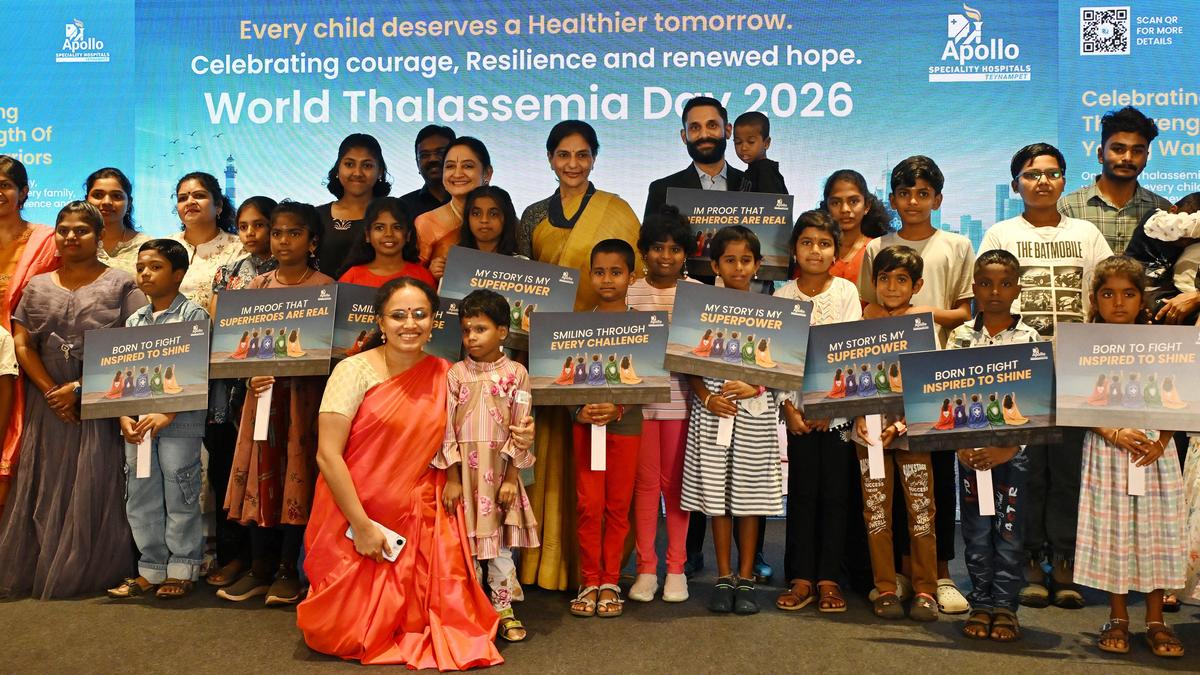
Young thalassemia survivors with Preetha Reddy, Executive Vice Chairperson of Apollo Hospitals at the event to mark World Thalassemia Day in Chennai on Thursday.
| Photo Credit: VELANKANNI RAJ B
Marking World Thalassemia Day 2026, Apollo Cancer Foundation and Apollo Speciality Hospitals, Teynampet, on Thursday reiterated their commitment to improving access to Bone Marrow Transplantation (BMT) for children affected by thalassemia, while celebrating the recovery journey of 30 survivors.The Foundation said it was supporting access to life-saving Bone Marrow Transplantation (BMT) procedures for economically weaker children under the Thalassemia Bal Sewa Yojana (TBSY), implemented in association with Coal India Ltd. BMT remains the only established curative treatment for many children affected by Thalassemia Major.Revathi Raj, Senior Consultant, Paediatrics and Haematology Oncology, Apollo Speciality Hospitals, said timely diagnosis and access to transplantation could help children lead healthier and disease-free lives. She stressed the need for greater awareness and earlier intervention to reduce dependence on lifelong blood transfusions.Thamirabarani, a 25-year-old thalassemia survivor who now works as a teacher, said her parents first noticed health complications when she was one-and-a-half years old and initially mistook them for jaundice. After she was diagnosed with thalassemia, she underwent monthly blood transfusions until the age of five and later had her spleen removed. She said it was only after consulting Dr. Raj that she was placed on the right course of treatment. Dr. Raj also encouraged her parents to have another child, whose bone marrow was later used for a transplant that helped her recover.Siddharth, another survivor, said at the event that when he underwent treatment in 2007, his parents faced severe emotional and financial strain as there was little awareness about thalassemia and no government schemes to subsidise treatment costs.Preetha Reddy, Executive Vice Chairperson of Apollo Hospitals, said caring for children with thalassemia was both a professional and emotional responsibility and stressed that more support and partnerships were needed given the large number of children requiring treatment. Keshika, a 16-year-old survivor, highlighted the importance of regular blood donation and the need for adequate blood availability. “Every month, we had to make countless calls just to arrange a unit of blood. If you are able to donate blood, please do. It can save and support countless patients like us,” she said.Mothers of survivors at the event urged expectant parents to undergo haemoglobin (Hb) electrophoresis testing during pregnancy to help identify thalassemia early and prevent complications. Published - May 15, 2026 12:12 am IST