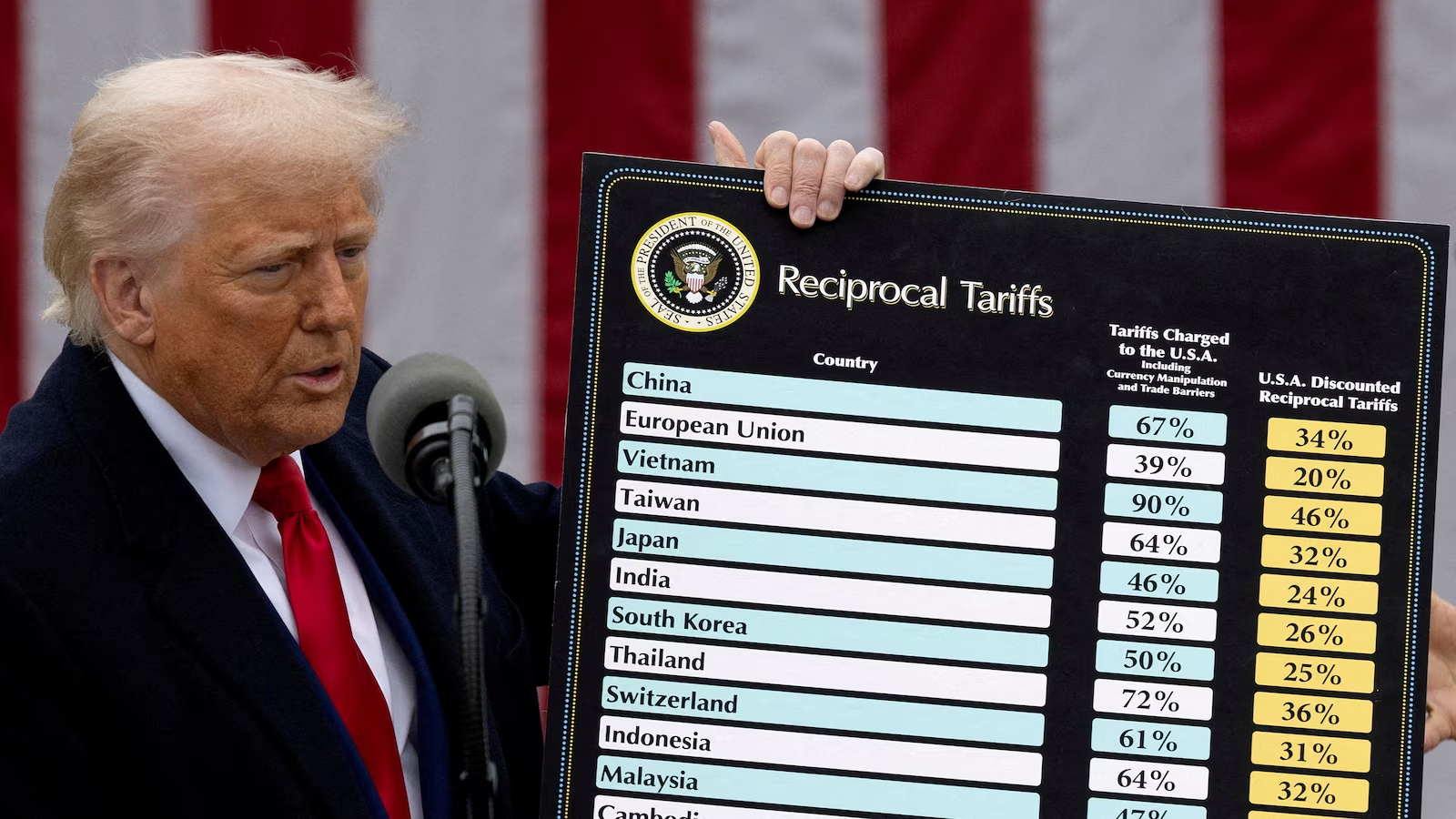
The long-running legal and political fight over President Donald Trump’s tariff policy has entered a dramatic new phase. Beginning this week, thousands of U.S. companies are expected to start receiving tariff refunds after the Supreme Court struck down major Trump-era tariffs imposed under emergency powers.The U.S. Customs and Border Protection confirmed that tariff refund disbursements were set to begin as early as Tuesday, May 12. For American importers who shouldered billions in tariff costs during months of legal uncertainty, that date carries extraordinary weight.Now, while companies are receiving refunds, ordinary shoppers are asking whether they will ever see any of that money returned through lower prices or direct compensation. That question is beginning to define the next chapter of the Trump tariff refund debate.The Supreme Court ruling fundamentally changed how emergency economic powers may be used by future administrations. The court determined that the sweeping tariffs introduced under the International Emergency Economic Powers Act of 1977 exceeded presidential authority. That legal conclusion instantly transformed billions of dollars in collected tariffs into refundable payments owed back to importers.Trump tariff refunds begin this week — why are importers receiving payouts while inflation-hit consumers receive nothing?The tariff refund rollout officially accelerated after CBP activated its Consolidated Administration and Processing of Entries system, widely known as CAPE. The platform allows importers and customs brokers to submit refund claims connected to the invalidated tariffs.The scale of the repayment process is staggering. Federal filings show that CBP approved more than 86,000 refund applications involving roughly 15.1 million qualifying import entries. Of those, millions of shipments have already completed processing stages. That volume highlights how deeply Trump’s tariff agenda shaped American trade during its enforcement years.Businesses ranging from global retail giants to smaller regional importers are expected to benefit. Companies including Walmart, Target, Nike, Gap, and Home Depot are among those reportedly positioned to receive reimbursements tied to earlier tariff payments. The refunds include interest, meaning some firms could recover substantially more than they originally paid.At the same time, the refund process also reveals how dependent modern American commerce became on tariff-sensitive global supply chains. Even businesses that publicly supported domestic manufacturing often relied heavily on imported goods and materials affected by the now-invalidated tariffs.Who qualifies for Trump tariff refunds and why most consumers are excludedOne of the most misunderstood parts of the tariff refund process involves eligibility. Despite widespread public interest, ordinary consumers generally do not qualify for direct refunds from the federal government.According to CBP guidelines, only importers of record and customs brokers can officially file claims through the CAPE system. These entities originally paid the tariffs directly to the government when goods entered the United States. Because the payments legally originated from importers, federal reimbursements are returning to those same entities.That distinction matters because millions of American consumers ultimately carried the economic burden through higher prices at stores, online marketplaces, and shipping services. Although businesses paid the tariffs upfront, economists widely agree that much of the financial cost was eventually passed down to customers.This has triggered growing frustration among consumer advocates and legal analysts. Several lawsuits now argue that companies benefiting from refunds should return at least part of those gains to shoppers who absorbed years of higher prices. Some class-action cases already target large corporations accused of retaining tariff-related profits without compensating consumers.How the Supreme Court Ruling Set the Stage for Tariff RefundsMore than two months ago, the Supreme Court delivered a ruling that the Trump administration did not see coming — or at least did not want to accept. The court struck down the sweeping tariffs that Trump had imposed using emergency powers under the IEEPA, a 1977 law that was never designed to serve as a blanket trade weapon. The ruling was clear and it was final. Those tariffs, applied broadly against dozens of trading partners, were illegal.That legal determination triggered something the federal government rarely faces: a mandatory, large-scale financial obligation to private industry. Over 300,000 importers had paid into a tariff system that the highest court in the land had just declared unconstitutional. The Trump administration was now required to pay it all back — with interest."Over 300,000 importers had paid into a tariff system the highest court declared unconstitutional. The government was now required to pay it all back — with interest."The total liability crossed $166 billion. That figure alone makes this one of the most consequential domestic trade rulings in decades. It forced the U.S. Customs and Border Protection to build — quickly — an entirely new digital infrastructure to manage the refund process at scale.Who Qualifies for Trump Tariff Refunds?Here is where many people — including some business owners — are getting confused. The Trump tariff refund portal is not open to everyone. It is not open to individual consumers, even though they are the ones who ultimately absorbed the cost of higher prices. The CBP has been explicit: only importers of record and licensed customs brokers may file for tariff refunds through the new CAPE system.CAPE — the Consolidated Administration and Processing of Entries portal — launched on April 20. It was built to consolidate refunds of IEEPA duties, including accrued interest, rather than processing individual shipments one by one. Approved importers receive a single consolidated refund after submitting a verified declaration through the portal. As of May 11, the CBP had already received over 126,000 applications covering 15.1 million qualifying entries.Among those entries, 8.3 million shipments have been fully processed. The anticipated total payout for those finalized cases alone — including interest — stands at $35.46 billion. That number, confirmed in a court filing by a senior CBP official, signals the sheer scale of what is already in motion.Major retailers including Walmart, Target, Nike, Gap, and Home Depot are among the approximately 300,000 importers set to receive reimbursements. These companies imported goods, paid the tariffs directly, and are now legally entitled to get that money back. The law is not ambiguous on this point.Will Ordinary Consumers See Any of This Tariff Refund Money?This is the question most people are actually asking — and the honest answer is uncomfortable. The federal refund process does not include American consumers. The government's position is simple: importers paid the duties, so importers receive the refunds. There is no legal mechanism to redirect those payments to households that paid more for goods at the register.That gap between legal reality and moral logic is significant. Ordinary Americans absorbed higher prices on clothing, electronics, household goods, and everyday essentials for months. They are not going to receive a check from the CBP. The refund pipeline runs B2B, not B2C.However, some companies are choosing to act differently. Cards Against Humanity, Costco, and FedEx have all committed publicly to passing their tariff refunds on to customers — either through direct payments or visible price reductions in stores. Whether other large retailers follow suit will depend largely on competitive pressure and public scrutiny. Consumer advocates are already watching closely.
Trump tariff refund checks begin disbursing this week — who qualifies and why are millions excluded from payouts?
Trump tariff refunds begin disbursing this week after the Supreme Court voided IEEPA-based tariffs, leaving the U.S. government liable for over $166 billion. The CBP's CAPE portal has already received 126,237 applications. Some $35.46 billion in refunds is finalized. Only importers of record and customs brokers qualify — not individual consumers. Around 300,000 companies, including Walmart and Nike, are eligible. A few firms, like Costco and FedEx, plan to pass savings to customers. The refund process marks one of the largest customs reimbursements in U.S. history.
1,155 words~5 min read