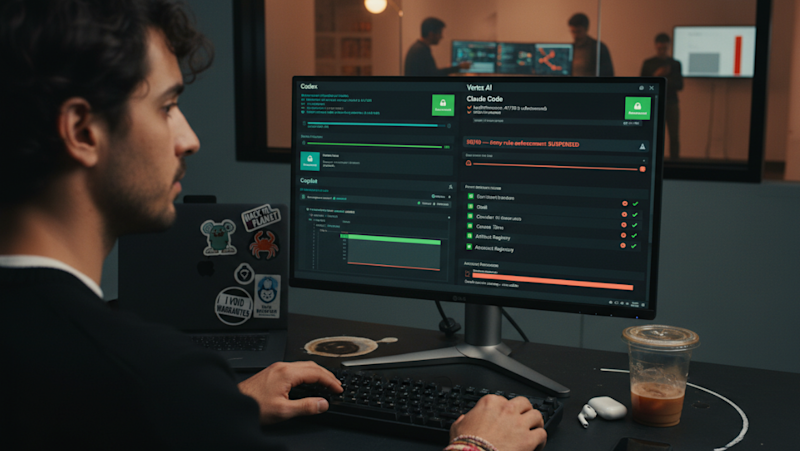
On March 30, BeyondTrust proved that a crafted GitHub branch name could steal Codex’s OAuth token in cleartext. OpenAI classified it Critical P1. Two days later, Anthropic’s Claude Code source code spilled onto the public npm registry, and within hours, Adversa found Claude Code silently ignored its own deny rules once a command exceeded 50 subcommands. These were not isolated bugs. They were the latest in a nine-month run: six research teams disclosed exploits against Codex, Claude Code, Copilot, and Vertex AI, and every exploit followed the same pattern. An AI coding agent held a credential, executed an action, and authenticated to a production system without a human session anchoring the request.
The attack surface was first demonstrated at Black Hat USA 2025, when Zenity CTO Michael Bargury hijacked ChatGPT, Microsoft Copilot Studio, Google Gemini, Salesforce Einstein and Cursor with Jira MCP on stage with zero clicks. Nine months later, those credentials are what attackers reached.
Merritt Baer, CSO at Enkrypt AI and former Deputy CISO at AWS, named the failure in an exclusive VentureBeat interview. “Enterprises believe they’ve ‘approved’ AI vendors, but what they’ve actually approved is an interface, not the underlying system.” The credentials underneath the interface are the breach.