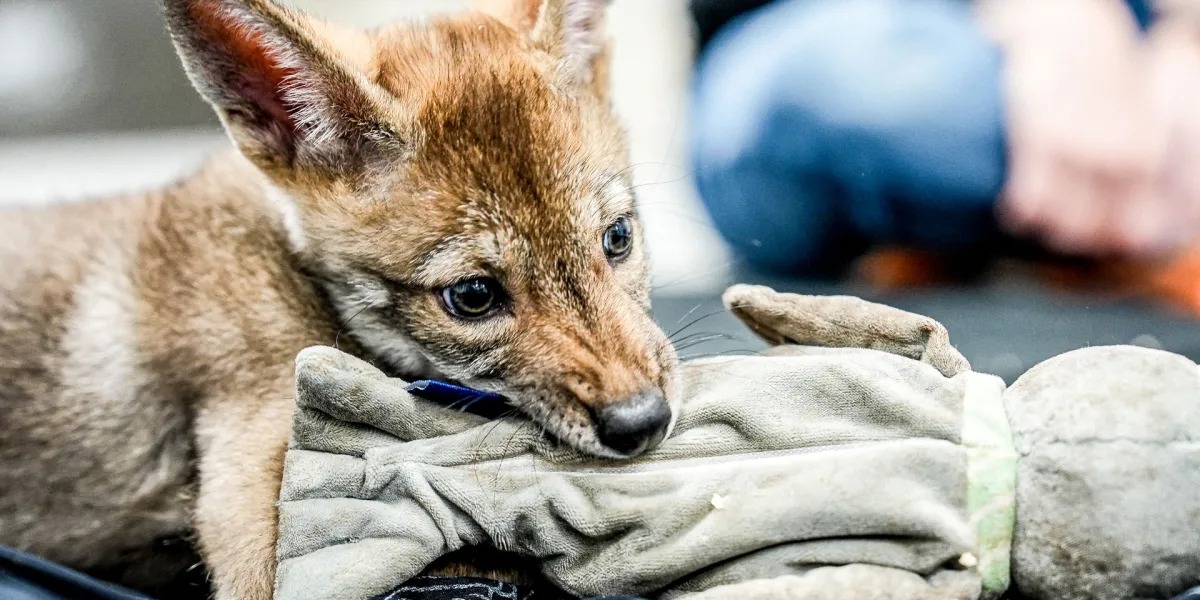
If you want to capture something wolflike, it’s best to embark before dawn. So on a morning this January, with the eastern horizon still pink-hued, I drove with two young scientists into a blanket of fog. Forty miles to the west, the industrial sprawl of Houston spawned a golden glow. Tanner Broussard’s old Toyota Tacoma bumped over the levee-top roads as killdeer, flushed from their rest, flew across the beams of his headlights. Broussard peered into the darkness, looking for traps. “I have one over here,” he said, slowing slightly. A master’s student at McNeese State University, he was quiet and contemplative, his bearded face half-hidden under a black ball cap. “Nothing on it,” he said, blandly. The truck rolled on. Wolves and their relations—dogs, jackals, coyotes, and so on—are classed in the family Canidae, and the canid that dominated this landscape in eastern Texas was once the red wolf. But as soon as white settlers arrived on the continent, Canis rufus found itself under siege. The war on wolves “lasted 200 years,” federal researchers once put it, in a surprisingly evocative report. “The wolf lost.” By 1980, the red wolf was declared extinct in the wild, its population reduced to a small captive breeding population. Still, for decades afterward, people noted that strange wolflike creatures persisted along the Gulf Coast. Finally, in 2018, scientists confirmed that some local coyotes were more than coyotes: They were taller, long-legged, their coats shaded with hints of cinnamon. These animals contained relict red wolf genes. They became known as the ghost wolves. Broussard grew up in southwest Louisiana, watching coyotes trot across his parents’ ranch. The thrilling fact that these might have been not just coyotes but something more? That reset a rambling academic career. In 2023, Broussard had recently returned to college after a seven-year pause, and his budding obsession with wolves narrowed his focus. Before he finished his bachelor’s degree, he began to supply field data to a prominent conservation nonprofit.
Colossal Biosciences said it cloned red wolves. Is it for real?
The red wolf has long been a contentious species. The debate over its preservation got even messier last year, when Colossal said it had cloned the animal.
5,360 words~24 min read