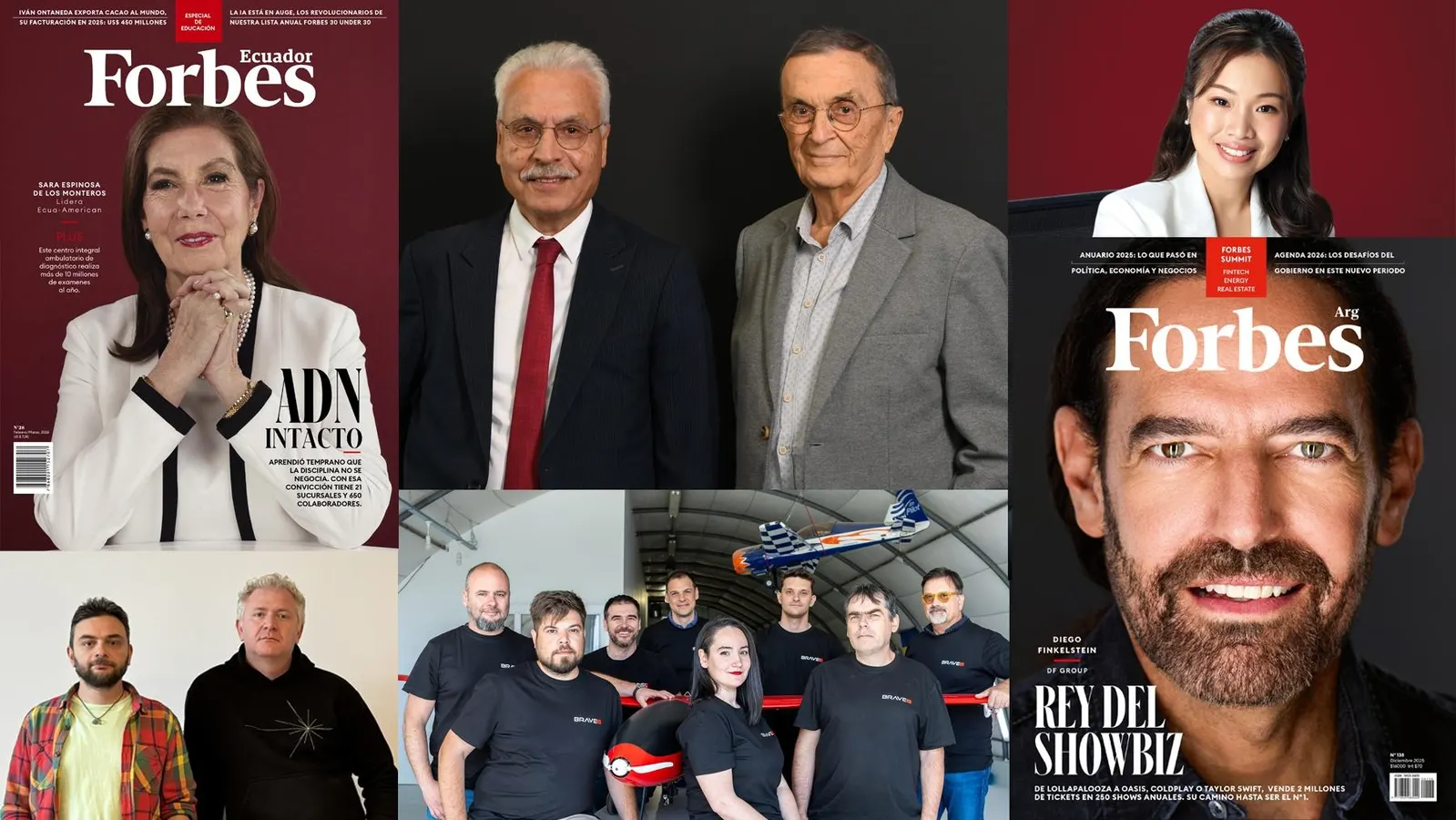
Across the planet, our 47 licensed editions span six continents, 82 countries and 30 languages. They all share the same mission: celebrating entrepreneurial capitalism in all its forms. Here we present short summaries of some of the most interesting articles these editions have published in recent months.Diego Finkelstein's company produces some 250 concerts & shows a year.Forbes ArgentinaArgentinaDiego Finkelstein got his start working for his then-girlfriend’s father, the mogul behind Argentine supermarket chain Coto. He’s now the nation’s leading show business entrepreneur, Forbes Argentina writes. His DF Entertainment, in which global giant Live Nation acquired a 51% stake in 2018, sells more than 2 million tickets to some 250 shows it produces each year–including Lollapalooza Argentina, Taylor Swift and Coldplay. What’s the secret to his success? “You have to pay artists upfront, regardless of exchange rates,” Finkelstein, 50, says. “The artist is the majority shareholder.”19-year-old tennis star João FonsecaChico Cerchiaro for Forbes BrasilBrazilForbes Brasil went behind the scenes with 19-year-old tennis phenom João Fonseca, a member of Forbes Brasil’s 30 Under 30 list in 2023 and one of the youngest-ever winners of the ATP 500 tournament in Switzerland last October. Sponsors of Fonseca— the highest-ranked Brazilian tennis player in the world (his career high was No. 24 in November)—include Rolex and shoe brand On. Says Fonseca: “Things have been happening very quickly in my life.”Healthcare entrepreneur Sara Espinosa de los MonterosForbes EcuadorEcuadorArmed with a degree in chemistry, Sara Espinosa de los Monteros built Ecua-American from one diagnostic lab in Quito in 1979 to a group of 21 outpatient diagnostic centers that now process about 10 million tests for more than 500,000 patients a year in five Ecuadorian cities, writes Forbes Ecuador. She’s now bringing in her daughter, Adriana Sánchez, to join her in managing the $37 million (revenue) group, which employs 650.Optio founders Giorgi Mirzikashvili (left) and Shota GiorgobianiOptioGeorgiaForbes Georgia profiled Tbilisi-based software startup Optio, a key technology partner for just under a third of Georgia’s largest banks. Optio founders Giorgi Mirzikashvili and Shota Giorgobiani cofounded a Georgian software company in 2006 and then separately worked for financial firms and led IT projects, respectively. They launched Optio, the only Georgian company ever accepted into startup accelerator Techstars Berlin, around on-premise systems–instead of in the cloud– tailored to financial institutions’ strict security and regulatory requirements.Tether CEO Paolo ArdoinoTetherItaly“We are a technology company operating a global payments network, not a monetary authority.” —Paolo Ardoino, the billionaire CEO and cofounder of cryptocurrency stablecoin firm Tether, responding to a question from Forbes Italy about whether Tether feels closer to a shadow central bank than a crypto startup, given that it’s one of the 20 largest holders globally of U.S. Treasury securities.BraveX.Aero team—with their droneBraveX.AeroRomaniaAmid a surge in drone use in neighboring Ukraine, Romania’s fledgling drone industry is expanding, Forbes Romania reports. One startup, BraveX.Aero, is developing long-range drones for military use (for surveillance) and for emergency medical and search-and-rescue purposes. Founded in 2020, BraveX has raised more than $800,000 from angel investors and inVest, an urban mobility accelerator backed by an arm of the European Union.Molecular biologist Edita RévayForbes SlovakiaSlovakiaMolecular biologist Edita Révay, whose work has taken her to Israel, the U.S. and Mali, is the first Slovakian scientist to receive grant funding from the Gates Foundation—in excess of $20 million for her and her team over six years—for her research into malaria, one of the world’s deadliest tropical diseases, Forbes Slovakia notes. With her husband, Günter Müller, Révay developed a new type of “attractive toxic sugar bait” on which mosquitoes feed and then die at rates of up to 90%; a two-year study she performed led to a 10% reduction in malaria cases.Marián Mouriño, president of Spanish pro soccer team Celta VigoPaula PezSpainForbes Spain spoke with Marián Mouriño, president of Spanish pro soccer team Celta Vigo and the only female leader in La Liga, the country’s highest-level league. The 50-year-old businesswoman took over in 2023 from her father, Carlos Mouriño, Celta Vigo’s main owner and founder of Corporativo GES, a family-owned gas station and restaurant firm with operations in Spain and Mexico–which Marián also leads as president. She launched a women’s team, As Celtas, in 2024.Popular hot pot buffet restaurant chain Suki TeenoiWarach PattayananThailand A hot pot buffet restaurant chain called Suki Teenoi has been drawing in 100,000 customers a day across Thailand with all-you-can-eat meals that cost as little as $7. Nattamon “Fern” Pisankitvanich, 34, who hails from a restaurant family, founded the eatery eight years ago and still gets guidance from her father, Forbes Thailand reports. Revenue last year at the 106-unit chain, which employs 10,000, grew to $290 million.ThorAtom and FIGES founders Tarÿk Öÿüt (left) and Reÿat Uzmen.Ergun Candemir for Forbes TurkeyTurkeyThorAtom, a subsidiary of FIGES, a small engineering company in Turkey with about $15 million in annual revenue, is developing a fourth-generation nuclear reactor that uses a mix of thorium and uranium. (Turkey has an abundance of thorium.) Known as “molten salt reactors,” these new units reportedly operate more safely than traditional designs, Forbes Turkey writes. The country’s Ministry of Industry and Technology has pledged to cover half of the $500 million needed to develop a prototype.
World Of Forbes: From Argentina’s Biggest Concert Producer To A Buzzy Restaurant Chain In Thailand
Snapshots of entrepreneurs featured in Forbes' international editions, from Argentina to South Africa.
858 words~4 min read