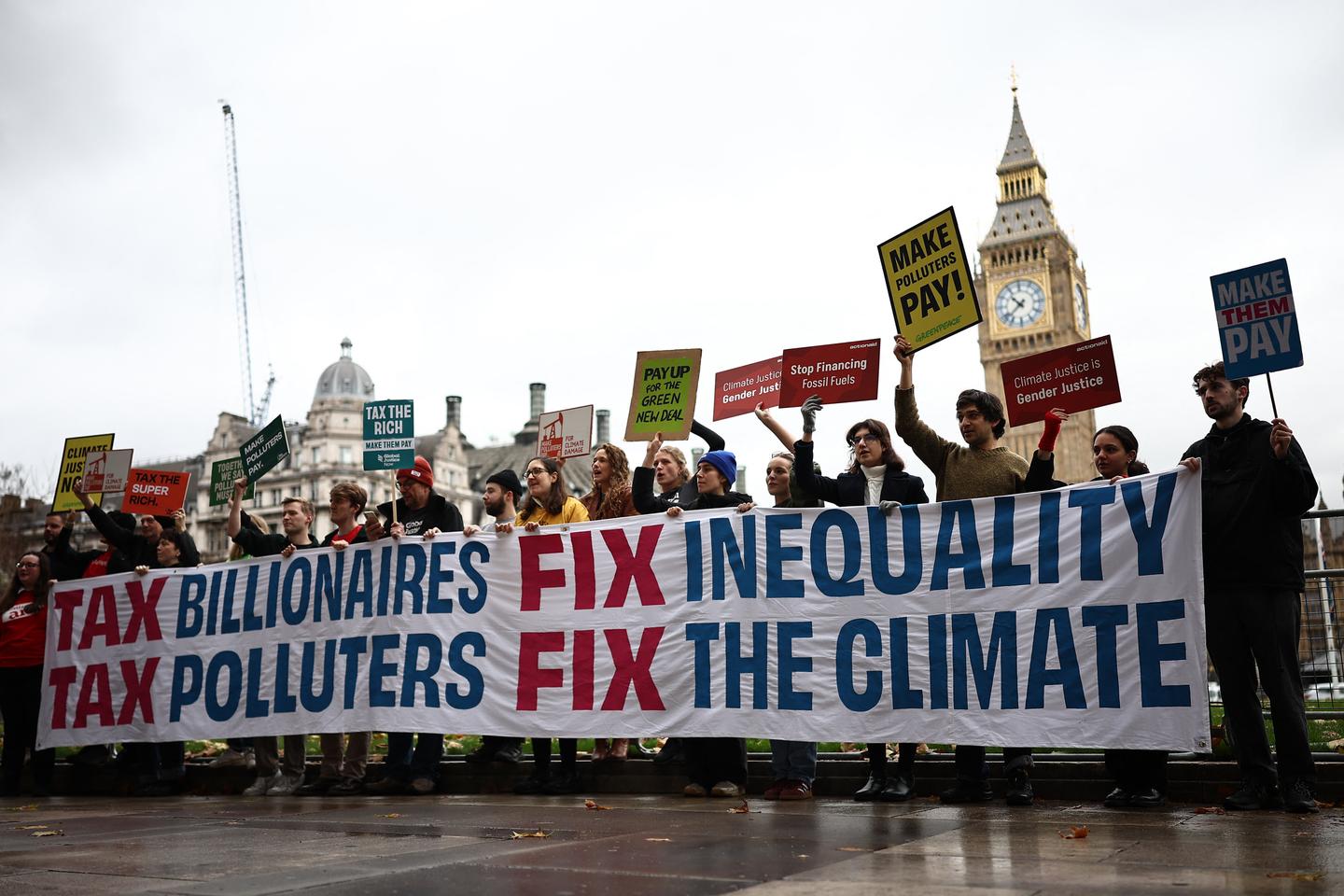
A protest against inequality, polluters and climate change, outside the Houses of Parliament in London, on November 24, 2025. HENRY NICHOLLS/AFP
In 2025, a man born in Blackpool, an economically disadvantaged seaside town in the northwest of England, had a healthy life expectancy of just 51 years. By contrast, his counterpart from Richmond, an affluent London neighborhood, could expect to enjoy good health for up to 69 years. Their income prospects were also vastly different: the bottom 10% of British people did not earn more than £11,800 (€13,664) per year, compared to £69,500 for the top 10%.
These figures are the result of six years of research conducted by economists, sociologists and public health experts for the Nuffield Foundation and the Institute for Fiscal Studies think tank, compiled in a report entitled "the IFS Deaton Review" published in late April. "Our aim was to examine inequality in the UK across several indicators," said Richard Blundell, a professor of political economy at University College London who participated in the study. "We realized the UK is one of the most unequal countries in the world."
Its Gini coefficient, a measure of inequality, stands as the worst among all G7 countries except the US, according to the report. Compared to the European Union, only Lithuania and Latvia fared worse than the UK. "Inequality is particularly pronounced at the top of the income pyramid," said Blundell. The top 1% of earners captured 15% of all taxable income for the 2018-2019 financial year, more than the bottom 55% of earners combined, the IFS Deaton Review showed.