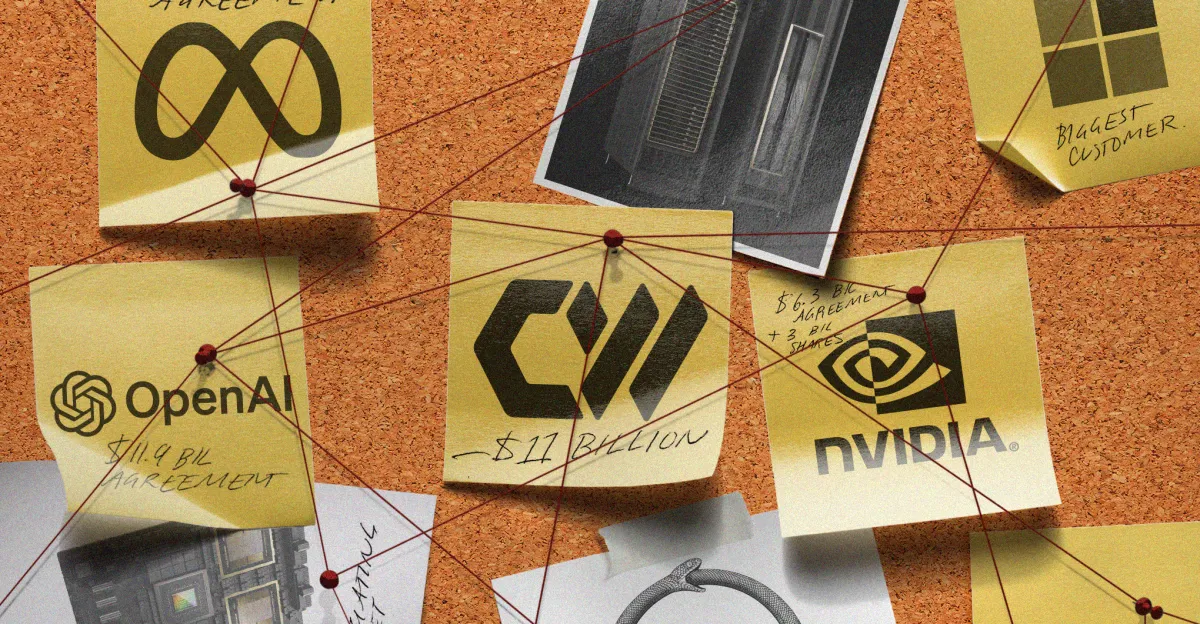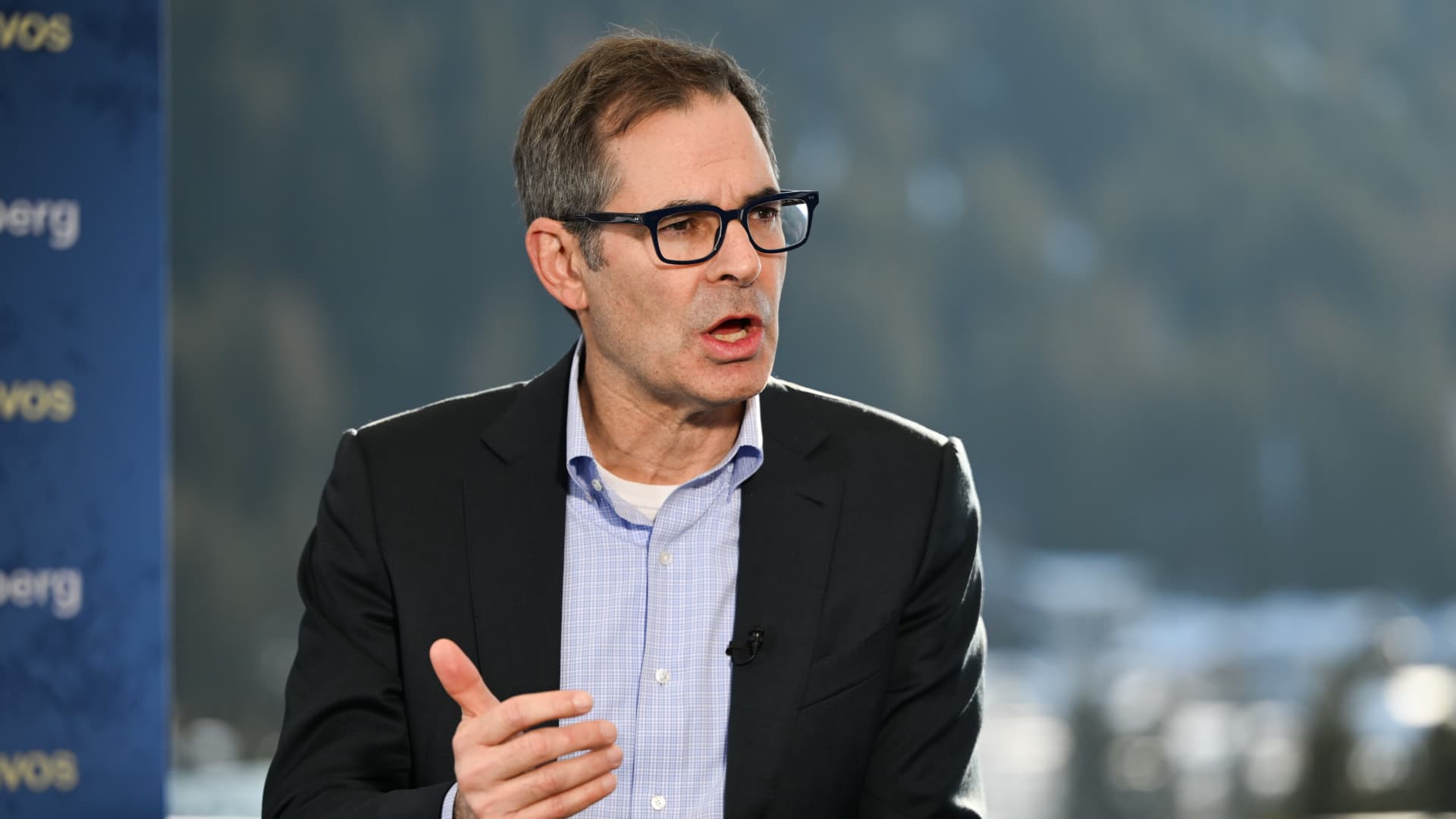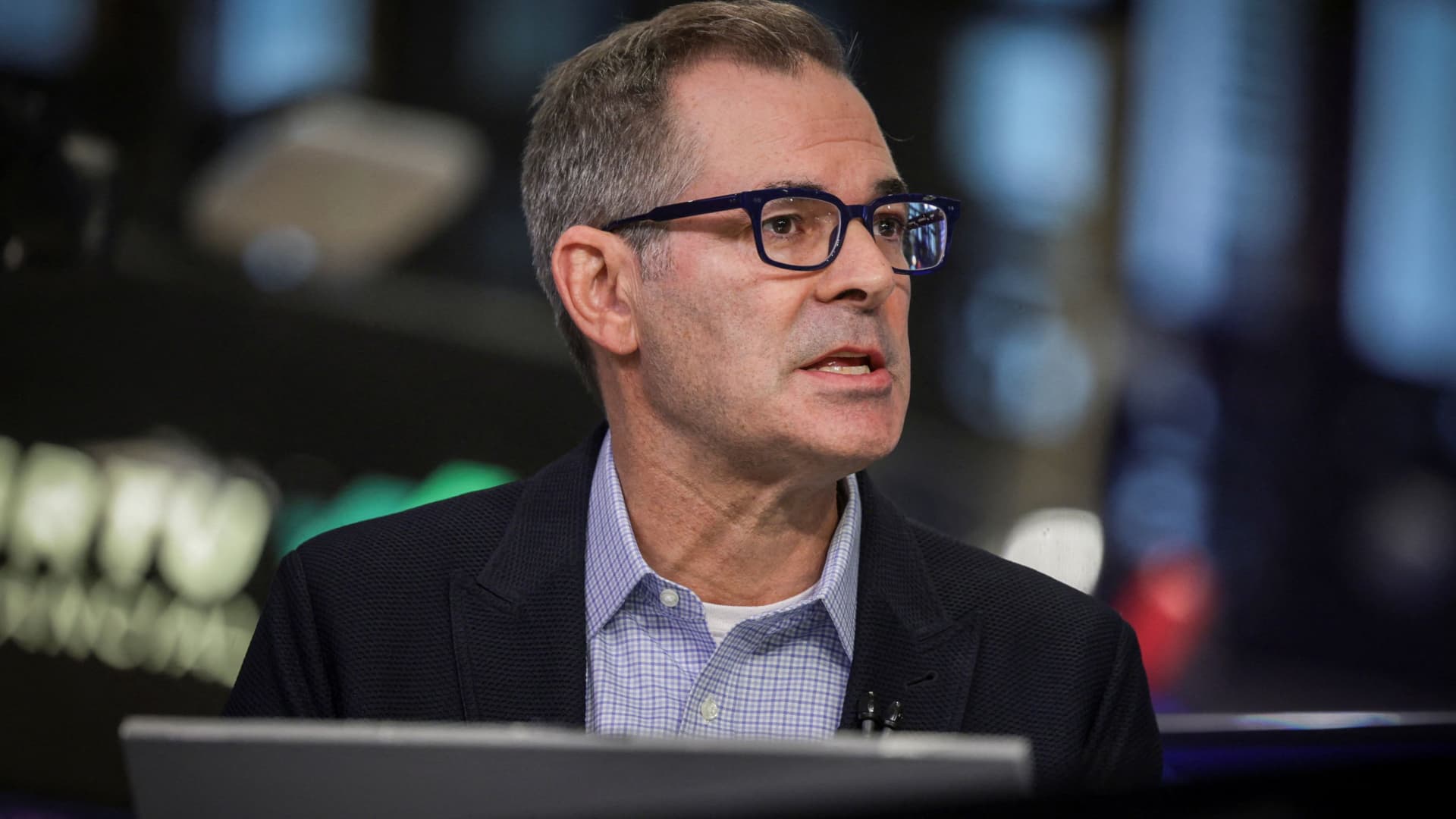
CoreWeave CEO Michael IntratorGuerin Blask for ForbesOver the last year, as its CEO Sam Altman preached a gospel of insatiable compute, OpenAI has created a web of deals that tie a meaningful chunk of Silicon Valley’s AI buildout to its own trajectory. Big names like Nvidia, Oracle and SoftBank have all inked infrastructure contracts with the ChatGPT maker, but there is one company perched further out on a limb than the rest: CoreWeave, an AI cloud company with a roughly $60 billion market cap.The Wall Street Journal reported Monday that OpenAI missed internal projections for revenue and user growth. It claimed OpenAI CFO Sarah Friar is worried the company may not be able to pay for future computing contracts. If that’s even directionally right, it will land hardest on CoreWeave—which counts OpenAI as one of its biggest customers and has borrowed more than $40 billion in mostly high-interest debt used to finance GPUs and data centers. CoreWeave’s view, at least publicly: it can ride out turbulence as long as demand for AI compute keeps outrunning supply."OpenAI is a terrific partner, but not our only one,” a CoreWeave spokesperson said, namechecking other big-name customers including Meta, Anthropic, Microsoft and Google. “As more companies build and deploy AI, demand for compute continues to grow. We continue to see demand exceed supply across the AI ecosystem.”Problem is: that “AI ecosystem” is not a broad-based consumer market so much as a coterie of spenders writing very large checks. Trillions of dollars’ worth of infrastructure commitments are concentrated in a few places: big tech balance sheets (Oracle, Meta, Microsoft and Nvidia) and a handful of newer entrants that buy AI capacity and then rent it out (like CoreWeave, Nebius and Nscale). CoreWeave’s model—buy GPUs, spin up data centers, lease the capacity to labs—turns that concentration into both opportunity and fragility.In 2025, Microsoft accounted for 67% of CoreWeave’s revenue; Meta and OpenAI are CoreWeave’s other key customers. And while OpenAI may not be the biggest revenue customer yet, it’s a huge part of the forward book: OpenAI represents an estimated third of CoreWeave’s existing contracted revenue over the next seven years, accounting for more than $22 billion in deals.“The problematic thing all comes down to one issue, which is, ‘who’s going to take residual risk on the technology?” DigitalBridge managing director Chris Moon told Forbes last fall.Have a tip? Contact Phoebe Liu at pliu@forbes.com or phoebe.789 on Signal or Rich Nieva at rnieva@forbes.com or RNieva.26 on Signal. Reporting that OpenAI, which is aiming to go public this year, missed an ambitious internal projection already sent CoreWeave’s stock down 6% on Tuesday. Nvidia, Oracle and others also dipped, erasing more than $100 billion in market value (though some has since rebounded).OpenAI dismissed the Wall Street Journal report for referencing outdated numbers, touting “breakout” growth for its generative coding product Codex and “a compute strategy built to accelerate.”The report comes as giant AI labs have collectively committed trillions toward AI infrastructure over the next several years. Google has earmarked up to $185 billion this year, more than double the $90 billion it spent in 2025. Meta said it plans to spend up to $135 billion. Project Stargate, an effort by OpenAI, SoftBank, Oracle and others to build $500 billion worth of AI infrastructure, has been a marquee tech initiative to kick off President Trump’s second term, though some progress on the effort has reportedly stalled, per The Information. The question hanging over all of this is simple: how much of today’s demand is durable demand, and how much is a land-grab that slows once the bills hit the income statement?The volatility that might drive AI markets if OpenAI were a public company is an even bigger question. If OpenAI struggles to pay cloud computing contracts on time or in full in the future, the most likely outcome is that the counterparties will renegotiate terms. After all, some revenue is better than none. Still, renegotiation isn’t painless: it could mean slower revenue growth, lower share prices and thus a harder time borrowing large amounts of lower-interest debt. CoreWeave’s future profitability also hinges not only on OpenAI, but on the broader AI industry’s continued exponential growth. In interviews with Forbes from 2025, CoreWeave executives and partners made similar comments—emphasizing non-OpenAI “investment grade” customers, the company’s plans to diversify its revenue and the ironclad guarantees baked into its contracts. The tension, of course, is that CoreWeave also appears to have deepened its exposure to OpenAI while talking about moving in the opposite direction.“We are getting this exposure against lots of different companies,” CoreWeave cofounder and chief development officer Brannin McBee told Forbes last August. “So if we have one failure somewhere, that’s a tolerable risk for us. If we have a handful of failures … that’s still tolerable for us. But if the question is existential, ‘is AI going to work?’, that’s our explicit risk that we’re underwriting.”One of CoreWeave’s biggest backers said last fall that lending the cloud company money wasn’t risky because CoreWeave’s contracts are fully backed by “cash flows coming from the highest quality companies in the world.” By that, he was referring to “investment grade” companies like Microsoft and Meta, which come with lower borrowing costs (something like 6% instead of 15%) in part because their risk of defaulting on the loan is so low, not OpenAI. We wanted to make “sure that the customers had no ability to walk away from those contracts unless they were like acts of God,” the lender said. OpenAI CEO Sam AltmanCody Pickens for ForbesCoreWeave and its biggest lenders—including Blackstone, Mitsubishi and Morgan Stanley—have taken steps to de-risk the company’s expensive GPU financing. But nothing is for sure in a nascent industry like AI. McBee previously told Forbes he’s not worried that large AI model makers are losing money because inference, or using (rather than training) AI is profitable. He expects that 85% or more of CoreWeave’s compute used for AI will be for inference in five years. If that shakes out to be true, OpenAI, Anthropic and other companies that have large shares of the inference market may be able to pay their large contracts after all. But it hasn’t happened yet—and OpenAI and Anthropic are still rapidly bleeding cash, and will for the foreseeable future.Three of CoreWeave’s billionaire cofounders—McBee, Michael Intrator and Brian Venturo—and its once-largest investor, Magnetar, have certainly hedged their personal risks. Collectively, they’ve cashed out more than $6 billion since CoreWeave’s 2025 IPO. Magnetar is responsible for $4.2 billion of the sales; the asset manager unloaded $650 million worth this month. Uncertainty around the future of AI infrastructure financing is also reflected in credit ratings. These are important because they affect CoreWeave’s and others’ ability to borrow and tell investors how high the risk of default is. Data center credit has deteriorated by 10-12% over the past six months, according to credit risk data platform Credit Benchmark. Currently, most debt for data centers sits at the highest junk debt rating. Generally, that means the debt is subject to substantial credit risk, but it’s the highest—or least risky—of the speculative credit ratings. Much of CoreWeave’s debt falls into this category, although its latest deal—$8.5 billion in debt financing, its biggest yet—is its first investment-grade loan.“No one really knows. It’s a conservative place to put things that are uncertain,” says Ryan Hoffman, product manager of analytics at Credit Benchmark. “I think we just live in a very uncertain time … I don’t think we could even forecast up to three months.”Rashi Shrivastava contributed reporting.More from Forbes:ForbesWhy Sam Altman Won’t Be On The Hook For OpenAI’s Massive Spending SpreeBy Rashi ShrivastavaForbesCoreWeave’s $29 Billion Bet That Its Debt-Fueled AI Boom Won’t Go BustBy Rashi ShrivastavaForbesThe OpenAI Graveyard: All The Deals And Products That Haven’t HappenedBy Phoebe Liu
OpenAI Is A Third Of CoreWeave’s Business. What If The AI Company Can't Pay Up?
OpenAI is one of the former crypto miner’s largest contracted customers. Here are the risks and how CoreWeave is thinking about them.
1,297 words~6 min read