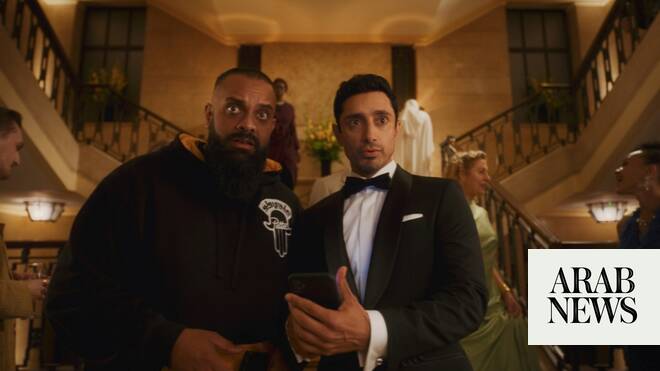
There’s a pivotal scene in the movie “ Hamlet” where its title character — played by the illustrious Riz Ahmed, cloaked in his signature wistful contemplation — drifts into his dead father’s bedroom in a grief-stricken daze. Just moments before that, he’d found out that his recently widowed mother, Gertrude (Sheeba Chaddha), is set to wed his deceitful uncle Claudius (Art Malik).
Another sort of wedding occurs. Hamlet finds his father’s ring on top of a nightstand and promptly slips it onto his own ring finger. The moment sets the stage for what the audience will witness over the course of an hour and a half: that Hamlet is lawfully, dutifully wedded to his grief and the psychological deterioration that surrounds it.
To put it plainly: Hamlet crashes the fuck out.
If there’s anything that the classically trained Ahmed knows how to do, it’s how to intentionally and powerfully crash out — to throw a fit of spiraling, distressed rage that permeates every pore in his audience’s body. He’s a masterclass in wholly surrendering himself to both the narrative and the craft, from the pity-fueled crash-out (see: “Bait”) to the psychological dissolution crash-out (think: “Night Of”).
His most gutting — and his best — emotional breakdown, I argue, is in “Hamlet.” The film adaptation, directed by Aneil Karia and released in U.S. theaters on April 10 for a limited run, trades Danish royalty from the Middle Ages for modern-day London’s South Asian elite, who are real estate tycoons with shady dealings. Like other adaptations, writer Michael Lesslie strung “Hamlet’s” script together directly from Shakespeare’s play; some characters were cut (farewell, Rosencrantz and Guildenstern), while dialogue was cherry-picked and consolidated for the film’s existing characters.