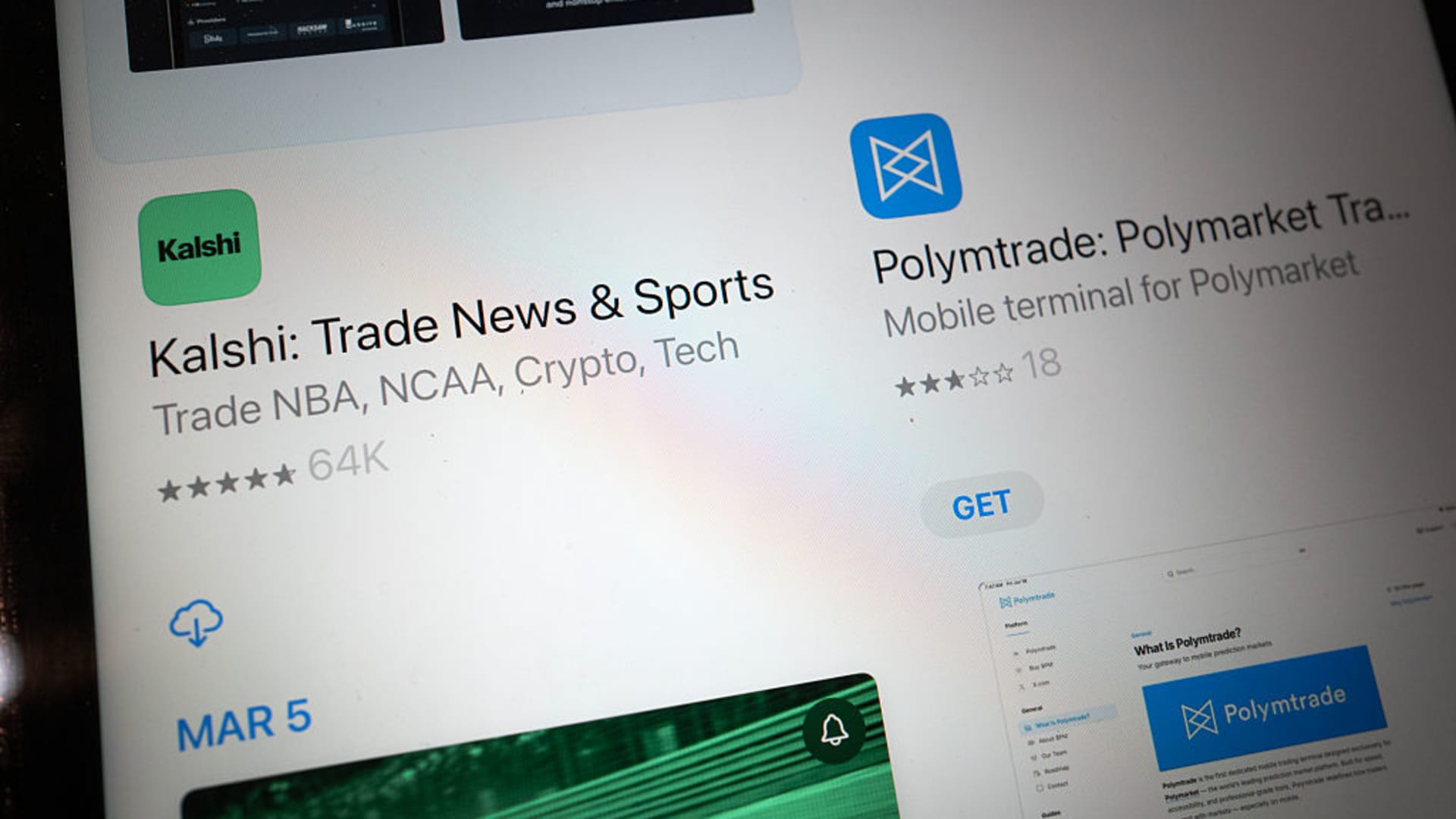
ToplineRobinhood and Coinbase will be the biggest public market winners of prediction markets, which users are expected to bet $1 trillion on annually by 2030, according to Cantor Fitzgerald and Bernstein reports published Tuesday. (Photo illustration by Cheng Xin/Getty Images)Getty ImagesKey FactsCantor and Bernstein analysts said Robinhood and Coinbase are the two public stocks that will benefit most from the growth of prediction markets, with Bernstein noting Robinhood’s advantage given its large retail customer base and user-friendly app. Bernstein estimates prediction market volume is on pace to quadruple to $240 billion this year from $51 billion in 2025 and reach $1 trillion in annual volume by 2030. Volume on Kalshi and Polymarket, the two largest prediction markets, this year is already around $60 billion, largely driven by major sporting events including the SuperBowl, March Madness and Masters tournament. Robinhood and Coinbase began offering Kalshi's prediction markets to their users in March 2025 and this January, respectively (Polymarket received regulatory approval to operate in the U.S. in late 2025, and its U.S. app is not fully available to the public yet). Robinhood stock was up as much as 10%, and Coinbase up as much as 6% following the reports. Key Background Prediction markets first gained mainstream traction during the 2024 U.S. presidential election, when users bet more than $4 billion across Kalshi and Polymarket on a presidential candidate. The markets, which allow users to bet “yes” or “no” on the outcome of a future event, rode momentum from the election into cultural relevance, with markets on topics ranging from next year’s Oscar nominees to the SuperBowl winner. Kalshi and Polymarket have become two of the fastest-growing startups, with billion dollar investments valuing the companies at $11 billion and $9 billion, respectively. Both companies are reportedly raising fresh rounds at roughly $20 billion valuations, according to The Wall Street Journal. The massive growth of prediction markets has brought institutional involvement from firms including billionaire Jeff Yass’ hedge fund Susquehanna International Group and New York Stock Exchange owner Intercontinental Exchange, which invested $1 billion into Polymarket last October. Within the last year, trading apps including Robinhood, Coinbase, Gemini and Crypto.com, as well as sports betting sites FanDuel and DraftKings, began offering prediction markets to capture customers and keep up with competition. “[Prediction markets] have become a feature that you need if you are in the exchange business,” Mizuho Securities analyst Dan Dolev told Forbes. Crucial Quote"We're at the beginning of a prediction markets supercycle that could drive trillions in annual volume over time," said Robinhood CEO Vlad Tenev during Robinhood’s February earnings call. Forbes ValuationThanks to the prediction market boom, the young cofounders of Kalshi and Polymarket broke back-to-back records. Last October, 27-year-old Polymarket founder Shayne Coplan became the youngest self-made billionaire in the world after a $2 billion investment from Intercontinental Exchange valued his stake in the company at around $1 billion (his title was taken just 20 days later by the three 22-year-old founders of AI startup Mercor). Just two months later, Kalshi cofounders Tarek Mansour and Luana Lopes Lara, both 29, became billionaires after raising $1 billion in capital. The round valued each of their 12% stakes in the company at $1.3 billion, making Lopes Lara the world’s youngest self-made woman billionaire. TangentBernstein analyst Gautam Chhugani said in Tuesday’s report that despite state litigation against prediction markets, regulatory favor from federal agencies will benefit Kalshi and Polymarket, as well as public companies including Robinhood and Coinbase. Sports has been an area of legal contention for prediction markets, with their classification as a federally regulated financial market allowing them to bypass the state regulation and steep taxes sportsbooks and other gambling businesses must pay. States have filed at least 20 lawsuits against Kalshi, arguing that its sports markets should be classified as gambling and regulated by states: So far, Kalshi has won injunctions in New Jersey and Tennessee but lost in Maryland, Ohio, Nevada and Massachusetts. On April 2, the Trump administration sued Connecticut, Arizona and Illinois, arguing that the federal government has exclusive authority over regulating these markets. Around 80% of Kalshi’s trading volume comes from sporting events, while more than 40% of Polymarket’s trading volume is on sports. The president’s son, Donald Trump Jr., is an advisor to both Kalshi and Polymarket, as well as an investor in Polymarket.
Robinhood And Coinbase Stocks Surge As Prediction Markets Could Grow To $1 Trillion
Robinhood and Coinbase will be winners in the prediction market boom, analysts say.
720 words~3 min read