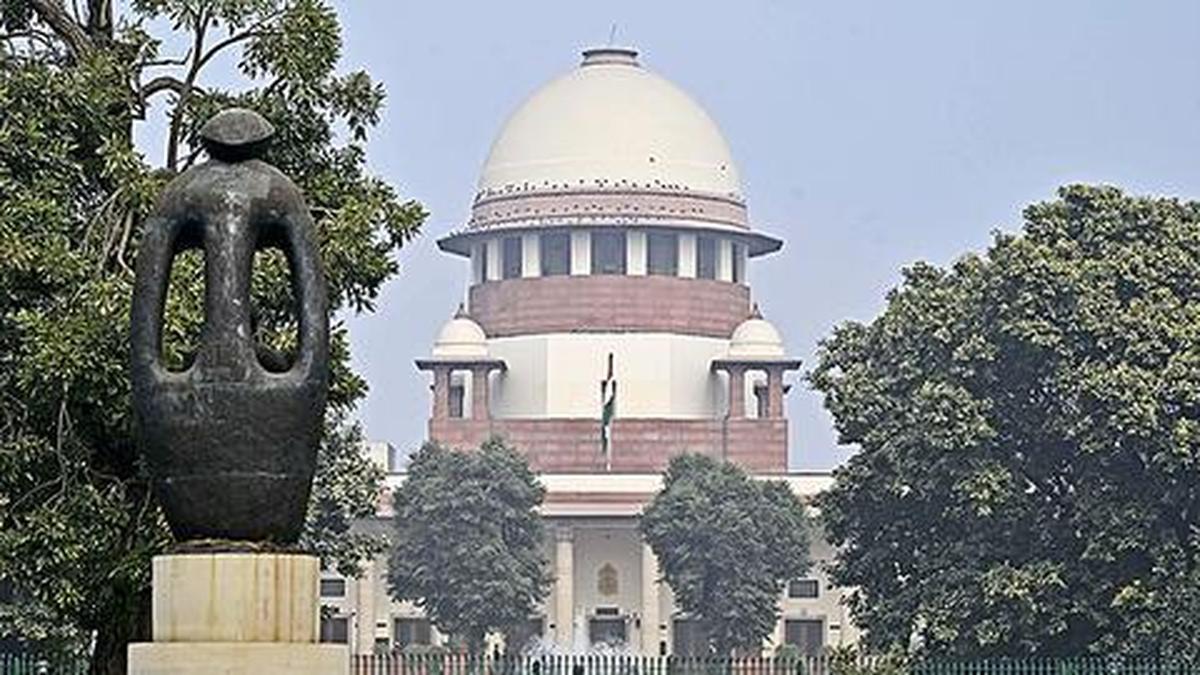
“On the issue of a uniform policy for all farmers, there are some who own huge chunks of land,” Chief Justice of India Surya Kant pointed out a problem.
| Photo Credit: The Hindu
The Supreme Court on Monday (April 13, 2026) decided to examine a petition saying the government should pay farmers at least the weighted average cost of production of various crops through the declaration of a proper minimum support price (MSP), and procurement at that rate.“On the issue of a uniform policy for all farmers, there are some who own huge chunks of land,” Chief Justice of India Surya Kant pointed out a problem.“Indian farmers are facing a terrible financial crisis as they are unable to sell their produce even at their actual cost of production. This has led to large-scale suicides of farmers; 17,000 have taken their own lives in Maharashtra alone in the last five years,” advocates Prashant Bhushan, Cheryl d’Souza, and Shiyas K.R. submitted.The court issued notice to the Centre on the petition which argued that the government and its institutions calculate the cost of production of different agricultural products on a State by State basis. This cost is calculated by factoring in the actual input cost (A2), the notional cost of family labour used to produce the crop (FL), the rental value of owned land and rent paid for leased land, and the interest incurred on the working capital.“This cost is aggregated to compute the total cost of the farmer, which is called C2,” Mr. Bhushan submitted.The M.S. Swaminathan Commission Report in 2006 had recommended that the farmers should be paid their cost in addition to 50% profit in order to make farming viable in the country, Mr. Bhushan said. This recommendation of the Swaminathan Commission had never been questioned by the government.“However, the MSP being fixed by the government year after year and crop by crop is considerably less than the weighted average cost of production, i.e., C2, for the country. It is less than the average cost of production for almost all States and certainly less than the weighted average cost… This has led to acute distress amongst farmers in the country leading to a violation of their Article 21 rights guaranteed under the Constitution,” the petition said.Adding to the already acute distress was the newly concluded trade deal between India and the U.S., by which most agricultural products were allowed to be imported into India virtually free of any import duty, the petition said.“The U.S. farmers are heavily subsidised by the government, and therefore, it is largely not possible for the Indian farmers to compete with the U.S. farmers on the cost at which U.S. agricultural products can be imported into India free of any import duty,” the petition submitted.The petition further noted that the government virtually held the monopoly for the purchase of wheat and rice, which it distributes under the Food Security Act at highly subsidised prices, virtually free of cost, to the people.The petition said although this was a laudable objective, it had also led to the “destruction of an agricultural market for these crops, as a result of which, if these crops are not procured by the government at least [at] the cost of production, the farmers will be unable to sell them in this distorted market”.“The provision of free wheat and rice under the Food Security Act, to roughly two-third of the population, has also resulted in artificially depressing the demand for other competing food crops/ particularly millets, etc.,” the petition said. Published - April 13, 2026 12:57 pm IST