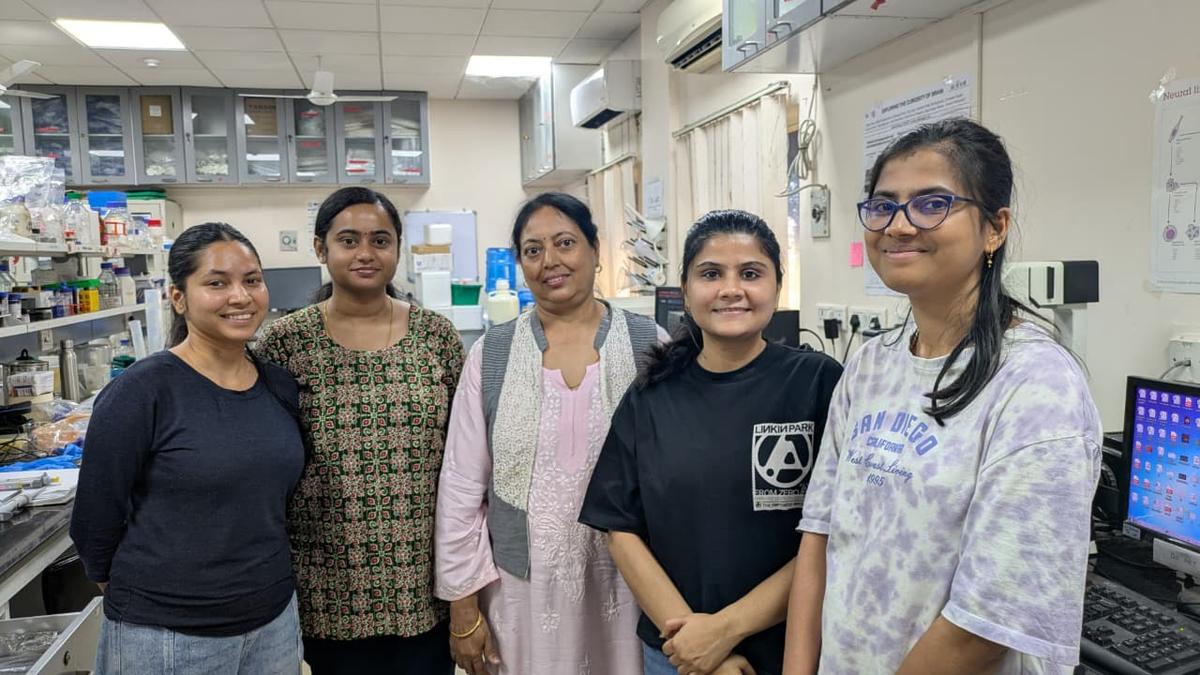
CSIR-IICT former scientist Sumana Chakravarthy with her research team. Photo: Special Arrangement
Research teams led by women scientists at Hyderabad-based CSIR–Indian Institute of Chemical Technology (IICT) are driving major advances across disciplines—from uncovering the neurobiology of depression in women to developing sustainable biofuels from agricultural waste—underscoring their vital role in cutting-edge indigenous scientific research.Among these breakthroughs, the development of a novel experimental model to study how chronic stress affects the female brain marks a particularly significant advance.Despite depression affecting women nearly twice as often as men worldwide, most preclinical researches have historically relied on male animal models, leaving female-specific biological mechanisms poorly understood, pointed out retired senior principal scientist Sumana Chakravarty.To address this long-standing gender gap in neuroscience, she and her team collaborated with scientists from the CSIR–Centre for Cellular and Molecular Biology (CCMB) to successfully develop a female-specific Chronic Social Defeat Stress (femCSDS) model.Unlike earlier models that relied on artificial or invasive manipulations, the team drew on naturally occurring postpartum aggression in female mice. This innovation enabled a biologically relevant and reproducible simulation of real-world psychosocial stress.Using the femCSDS model, the researchers demonstrated that chronically stressed female mice exhibit hallmark features of depression, including social withdrawal, heightened anxiety, and behavioural despair. Detailed biochemical analyses further revealed disruptions in glutamate signalling and synaptic protein expression in key brain regions, indicating altered neural communication and plasticity.The study also highlights the crucial role of astrocytes or the brain’s support cells in mediating stress responses. Altered expression of the glutamate transporter ‘EAAT1’ points to impaired glutamate clearance at synapses, potentially resulting in disrupted neuron communication — mechanisms increasingly implicated in depression, she said.“For decades, preclinical research has largely depended on male models. Our work provides a much-needed framework to study depression in females in a biologically meaningful way, which is essential for developing more effective and equitable treatments,” said Sumana Chakravarty. Her research team included Shashikant Patel, Roli Kushwaha, and former CCMB scientist Dr. Arvind Kumar, among others.Also read: Bridging the gender gap in health researchBuilding on this foundation, the scientists are now spearheading a follow-up study to examine how chronic stress alters female brain at the molecular level. The work is being carried out in collaboration with CSIR-CCMB’s Mohammed Idris along with Anusha P.V. and Anushka Arvind as key members of the research team.The study focuses on the nucleus accumbens, a central component of the brain’s reward circuitry. Using advanced quantitative proteomics or study of protiens, the researchers generated a detailed molecular profile of stress-induced changes.Pathway-level analyses revealed dysregulation of synaptic signalling networks, including proteins involved in vesicle trafficking, neurotransmitter release and postsynaptic receptor function. The researchers also observed marked changes in proteins associated with mitochondrial function and cellular energy metabolism, pointing to impaired bioenergetic balance.The findings suggest that chronic stress may lead to system-wide dysfunction in the female brain’s reward circuitry, potentially contributing to symptoms such as anhedonia – inability to experience pleasure, reduced interest in hobbies, social interaction, loss of motivation and reduced engagement in previously rewarding activities. By mapping molecular changes across multiple levels, the researchers said the study could help identify potential sex-specific therapeutic targets. Published - April 11, 2026 11:03 am IST