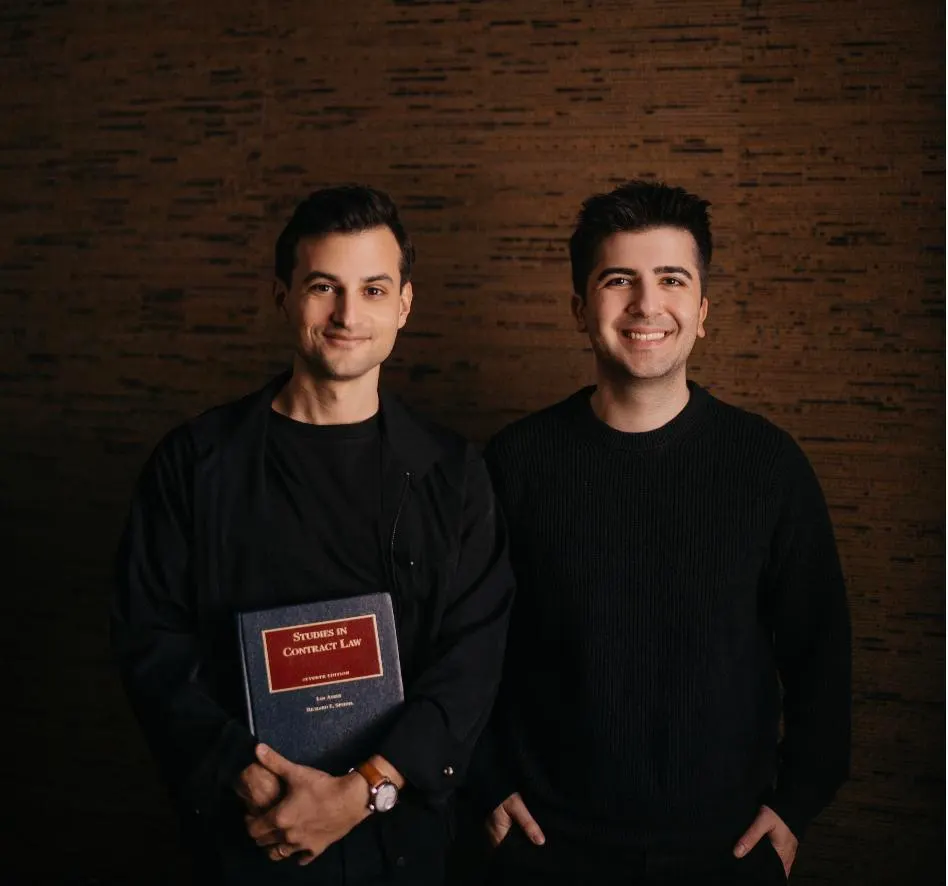
Ryan Daniels (left) and John Sarihan (right) cofounded AI law firm Crosby in September 2024. Today about 100 companies are clients using it AI to review contracts and get deals done faster.CrosbyRoss Weiser isn’t like most lawyers. Rather than spending hours digging through documents and responding to client emails, on a typical day he oversees a swarm of AI agents. After they’ve combed through contracts and marked them up with comments and suggestions, he’ll review the agents’ work, addressing legal nuances they missed and making sure they haven’t made anything up. Then Weiser works with a team of AI researchers, suggesting tweaks to prompts and explaining why one AI-generated answer is better than another from a legal standpoint. Six months ago, Weiser joined Crosby, an entirely new type of law firm where a suite of AI agents and 30 lawyers collaborate to speed up reviews for commercial contracts like services agreements, data processing agreements and NDAs. The gig is wildly different from Weiser’s previous job as an associate at storied law firm Sullivan & Cromwell. While the firm rolled out ChatGPT to help with legal work, he found the chatbot unhelpful for complex tasks and frustrating to work with. “It felt like with some more prompting, maybe I could get it to give me what I want, but I didn't have the time for that because you’ve got to bill your hours and you've got deadlines,” he tells Forbes. Now there’s no need to bill hours at all. Instead, Crosby charges by the contract, which its AI agents can review in a matter of hours instead of days or weeks, with a human lawyer to do a final check. The idea is to align the firm's financial incentives with those of its clients: closing deals faster. “This is I think the most dramatic change for lawyers in a hundred years,” says CEO Ryan Daniels, a former lawyer who worked as in-house counsel for over a decade at multiple AI startups. He cofounded Crosby in September 2024 with ex-Ramp engineering manager John Sarihan. The nascent law firm is already servicing about 100 clients, including buzzy AI startups like Cursor, Clay and Cognition as well as massive companies like real estate firm Tishman Speyer ($64.4 billion in assets under management). Its agents have reviewed 13,000 contracts to date and revenue has grown about 400% since October. On Monday, the startup announced that it raised $60 million in Series B funding co-led by top-tier VC firms Index Ventures and Lux Capital with participation from Sequoia Capital, Bain Capital Ventures and solo venture capitalist Elad Gil. The startup, which moved into its headquarters on Crosby Street in Manhattan’s SoHo neighborhood a month ago (the name is a coincidence), is now valued at $400 million, according to a person familiar with the deal. At its core, Crosby is upending the way traditional law firms work. Under the current hourly billing model, lawyers tediously track their work in six-minute increments and send multiple invoices for each contract — a set-up Daniels calls “taxing.” Instead, Crosby charges anywhere from $250 to $1,000 per contract, roughly based on the number of pages, about $10 to $50 per page. (Traditional law firms price basic contract reviews similarly but can charge up to $3,000 for complex ones, according to legal insights site Mondaq.) It also bills its customers only once regardless of the number of times a contract is reviewed. Daniels calls Crosby a “neofirm” — a services business built for the AI era from the ground up. “This is I think the most dramatic change for lawyers in a hundred years.”
Buzzy Startups Like Cursor Are Using This AI Law Firm To Close Deals Faster
New York-based startup Crosby’s AI agents and lawyers work together to review contracts quickly, billed by the page, for the likes of Cursor and Runway. CEO Ryan Daniels calls it a “neofirm.”
1,679 words~8 min read