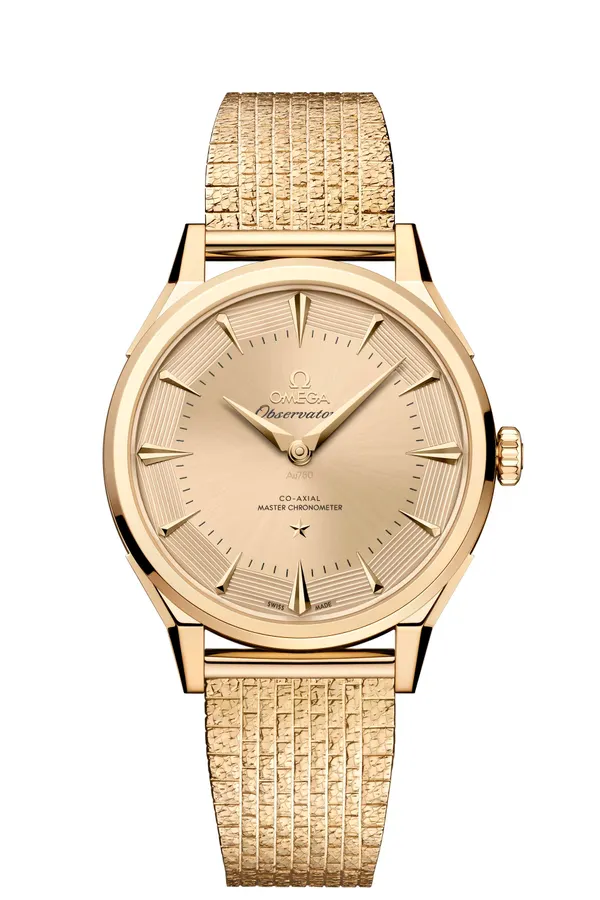
The Omega Constellation Master Chronometer with 18K Moonshine Gold mesh braceletOmegaOmega, says it has solved a longstanding limitation in watch certification, unveiling a Constellation model that becomes the first two-hand watch to earn Master Chronometer status by replacing traditional visual timing with acoustic measurement.The Constellation Observatory models unveiled this week by the Swiss watch brand mark a shift in how precision can be measured in mechanical watches. Traditionally, certification protocols required a seconds hand to track rate performance visually. Omega’s new approach replaces that requirement with an acoustic system that records the sound of the movement in operation.Developed by the brand’s Laboratoire de Précision and validated by METAS, the method is designed to continuously capture each tick of the escapement while monitoring environmental variables such as temperature, position and air pressure over a 25-day testing period. In contrast to conventional chronometer testing such as the industry standard, COSC—where timing is derived from periodic visual readings of a seconds hand—the acoustic system generates a continuous stream of data, allowing for more detailed analysis of rate variation and performance under different conditions.The caseback of the Omega Constellation Master Chronometer with observatory medallionOmegaMORE FOR YOUThe result is that watches displaying only hours and minutes can now meet the criteria for both chronometer and master chronometer certification, a category previously limited to timepieces with a central seconds display.While the development addresses a longstanding limitation in certification, it represents a shift in measurement rather than a fundamental change in watchmaking mechanics. The new Constellation models are powered by two new calibers, 8914 and 8915, which build on Omega’s existing Co-Axial Master Chronometer architecture. The new calibers are built on a skeletonized rotor base with polished or shined bevels, rounded outer zone on the rotor and an applied Constellation Observatory medallion. They are presented in three categories: Grand Luxe, Luxe, and Standard.The Laboratoire de Précision, announced two years ago, operates as an accredited testing facility for chronometer certification and is certified by METAS for Master Chronometer evaluation. Omega positions the lab as an independent entity, though its broader role within the industry remains to be established.The Constellation Observatory collection comprises nine references in 39.4 mm cases, spanning stainless steel and the brand’s proprietary gold alloys, including Sedna, Moonshine and Canopus. Design elements draw heavily on the Constellation line’s mid-20th-century origins, including the signature pie-pan dial with the Constellation Star on the dial at 6 o’clock and observatory medallion caseback. Other signature design details include the guilloché finish on the facets of the pie-pan, which first appeared in 1953. The hour markers, originally faceted kite-form indexes and the original dauphine hands, have been reinterpreted. Then there’s the dog-leg lugs that distinguished Omega models of the era and a nine-row brick pattern on an 18K Moonshine Gold mesh bracelet, inspired by brick bracelets of the same period.With this release, Omega effectively expands the scope of its Master Chronometer designation, applying it to a segment of watches that had previously been excluded due to testing constraints.Whether the acoustic method developed by Omega gains wider adoption across the industry remains to be seen, but it underscores a growing focus on metrology as a point of differentiation in high-end watch certification.
Omega Has Officially Certified A 2-Hand Watch As A Master Chronometer
An acoustic measurement system allows the Constellation Observatory models to meet METAS standards without a seconds hand
530 words~2 min read