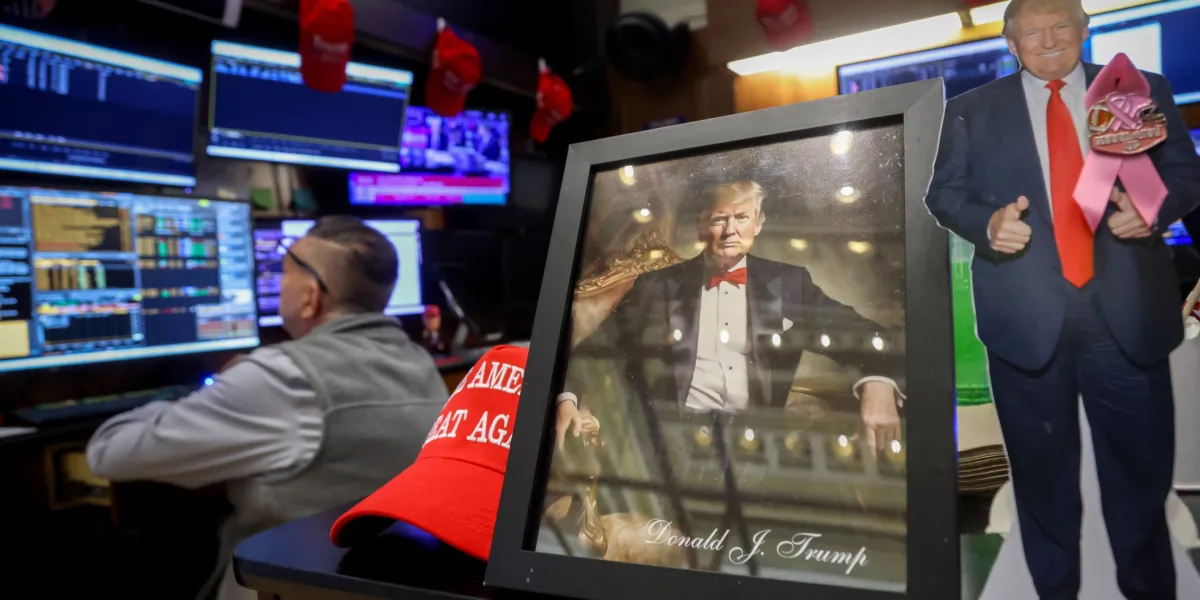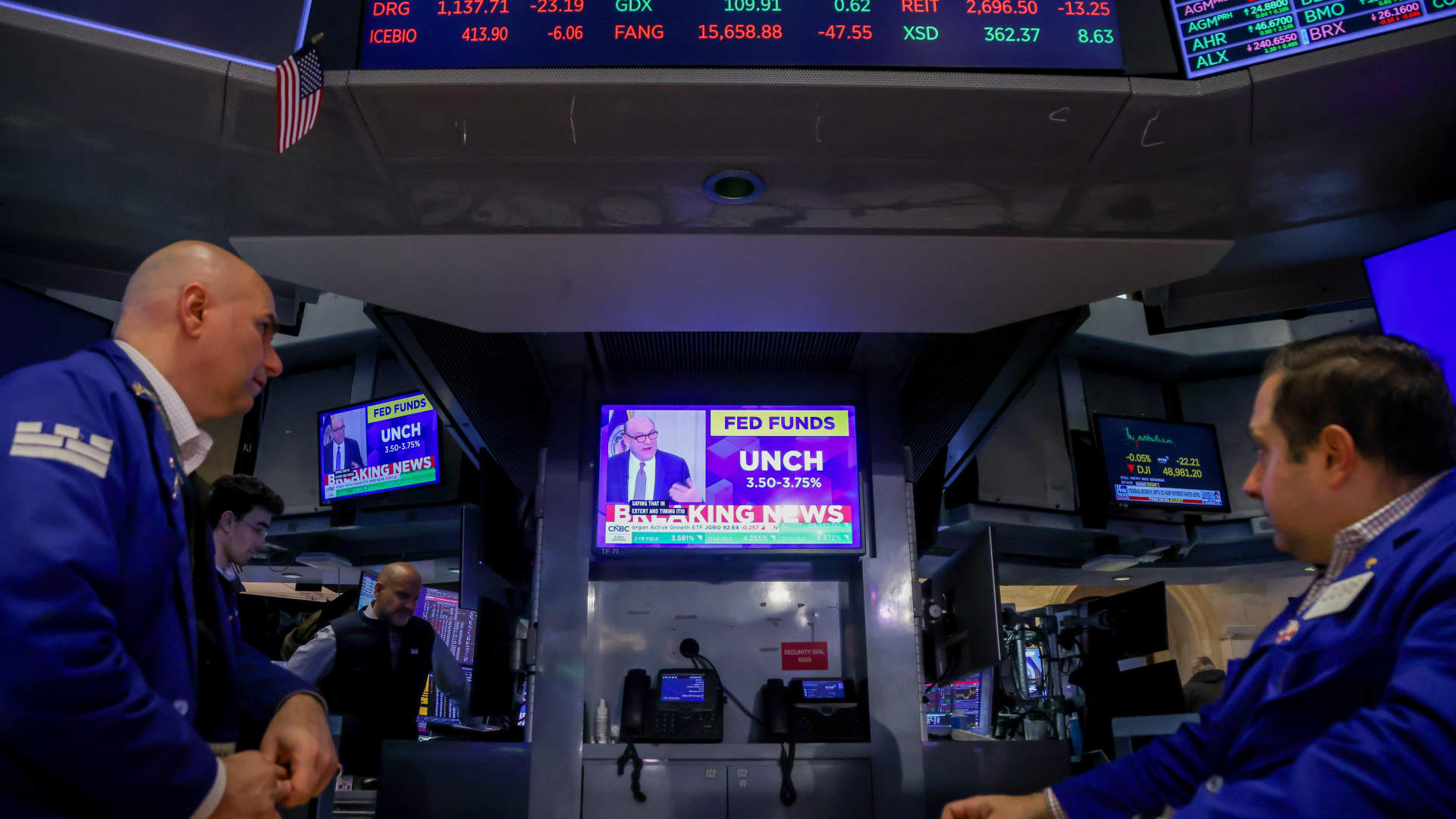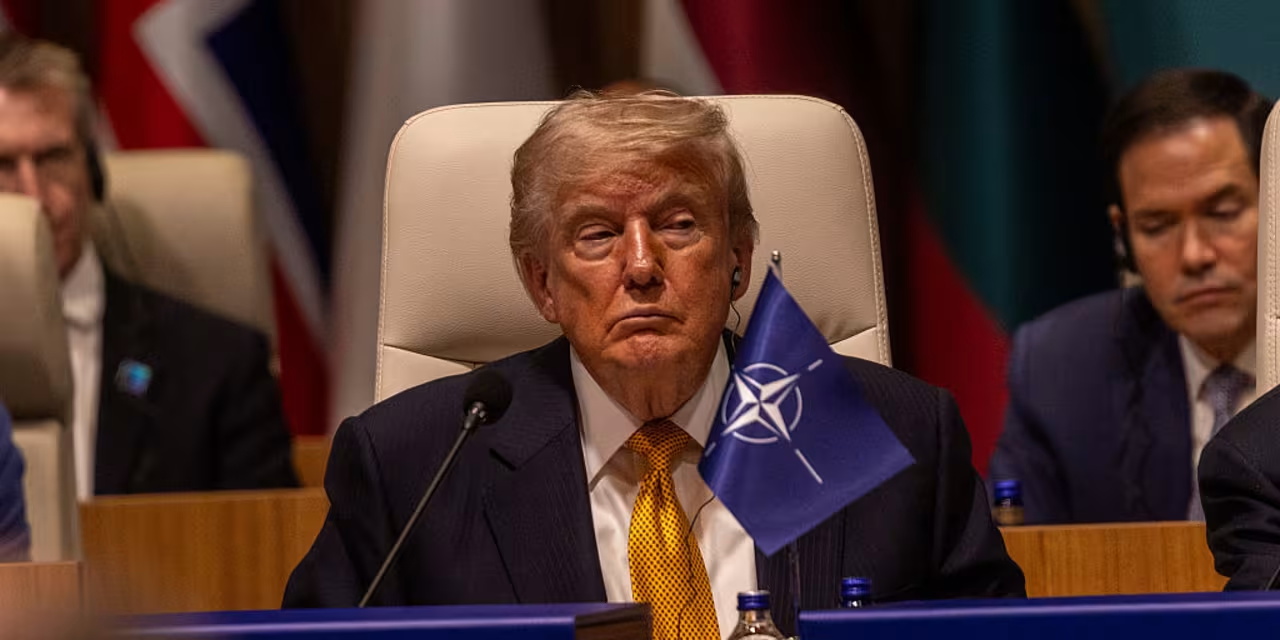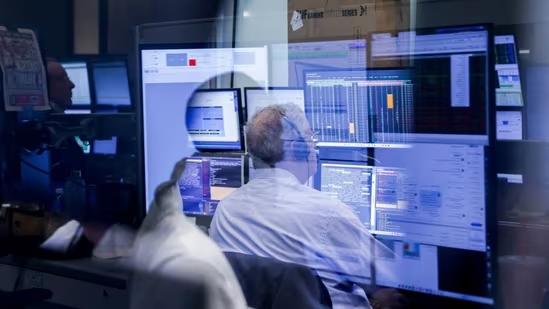
While some sectors of the broader economy seem to be slowing down as the war in Iran continues, the stock market and oil prices are ping-ponging up and down—mostly based on remarks or social media posts from President Donald Trump and his top advisors. After a week of falling fortunes on Wall Street, the stock market quickly regained momentum Monday following an early morning Truth Social post in which Trump touted “productive conversations” with Iran about an end to U.S. hostilities. In the post, Trump said he was postponing military strikes against Iranian energy infrastructure for five days. When markets opened for the week hours later, the Nasdaq, Dow Jones Industrial Average and S&P 500 all gained more than a point. And Brent crude oil prices dropped from $108.26 to $93.85 following his post. Have these “productive conversations” actually happened? It’s unclear—Iran’s foreign ministry denied having talks with the U.S., claiming that Trump’s remarks were an effort to reduce energy prices and buy time. Considering that the desired outcome of the war is still in question, it could be the case. And while this kind of short-term spike may be a boon for investors and traders, an actual and lasting change in the status quo is what businesses need to move forward with more clarity.Businesses need to play the long game in order to succeed, and part of that is building and bolstering their reputations. Public relations firm Burson took a close look at how reputations are built, how they pay off in terms of business, and they quantified just how much reputation matters. I talked to CEO Corey duBrowa about how reputation helps your bottom line and how it can be improved. An excerpt from our conversation is later in this newsletter.I will be taking a break next week, and Forbes CEO will not send on Monday, March 30. We’ll be back in your inboxes on Monday, April 6.This is the published version of Forbes’ CEO newsletter, which offers the latest news for today’s and tomorrow’s business leaders and decision makers. Click here to get it delivered to your inbox every week.ECONOMIC INDICATORSgettyAs we enter the fourth week of war in Iran, economists are warning of a potential recession if the trend of broadly falling markets and rising consumer gas prices continue, with Moody’s issuing 49% odds that the economy will hit that breaking point in the next 12 months. The markets spent last week on a pretty steady decline, with the Dow Jones Industrial Average, Nasdaq and S&P 500 hitting 2026 lows late last week, and nearing correction territory on Friday. Gas prices continued to rise as well. On Monday, AAA pegged the national average price at nearly $3.96 a gallon—more than $1 more than a year ago. And while that’s high, diesel prices have risen much more, hitting nearly $5.29 a gallon. Because diesel fuel powers trucks that haul goods across the country, analysts say that the trickle-down effect will hit consumers soon. Food prices may see one of the biggest spikes, considering most food is moved by truck, and diesel also powers the equipment used to prepare and cultivate farmland.Not surprisingly, the Federal Reserve Open Market Committee opted last week to hold interest rates steady, mentioning in a statement that “implications of developments in the Middle East for the U.S. economy are uncertain.” Forbes senior contributor Simon Moore writes the Fed is likely to continue to take a more careful look at the economic picture this year when looking at interest rates. After all, the Iran war and energy prices is just one big economic question mark. Another is tariffs. After last week’s meeting, Powell said that tariff inflation—consumer price increases due to new import taxes—tends to take between eight months and a year to impact consumers. And even though President Donald Trump’s initial slate of tariffs have been invalidated by the Supreme Court, their impact may not have fully run its course.Meanwhile, the National Retail Federation predicted last week that 2026 would see retail growth of 4.4%. Forbes senior contributor Pamela Danziger writes in light of the current geopolitical and economic climate, that projection seems overly optimistic. The forecast says higher income households will bring a majority of the growth, but Danziger writes higher energy costs, shipping and commodity sourcing difficulties caused by the war, and falling consumer confidence—including more financial risk for those in higher income brackets—are all likely to challenge retail growth. FROM THE HEADLINESDisney CEO Josh D'Amaro at "The Future of World-Building at Disney" during SXSW earlier this month.Adam Kissick/SXSW Conference & Festivals via Getty ImagesThe Mouse House has a new leader. Josh D’Amaro officially became CEO of Disney last week, succeeding longtime leader Bob Iger. Bringing new leadership into any large company is always a significant moment, but considering that Disney has only had three CEOs in the last four decades—and one was Iger’s previous short-term successor Bob Chapek—new blood at the Mouse House is seismic. All together, Iger was Disney’s CEO for about 19 years—from 2005 to 2020, then a brief retirement before returning again in 2022. Iger leaves behind a long legacy of growth through acquisitions, technology, entertainment and branded experiences. Forbes senior contributor David Bloom goes through some of the highlights of Iger’s bifurcated tenure, including the acquisitions of Pixar, Marvel and the Star Wars franchise through LucasFilm; getting into streaming with Disney+ and building on the market through ESPN and Hulu; as well as large expansions to Disney parks, cruise ships and resorts worldwide—plus a licensed park in Abu Dhabi (which Forbes senior contributor Caroline Reid writes is still moving ahead, despite the nearby war in Iran). Iger also moved Disney into video games, purchasing a majority stake in Epic Games, and into generative AI through a character licensing deal with OpenAI’s Sora video generator.D’Amaro, a 28-year company veteran and the former head of Disney Experiences—which manages the company’s theme parks, hotels, cruise line, and Imagineering and consumer products divisions—was tapped as Iger’s successor in February, following a search that took more than a year. On his first day as CEO on Wednesday, D’Amaro outlined priorities that Variety reported seem very similar to Iger’s. The new CEO told employees in a memo “creative excellence will remain our North Star,” while embracing technology and innovation to build new experiences. At Wednesday’s shareholders meeting, D’Amaro said he wants to speed up the process by which Disney’s franchises move between film, television, digital, consumer product and real-world experiences, the Wall Street Journal wrote. And he said he wants to more tightly bring all of Disney together, bringing “a more connected, personalized and immersive experience to our consumers—wherever they are and whenever they would like to engage with us.”D’Amaro is already dealing with his first big controversy: The abrupt cancellation of the new season of ABC’s The Bachelorette following last minute revelations that appeared to show the star of the season’s reality TV series physically attacking an ex-boyfriend in front of her child. The decision could cost the company more than $60 million, Forbes’ Conor Murray found.ARTIFICIAL INTELLIGENCEJeff Bezos at the New York Times annual DealBook summit in December 2024.Michael M. Santiago/Getty ImagesAmazon founder Jeff Bezos is reportedly in talks to raise $100 billion for a fund that will buy up manufacturing companies that have been disrupted by AI. This fund is likely to be connected to the physical AI startup Bezos announced last November, Project Prometheus. Not much is known about the fund or Project Prometheus. The Wall Street Journal reports that investor documents describe the fund as a “manufacturing transformation vehicle.” Project Prometheus has been secretive from the beginning, with Bezos as co-CEO alongside former Google X director Vik Bajaj, and its LinkedIn page describing it only as “AI for the physical economy.”Physical AI—using sensors and robotics to monitor, maintain, optimize and streamline manufacturing, warehousing and hands-on utility work—could reshape many industries. A Manufacturing Leadership Council study from early 2025 found that just 9% of manufacturers were using physical AI—but close to a quarter had plans for its implementation within two years.TOMORROW’S TRENDSThe Dollars And Cents Of ReputationBurson CEO Corey duBrowa.BursonReputation has always been anecdotally important, but public relations firm Burson recently gave it a financial value, breaking down different “levers” that control the way a company is viewed: citizenship, creativity, governance, leadership, innovation, performance, products and workplace. The firm studied 66 companies, the way they are perceived through both owned media and social media, as well as their financial performance. The resulting report, which explains the methodology and offers suggestions, does not mention—or rank—companies that were studied.I talked to Burson CEO Corey duBrowa about the quantifiable reasons that reputation matters, and how companies can work to improve theirs. This interview has been edited for length, clarity and continuity.Tell me about Reputation Capital.DuBrowa: Corporate reputation has a quantifiable value. The 66 companies in our study with strong reputations realized as much as 4.78% in unexpected additional annual shareholder returns—above and beyond what could be expected strictly based on standard financial performance metrics. When you peel that apart, you still have some value that’s been created that’s harder to explain. When we looked at that and then extrapolated it across the world’s public markets, we came to the creation of a global reputation economy worth more than $7 trillion. The reason this matters so much now, even compared to previous eras, is the myriad forces that are colliding and creating acute stress on business leaders. You think about the economy being either slower growth or more fragmented, you think about climate stress, you think about regulatory expansion, the impact of AI, and the specter of geopolitical conflict happening right in front of you, you get the ability to navigate the disruption and the opportunity to predict where forces will have an impact on a company or brand’s reputation. That’s really what enables businesses to succeed: To be able to do both things, protect and build reputation in the same measure. The lesson of this study is that CEOs, in my experience, spend an enormous amount of time firefighting reputation crisis moments. But the long-term key to reputation is essentially the work executives do when nobody’s paying any attention, that brick-by-brick-by-brick building proactively on a consistent basis, of what reputation is comprised of, and creating meaningful connections to audiences. Through creative problem solving, this data gives you a sense of the key to the lock of understanding how reputation creates value for companies. Trust gets you into the C-suite. It gets you into an audience with your board. But reputation is what actually keeps you there. That, to me, is the starting point for the conversation. Tell me how companies are doing in terms of reputation building, and where they can improve.In general terms, there are three buckets that companies fall into. Twenty percent are cultivating reputation, 60% are in stagnation mode, and another 20% are eroding reputation. For the 20% that are in cultivation mode, they’re the intentional builders of a strategy to maximize reputation. Whereas you look at 60% of companies essentially in stagnation mode or treading water. While they may be taking positive steps, they’re missing the opportunity to do so much more.And 20% of these are in active deterioration, or shedding-value mode. Think of companies that in any given year, whether it was the way that they responded to a crisis, or their industry or sector was in complete transformation, and they missed the opportunity to take advantage of that. Moving from stagnation to cultivation seems like the single biggest untapped value creation opportunity. Having these tools gives companies a chance to know much more about how to build their reputation capital. They may excel at manufacturing or marketing, they may have an exceptional leadership team, but they’ve lacked up until now a data-driven understanding of how to manage this asset like any other hard asset that sits on their balance sheet. If a company thinks they’re in that stagnating area, what should they do to move toward cultivation and improve their reputation? I think it really comes down to the grinded out work of what the study reveals about the eight levers of reputation. You really have to dig in and understand as a company where your strong suit is, and where your gaps are. Reputation capital essentially analyzes the shareholder value that’s attributable to reputation, so you have to go back, look at these levers and see where both the upside and downside risks are. It serves as a diagnostic tool, if you will, but it’ll be different company by company. For example, if you are in a heavily regulated industry, I would expect those kinds of companies to have governance structures, policies and integrity that are firmly in place. Their scores would probably be better. But whether those companies were seen as innovative, or they withstood the test of having quality, reliable products with a high perception at the end customer level, that’s where you’ll start to see the differences. The way that we think about reputation with these levers lends itself to a more analytical approach, in which you are investing in those areas where you may have gaps, and you’re looking to maintain, build or otherwise keep in place those areas where you’re already solid. COMINGS + GOINGSMining company BHP promoted Brandon Craig to be its next chief executive officer and director, effective July 1. Craig currently works as the company’s president for the Americas and he will succeed Mike Henry.Professional services and accounting firm KPMG promoted Gary Wingrove to be its next global chairman and CEO, effective October 1. Wingrove currently works as the firm’s global chief operating officer, and he will succeed Bill Thomas.Health insurer Highmark appointed Victor Fields as president and CEO of Highmark Wholecare. Fields most recently worked as health plan CEO for UnitedHealthcare Community Plan of Minnesota and will succeed Ellen Duffield, who is retiring.STRATEGIES + ADVICEWhen you bring AI to your business, you want to make sure it works and has staying power. One way to do that is by building an employee task force to advance AI throughout your organization, advocating, training and promoting the tech throughout the company. Here are five tips for building this kind of team.Growth is important, but your business may be stagnating, no matter what you try. Before tasking marketing to come up with a new message, here are three questions you should ask to try to diagnose the root problem and come up with a solution that is likely more effective.QUIZWhich state sued prediction market Kalshi last week, calling it an illegal gambling operation?A. NevadaB. New JerseyC. ArizonaD. LouisianaSee if you got the answer right here.
Ping-Ponging Stock Market Won’t Help Business As Recession Fears Return
Also in the Forbes CEO newsletter: What company reputation is worth; as war continues, signs of economic caution; Disney gets a new CEO.
2,447 words~11 min read