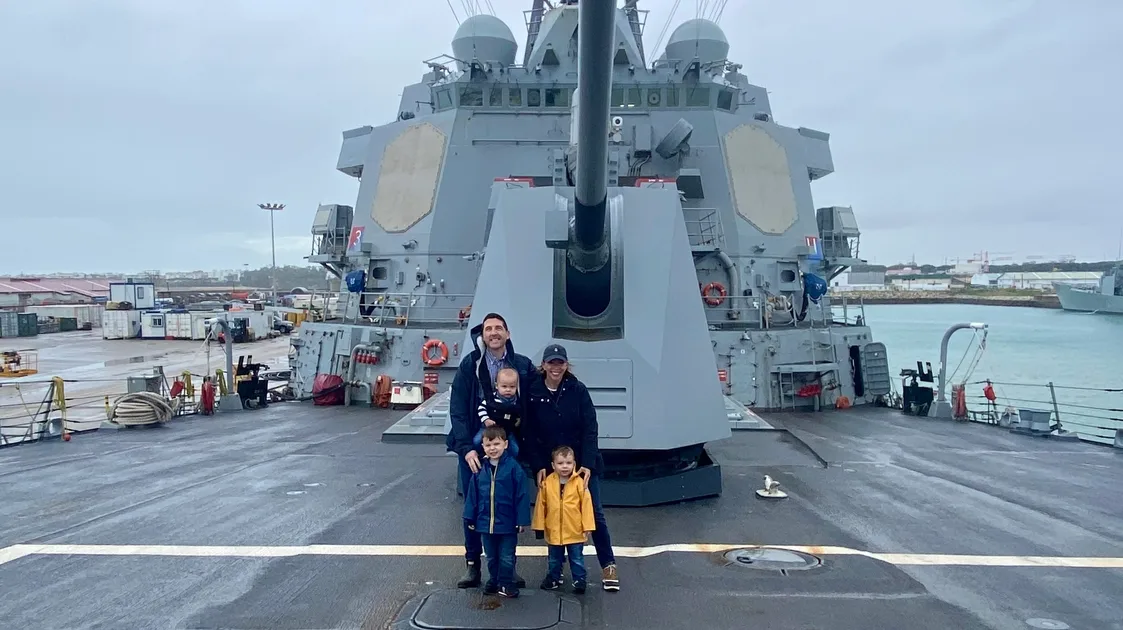
When news alerts start lighting up their phones ― headlines about Iran, explosions in the Middle East, more troops headed to the Persian Gulf ― many Americans feel concerned. Military spouses feel something else entirely. For us, the news doesn’t just describe what’s happening in the world; every headline brings a heavy mental checklist.Who do we know over there?What happens if this escalates?Will my spouse be deployed there? The questions come faster than the answers, and the uncertainty is exhausting. I used to deliver these headlines. Before I married my husband, a Navy helicopter pilot, I was a television news anchor. I sat behind the news desk and delivered breaking news alerts just like the ones we’re seeing now. I reported on conflicts overseas, deployments and escalating tensions around the world.I did what journalists are trained to do: present the facts clearly, respectfully and with empathy for the people affected. And I meant that empathy. When I read stories about another unit deploying from Fort Hood or casualties after an F/A-18 crashed, I genuinely felt sad for the families impacted. But if I’m being honest, it still felt distant. It wasn’t until I married into military life and experienced my husband’s deployment that I truly understood what those headlines actually mean in the home of a military family. The author, left, working as a morning news anchor at NBC affiliate KCEN-TV in Temple, Texas.Photo Courtesy Of Teal YostThat first deployment, we were stationed in Japan, during a period when North Korea routinely launched intercontinental ballistic missiles, or ICBMS. The difference between reporting the news and living it is something you can’t fully grasp until you experience it yourself.Right now, my husband is in a training program, which means that for this moment in time, I know he won’t be directly involved in whatever missions that may unfold in the weeks or months to come. It’s not lost on me how lucky that is. But military families don’t measure time in moments. And I know there are deployments ahead of us ― likely long ones. Additionally, we have close friends in harm’s way. Friends serving on ships operating in the Persian Gulf. Friends flying missions in aircraft directly involved in the region. Friends stationed in Bahrain who are literally hunkering down while Iran launches attacks nearby.So when we turn on the news, it’s not distant. We’re picturing faces. We’re thinking about their kids. We’re wondering if their spouses have slept. And every time a new headline is dropped, it feels personal. The author's three young boys with an MH-60R helicopter at Naval Station Rota.Photo. Courtesy Of Teal YostMost civilians want to support military families during times like this. They just aren’t always sure how. Everyone processes stress differently, but in general, the most meaningful support is surprisingly simple.Check In: Send a quick text message that says: “I saw the news and thought of your family.” That’s enough. You don’t need to have the perfect words; just acknowledging that the moment might feel heavy means more than you know.Offer Practical Help: If tensions escalate and deployments follow, military spouses may suddenly be responsible for doing everything alone. Overnight, they become the sole planner, decision-maker and emotional anchor. Helping with things like child care, meals or school pickups can make a huge difference.Distract Us: Most military spouses already have plenty of friends who are military spouses. So when we’re with someone outside of that bubble, we may want to talk about anything but military life. Talk to us about the latest episode of “Love Story” (all in favor of convincing our husbands to sport backward baseball caps?!), the recipe you tried that turned out amazing or your new mahjong set. Normal conversation can be a gift.On the other hand, even well-meaning comments can land wrong during times like this.“Well, they signed up for it.” Service members chose to serve. Their families did not choose the fear, the distance, or the uncertainty that comes with it.Asking for Inside Information: Questions like “Do you think we’re going to war?” or “Do you know where your spouse will go?” put spouses in an uncomfortable position. Most of us don’t have those answers. And even if we did, we likely couldn’t share them.“I could never do what you do.” This is often meant as a compliment, but it can unintentionally create distance instead of connection. In my experience, most military spouses don’t see themselves as extraordinary. Resilience isn’t a badge of honor ― we’re just people putting our heads down and doing what we can for our families. It is all the more reason to check in if you have a military family in your life. Even the strongest people shouldn’t have to carry the weight alone.Teal Yost is a Navy spouse and former television journalist who reported for NBC, CBS, Fox, and Bloomberg. A graduate of Columbia University’s Graduate School of Journalism, she writes about military family life and the human side of the national security stories Americans see in the headlines every day.Do you have a compelling personal story you’d like to see published on HuffPost? Find out what we’re looking for here and send us a pitch at pitch@huffpost.com.
My Husband Is In The Navy. Here Are 3 Things You Should Really Consider Right Now Amid The War In Iran.
“Every time a new headline is dropped, it feels personal.”
865 words~4 min read