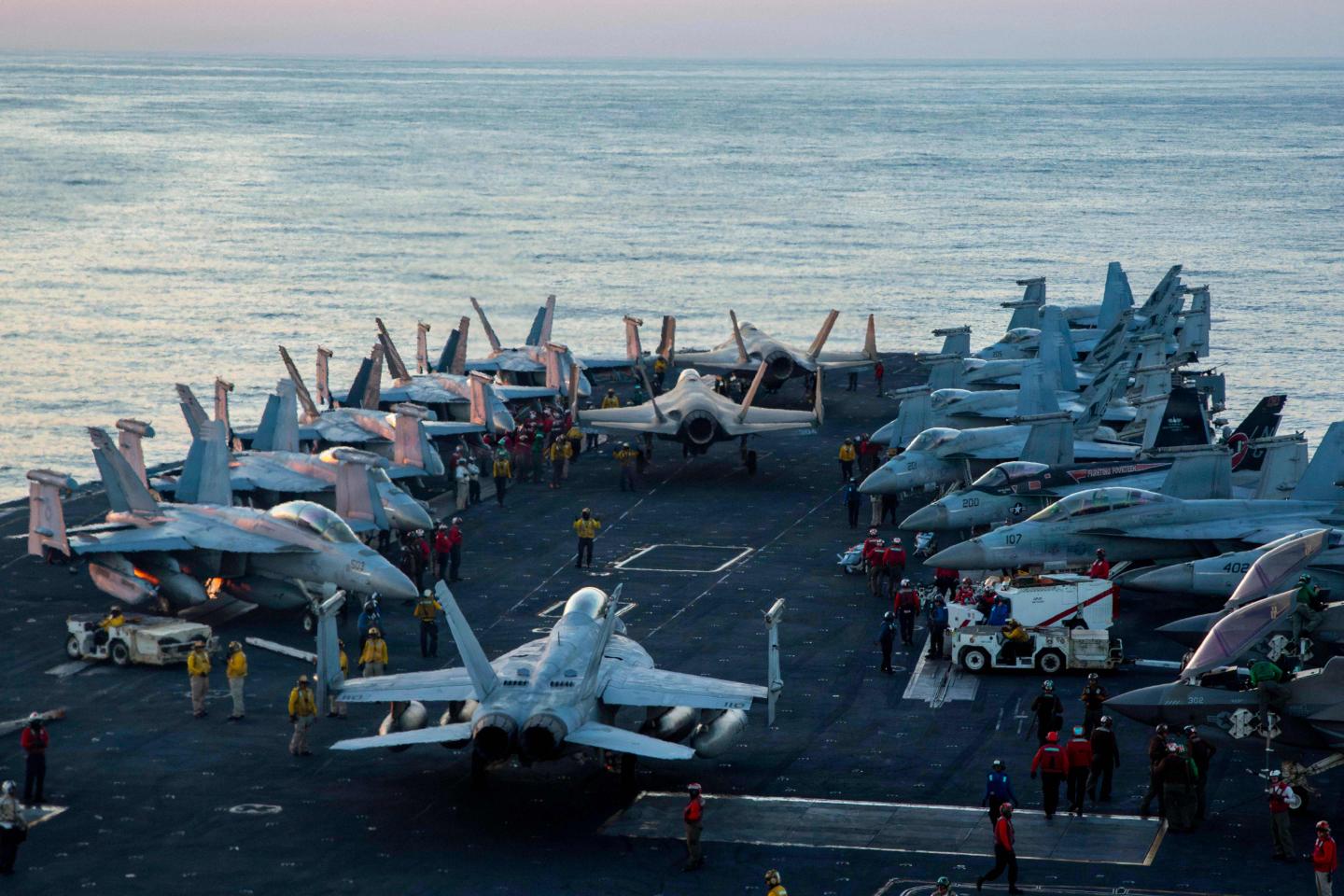
US Navy sailors conduct maneuvers on the flight deck of the USS Abraham Lincoln (CVN 72), which is supporting Operation 'Epic Fury,' on February 28, 2026, in a photo provided by US Central Command. MARINE AMERICAINE VIA AFP
It's a war with no set timetable and no shortage of resources. After a weekend of mixed messages, on Monday, March 2, the White House and the Pentagon tried to tighten up their messaging on the offensive launched against Iran.
Following the first six American soldiers' deaths, the downing of three F-15 fighter jets, which Kuwait officially shot down in a "friendly fire incident," and the conflict's expansion across the region due to Iranian strikes, Washington aimed to counter the idea that the United States-Israeli joint offensive had been improvised and lacked clear, legitimate objectives.
Overthrowing Iran's regime was no longer on the table, even though Donald Trump had openly called for it just 48 hours earlier. Now, Washington was solely describing the offensive in terms of its military aims: destroying the opponent's naval forces and ballistic missile capacity. According to US Secretary of State Marco Rubio, the operation was necessary due to reasons linked to the missile program. He claimed that within "a year from now or a year and a half," Iran would have crossed "the line of immunity": The regime would have had "so many short-range missiles, so many drones, that no one could do anything about it because they could hold the whole world hostage." This was a significant shift in the official messaging. On Saturday, Trump spoke of long-range missiles that "could soon reach the American homeland."