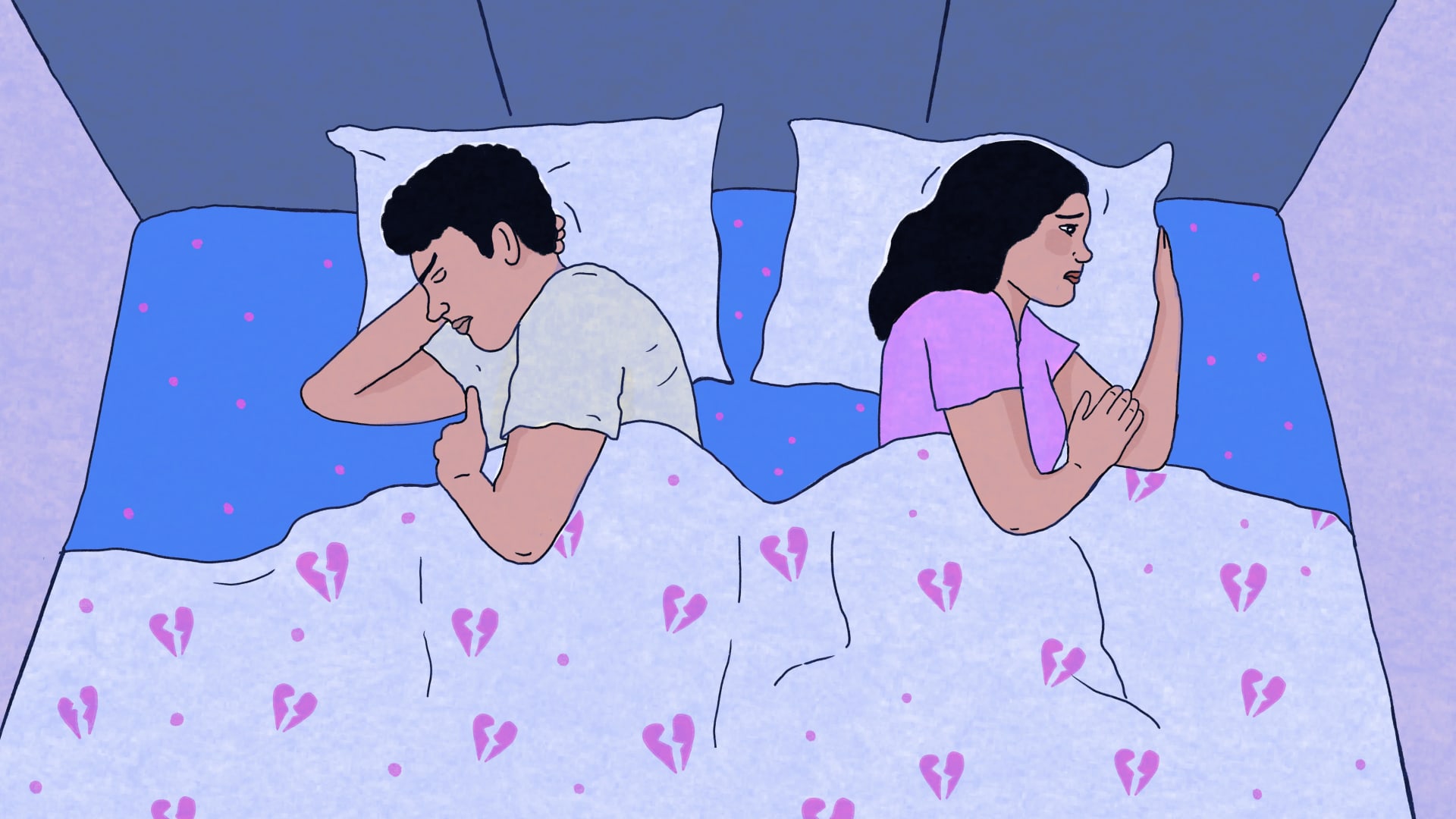
Relationships end for many reasons, but certain patterns show up again and again. One of the most concerning is when a partner becomes a “burned-out pursuer.”“A burned-out pursuer is someone who has spent a long time trying to create closeness, communication or change in a relationship and eventually becomes emotionally exhausted, shuts down and begins to give up,” said Colette Jane Fehr, a licensed marriage and family therapist and author of “The Cost of Quiet: How to Have the Hard Conversations That Create Secure, Lasting Love.”Typically, this is a partner who feels worn down after years of trying to connect and to feel heard and valued in the relationship.“They are often the anxious partner in the relationship and view themselves as the one ‘fighting for the relationship,’ but when they burn out they become apathetic and detached,” said Danielle Kepler, a licensed clinical therapist and owner of DK Therapy. The term “burned-out pursuer” stems from the work of clinical psychologist and couples therapist Sue Johnson, a developer of emotionally focused therapy (EFT) and a leading researcher on attachment theory. She identified a “pursuer-withdrawer” dynamic in relationships in which one partner (the pursuer) urgently seeks connection while the other (the withdrawer, or distancer) pulls away to avoid conflict or emotional flooding.“And ‘burned out pursuer’ specifically identifies the dangerous transition from the anxious seeking of closeness and connection to a state of detachment,” said marriage and family therapist Marni Feuerman. “The pursuer is now also withdrawn and has essentially given up on getting their needs met by the partner.”Over time, the pursuer might still want the relationship, but stop believing their efforts make any difference because they can’t seem to get through to their partner, the withdrawer. Eventually, they hit a wall.“As a therapist, I see this specific dynamic quite often and unfortunately it’s one of the most painful ‘end-stage’ patterns a couple can hit,” Feuerman said. “The burned out pursuer has spent possibly years trying to get their partner to emotionally engage or show affection or attention, but after being met with repeated stonewalling or avoidance, they finally give up. They detach or go quiet. Not because the relationship is better, but because they’ve hit a point of despair and have lost hope.” How does someone become a burned-out pursuer ― and what does it look like?Someone doesn’t become a burned-out pursuer overnight. This dynamic can take months or years to arise. “The pursuer tries to connect until they give up hope that their partner will engage with them,” Kepler said. “When the pursuer becomes burnt out, they start acting like their partner and not investing time and emotional energy into the relationship. Then neither partner is invested in the relationship. This is often one of the final states to either leave the relationship or have a big wake up call to change the dynamic.”But the origin of this cycle usually predates the relationship. Experts told HuffPost these dynamics tend to stem from individual attachment styles. Some partners are avoidant while others are more anxiously attached. “We come into relationships with our own baggage ― from our parents, our early caregivers, our life experiences, previous relationships,” said Melissa Divaris Thompson, a licensed marriage and family therapist who has created many viral videos about the burned-out pursuer. “Even though it’s a new relationship, we still have those raw spots or maybe some unhealed stuff that we haven’t worked through.”Because of these factors, people tend to naturally fall into a pursuer or withdrawer role, though these are not fixed and can change over time or depending on the specific context. “When there’s a disconnect or challenge in the relationship, the pursuer usually wants to talk about it yesterday, wants to get it done, wants to not go to bed angry,” Thompson said. “They want to protect themselves from feeling disconnected and abandoned and want to feel safe in their nervous system ― whereas the withdrawer wants to protect themselves from feeling emotionally overwhelmed. They might say things like, ‘Let’s not talk about it right now.’ ‘It wasn’t that big of a deal.’ ‘You’re too sensitive.’”The result is two partners who feel emotionally unsafe and unheard. The pursuer gets tired and the energy shifts from “Why won’t you talk to me?” to “Well, what’s the point in trying?”“One partner consistently initiates emotional conversations, asks for reassurance or raises concerns, while the other responds with avoidance, defensiveness or silence,” Fehr said. “The more one pursues, the more the other withdraws, creating a feedback loop that fuels itself and can become difficult to break.”jeffbergen via Getty ImagesAre you a burned-out pursuer in your relationship?Feuerman described the cycle as “a slow-motion collision.”“The pursuing partner starts to feel disconnected and reaches out ― perhaps subtly or in a respectful and assertive way at first,” she said. “Eventually they crank up the volume when not responded to and may come off as escalated. Their partner, in turn, withdraws from this. They may even feel overwhelmed by the ‘attack’ and are pulling away in an attempt to keep the peace.”The pattern can also escalate as the withdrawer pulls away, thus activating the pursuing partner even more. “They become more frantic and distressed until it reaches a breaking point,” Feuerman said. “Eventually the pursuing partner decides the ‘return on investment’ isn’t worth the emotional exhaustion caused by chasing it. They stop pursuing and instead start detaching as a protection from the pain of it all and they also start grieving the relationship while still in it.”Over time, the pursuer-withdrawer dynamic can also lead to other issues. “A withdrawer can eventually blow up spectacularly after bottling up their resentment toward their overtly demanding partner ― and add just as much lasting harm to the relationship if it’s not repaired,” said licensed marriage and family therapist Alejandro Daniel Pina.There are some common misconceptions about the burned-out pursuer.“A major misconception is that a burned out pursuer has stopped caring when in reality they are emotionally tired from repeated unmet bids for connection,” said licensed marriage and family therapist Gayane Aramyan. It’s not that the pursuer no longer cares, but that the cycle of pursuing connection without reciprocity went on for too long and became unsustainable. “They also aren’t giving the ‘silent treatment’ to their partner,” Kepler said. “This state is a sense of learned helplessness and done out of a need to protect themself from further pain and rejection.”Divaris Thompson emphasized that this negative cycle also doesn’t mean that all love is lost. “At this stage, I hear people in my office say, ‘I love them, but I don’t know if I’m in love with them anymore,’ which is a big kind of turning point,” she said. “It’s not as if the love disappeared, but that emotional responsiveness wasn’t there. You learn, ‘I’m not really held in this relationship, not really taken seriously, not given much back when hard things arise.’ Usually, there’s a lot of love still there. They’re just tired of being the engine of the relationship.”“When someone stops asking, stops pushing, or stops explaining how they feel, it’s rarely a sign of peace. It’s usually a sign of resignation.- Colette Jane Fehr, licensed marriage and family therapistAnother misconception is that burned-out pursuers are especially needy, mean, controlling or overly emotional.“It’s normal to want to resolve problems with someone you love and stay connected,” Fehr said. “Initiating repair is a healthy relational instinct. Most burned-out pursuers have this positive intent. Many have been patient for a long time and have simply been carrying the emotional labor alone.”She added that pursuers don’t always fall into the category of anxious attachment, as securely attached people can become burned-out pursuers as well. So it’s not always a simple matter of attachment styles but simply an unmet need for safety and security. “The biggest misconception is that the silence from the once pursuing partner equals peace,” Feuerman said. “Partners might think the relationship has improved because the ‘nagging’ has stopped. In reality, that silence is the sound of the bond breaking.”When someone stops bringing up concerns or trying to address challenges, it doesn’t mean things are magically better or more peaceful. More often, it signals a loss of hope that change is possible. That silence can reflect grief, sadness and emotional disengagement.“When the pursuer burns out, the relationship enters a danger zone of quiet where communication stops, resentment hardens, and emotional disengagement begins, sometimes long before a breakup or divorce is discussed,” Fehr said.“Burned-out pursuers are often mistaken for the problem, when they’re actually the early warning system,” she added. “When someone stops asking, stops pushing, or stops explaining how they feel, it’s rarely a sign of peace. It’s usually a sign of resignation. Without intervention, this stage can evolve into quiet quitting, where one partner stops initiating connection, stops raising concerns and disengages emotionally while still remaining in the relationship.”Feuerman described this point of emotional disengagement as “the waiting room for divorce.”“When a pursuer is loud and angry, they are still invested,” she explained. “They are fighting for the relationship. When they become burned out, they fall silent. By the time the withdrawer finally notices the silence and thinks, ‘Oh good, we aren’t fighting anymore,’ the pursuer is often already emotionally checked out or planning their exit.”praetorianphoto via Getty ImagesSilence does not necessarily indicate peace. It can instead signal emotional disconnect, grief and hopelessness. Here’s how to avoid reaching the burned-out pursuer phase ― or how to work through it. “The silence of a burned-out pursuer doesn’t have to be the end of the story,” Feuerman said. “Think of it as a final, quiet SOS. If you can catch the shift before the heart checks out, that exhaustion can become the catalyst for a much deeper conversation.”Indeed, there are ways to avoid this dynamic or work through it. The earlier partners recognize a negative pattern, the easier it is to change it. “Make sure to address this disconnection early, before resentment builds and don’t wait until one partner is emotionally exhausted to take bids seriously,” Aramyan said. “Respond with presence and reassurance rather than shutting down or defensiveness.”Fehr urged couples to slow down the cycle, validate each other’s experiences and try to rebuild emotional safety. Consider whether you are both sharing the responsibility of initiating difficult conversations and fostering connection. “Pursuers often need permission to stop over-functioning, while distancers benefit from learning how to stay emotionally present without feeling overwhelmed,” Fehr said. “Couples who can name the cycle together, rather than blaming each other, are far more likely to break it.”Seek to understand your partner’s unique perspective, rather than using simple, harsh labels like “too sensitive” and “too much” ― or “emotionless” and “uncaring.” The pursuer-withdrawer roles are not fixed in a good-bad binary. “Instead of thinking ‘my pursuer partner is such a nag,’ start thinking, ‘Oh they just want to feel at peace’ ― much like the withdrawer wants to feel at peace,” Thompson advised. “You have the same goal. You just go about it in different ways.”She’s noticed that pursuers are often better equipped with mental health-related language because they’ve read books, listened to podcasts and done their own therapy work. “They can come across as very intense or overwhelming for a withdrawer,” Thompson explained. “So pursuers need to check themselves and work on their communication style ― tone and settling your own nervous system so you don’t come across like a tsunami.”Slow down, take a deep breath and ground yourself when you’re speaking to your partner to avoid unnecessary hurt. “If you find yourself to be the pursuer in your relationship, try to express yourself by focusing on your needs and fears rather than blaming or criticizing your partner,” Kepler advised. “If you find yourself withdrawing from the relationship, try to monitor when you notice yourself doing those behaviors and what you are feeling when you do. Express to your partner when you are feeling overwhelmed and need to take breaks from conversations.”Be honest and explicit about what you need ― and truly listen to what your partner expresses, too. If the withdrawer says they need space or want to go for a walk or journal for a bit, the pursuer should extend them grace and recognize people process things differently. They can then take that time to focus on their own self-care and shift focus away from their partner. Withdrawers should also take what their partners say seriously and make the effort to understand what they need and how they might help provide that. “Every couple has a dance,” Fehr said. “One person moves toward, the other steps back. One pushes for connection, the other tries to calm the system by creating space. Both believe they’re reacting logically. Underneath that, the pursuer is often thinking, ‘I’m losing you,’ while the withdrawer is thinking, ‘I’m failing you.’”When couples can map this cycle together, they can see the pattern ― not each other ― as the problem to tackle together as a team. That allows couples to work through issues constructively and protect their emotional bond. Conflict is an opportunity for connection, not debate. “Couples therapy can be a great place to work on this negative cycle if you notice this in your relationship,” Aramyan noted. Again, seeking help sooner rather than later can make a huge difference and stop resentment from building.“Emotionally focused couples therapy helps partners become better equipped in listening and supporting each other,” Pina said. “It’s better to seek out couples therapy instead of trying to fix things yourself.”And you don’t have to wait for a crisis or major life event to gain better communication tools. “Focus on progress over perfection,” Thompson advised. “The pursuer is not going to get it right all the time when they bring up a hard conversation, and the withdrawer is not always going to handle it well. And you can meet a bit in the middle to help each other feel supported and heard.”You can acknowledge ways you got it wrong and show understanding for each other. These challenging conversations lead to true repair and depth in relationships. “Arguments don’t destroy relationships ― silence does,” Fehr said. “The goal isn’t to eliminate conflict. The goal is to have the hard conversations that bring you back to each other instead of pushing you further apart.”
This Common Relationship Cycle Is 'The Waiting Room Of Divorce,' According To Therapists
This dynamic is subtle but dangerous — and hard to recover from.
2,381 words~11 min read