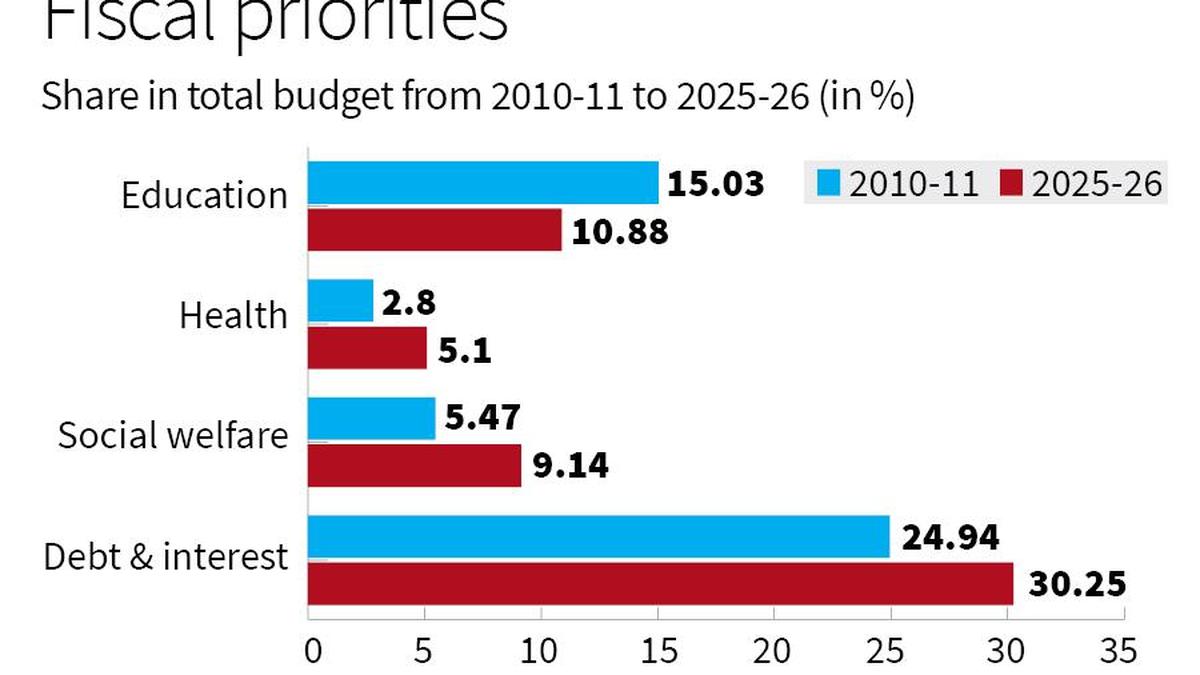
Budgetary trends in Haryana over the past 15 years reveal that the allocation for education has steadily declined as a share of the total budget, even as provisions for social welfare have grown significantly. At the same time, the share of debt and interest payments in total expenditure has also seen a sharp rise.The government spends more than half of the total budget for social welfare on two populist schemes — the Old Age Samman Allowance Scheme, implemented in 1966, and the Deen Dayal Lado Lakshmi Yojana, promised by the Bharatiya Janata Party (BJP) ahead of the 2024 Assembly election.Of the total budget of ₹18,751.78 crore towards social empowerment, nutrition and welfare of Scheduled Castes and Backward Classes in 2025-26, the two schemes together were allocated ₹10,210 crore. The total allocation for education was ₹22,312.46 crore.In 2010-11, the expenditure on education was ₹5,946.29 crore out of the State’s total expenditure of ₹39,554.83 crore, whereas ₹2,176.15 crore was earmarked for social welfare programmes.The allocation for education also includes the capital and revenue outlay on sports, arts and culture.0.77% GSDP on healthThough the health budget has seen an increase over the past 15 years, it is still below the national average of 5.7%, according to a Reserve Bank of India (RBI) report — State Finance: A Study of Budgets of 2025-26. Himachal Pradesh, Uttar Pradesh, Rajasthan and Delhi fare better than Haryana on the health front with spending percentages of 5.8%, 6.1%, 7.6%, and 12.9% respectively.As per the performance audit on Public Health Infrastructure and Management of Health Services, 2022-23, Haryana spends 0.77% of its Gross State Domestic Product (GSDP) on health.The total number of beneficiaries under the Old Age Samman Allowance Scheme in February this year stood at 20,05,367 – 10,44,069 men and 9,61,298 women.The monthly pension has recently been hiked to ₹3,200 per month.Similarly, 8 lakh women from families with an annual income of less than ₹1.80 lakh are given ₹2,100 per month under the Lado Lakshmi Yojana.The BJP, in its Assembly election manifesto, had promised the monthly assistance to all women. As per electoral data, there are 95 lakh women in the State.As per the RBI report, the national average for expenditure on education, sports and arts and culture as a percentage of the total expenditure is 13.1%.Except Punjab, which allocated 9.3% towards education, Himachal Pradesh, Uttar Pradesh, Rajasthan and Delhi have higher spending rates at 17.5%, 13.0%, 16.4%, and 19% respectively.The allocation for technical education, skill development and industrial training, as a percentage of the total expenditure, has also decreased in Haryana from 1.08% to 0.6% over this period.State of institutionsCompared with high-income States such as Tamil Nadu and Maharashtra, none of the universities and higher educational institutions in Haryana figure in the QS World University Rankings 2026 or find a mention in the top 150 higher educational institutions in the NIRF ranking, according to the Haryana Vision Document, 2047.In contrast, Tamil Nadu was home to 18 of the NIRF 2024’s top 100 institutions while Maharashtra had 10 universities in the QS World University Rankings for 2025.The vision document, released in December last year, also highlights a 4.9% secondary-level (Classes 9-12) dropout rate and notes the adverse impact on marginalised communities.It also contrasts the proportion of government schools with Internet — 69.3% — with that in private schools — 94.5%.As per an RTI reply, around 50% regular teaching posts are vacant in government and government-aided colleges in Haryana.On the technical education front, the Vision-2047 document calls for the need to address the high vacancy rate of ITI instructors, which currently stands at 50%.Experts voice concernRupamanjari Sinha Ray, Associate Professor, Economics & Public Policy, Management Development Institute (MDI), Gurugram, said: “The capital outlay for education is a cause for concern for Haryana.”She said the government could, in order to meet the needs of the health and education sectors, consider raising funds for social expenditure through corporate social responsibility funds.For infrastructure projects, the State could aim for public-private partnerships as it has done in the power transmission sector, she added. Ms. Ray, along with Sunil Ashra, Professor, Economics & Public Policy, MDI, had prepared a report titled ‘Evaluation of Finances of State of Haryana’ at the request of the Sixteenth Finance Commission last year.Haryana spends significantly less on education and health as a percentage of its social service expenditure than other high-income States despite having a much higher per capita income than the national average, the report stated.
Education outlay in Haryana shows downward trend as debt, welfare expenditures rise
Budgetary trends in Haryana over the past 15 years reveal that the allocation for education has steadily declined as a share of the total budget, even as provisions for social welfare have grown significantly. At the same time, the share of debt and interest payments in total expenditure has also seen a sharp rise.
738 words~3 min read