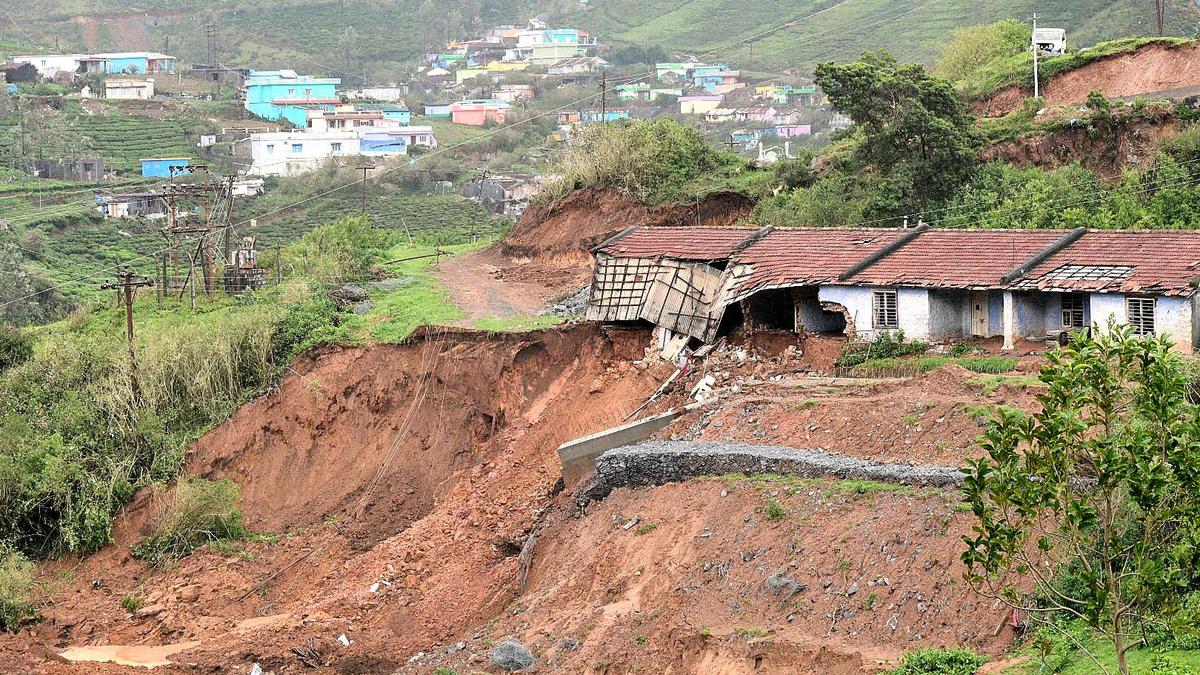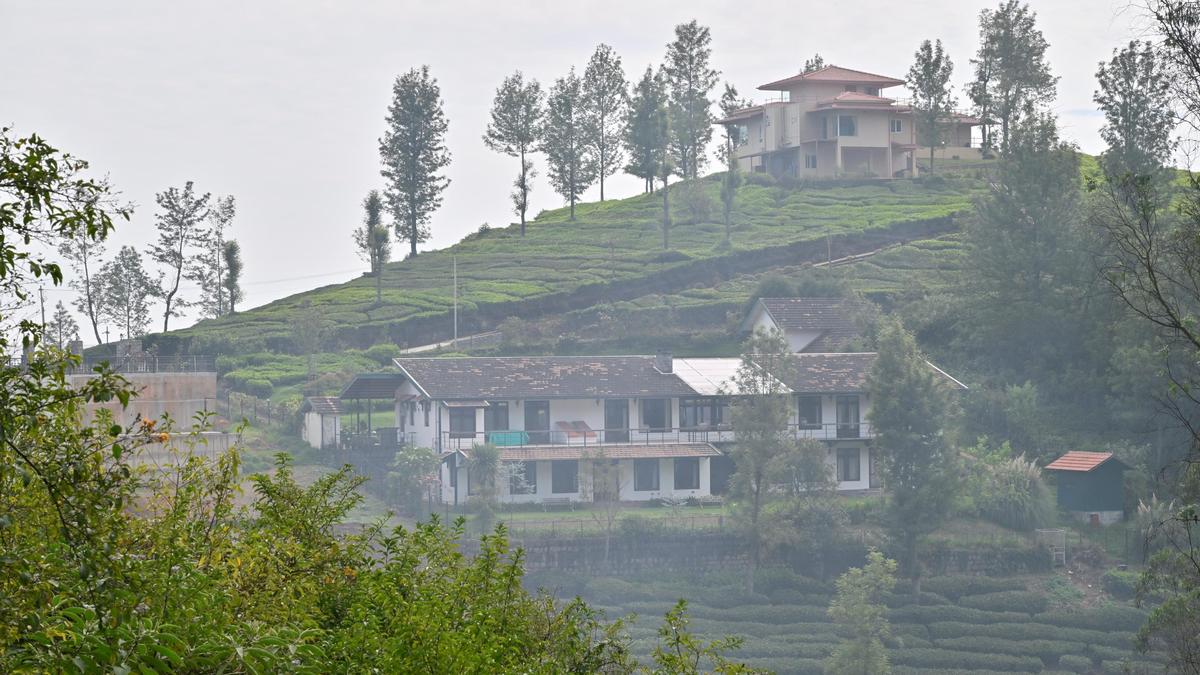
Large, palatial houses now peek over the high canopy of silver oak trees in Yedapalli in Coonoor. Over the years, the once-sprawling tea estate on which these houses stand was sold in small parcels in multiple phases to buyers and subsequently developed into real estate projects, readily purchased by those drawn to the allure of the Blue Mountains.Local residents say they have witnessed many such estates around Coonoor – once the defining feature of the landscape – gradually give way over the last two decades to buildings and residential layouts. “These buildings remain unoccupied for most of the year, serving only as holiday homes, retreats, and homestays for the wealthy,” said N. Muthu, a resident of Bandishola in Coonoor, another area where estates are being converted at a frenetic pace.The Nilgiris district administration is alarmed at the rising pace at which tea estates are being sold off to builders. “The issue is that tea cultivation is no longer viable for many small and medium-sized estates in the Nilgiris, prompting owners to sell them in small parcels to builders, who then construct buildings without obtaining plan approvals and later approach the district administration seeking regularisation,” said a district official.“Builders believe that individuals who can afford to purchase these properties are influential, and these groups then attempt to pressure us into granting approvals after construction is completed,” he added.Tea in crisisH. Thiagaraj, president of the Young Badaga Association and a small tea grower, said climate change and the financial unviability of tea cultivation were forcing small and medium-sized estate owners to sell their properties. “The price of green tea leaves has remained almost unchanged since the late 1990s, while input costs have steadily increased. Combined with an almost 50% reduction in yield across most estates due to climate change, a small estate owner can now expect to earn only ₹35,000 to ₹40,000 per acre annually, after accounting for input and labour costs,” he explained.He said this was leading estate owners and their heirs to sell land in the hills and move out of the Nilgiris. “The last 15 years have witnessed a distinct change. Persistently low prices for green tea leaves and climate change have certainly pushed estate owners to sell land that has been owned for generations. Unless immediate steps are taken in the form of a Minimum Support Price (MSP) and other measures, more estates will be sold and converted into bungalows and housing layouts,” he added.Illegal bunglowsThe construction of large bungalows within the estates, where once only a limited number of people lived, is illegal in many cases.Officials state that most of these bungalows, which have mushroomed in and around Coonoor as well as on the outskirts of Udhagamandalam, lack proper approach roads and have been built without approvals from the Directorate of Town and Country Planning (DTCP) and No-Objection Certificates (NOC) from multiple departments, which are prerequisites for construction to even begin.However, local residents around these large estates question how the district administration failed to notice such major projects as they were coming up. S. Harish, a resident of Yedapalli in Coonoor, said that as early as 2016, these large projects should have come to the attention of authorities, following the deaths of four construction workers at an estate while working on a new building. “Even then, it was clear that these buildings were being constructed, not just in Yedapalli, but across Coonoor,” he said.Retired IAS officer and chairperson of the Confederation of Environment Associations of the Nilgiris (CEAN) Surjit K. Chaudhary said that estates being converted for residential and commercial purposes were illegal. “Under the Tamil Nadu Land Reforms (Fixation of Ceiling of Land) Act ... exemptions under Section 73(iv) were granted to estates on the condition that the lands would be used only for tea cultivation. Any violation of this land-use condition should result in the government taking over the property,” he said.Mr. Chaudhary also questioned how parceled land plots, such as the one in Yedapalli, were registered by sub-registrars without objections. “Permissions are also granted by the Architectural and Aesthetic Aspects (AAA) Committee in the collectorate. How did the committee fail to prevent this?” he asked, adding that these layouts have also been provided with power connections and streetlights illegally.Tea estates’ ecological servicesConservationists argue that the conversion of these estates not only strains the Nilgiris’ infrastructure but also leaves deep wounds on local ecology, hydrology, and wildlife.While the ecological functions of tea estates are limited, conservationists argue that replacing these “green deserts” with concrete structures could have even greater negative impacts on the landscape.“With tea estates, there is still an opportunity for restoration initiatives,” said N. Mohanraj, a Nilgiris-based conservationist. “For example, some estates like Thiashola maintain patches of sholas within their grounds, providing habitat for wildlife and preserving ecological services. Others maintain grasslands and swamps and actively engage in eco-restoration, supporting native wildlife and ecology.”Mr. Mohanraj said that even smaller estates usually leave some patches of shola forests intact for water replenishment and other ecological services, which in turn provide benefits to wildlife and the local ecology.Gokul Halan, a hydro-ecologist from the Nilgiris, said that buyers of land in tea estates often prefer hilltops for aesthetic reasons. “The problem is that they are building over recharge areas where water collects, infiltrates the ground, and replenishes groundwater aquifers,” he said. “This has a very negative impact on the region’s hydrology and hydrogeology,” he added.Mr. Halan pointed out that layouts coming up within estates are inevitably fenced off, further limiting habitat contiguity for many species. “It is better to have a tea estate with limited ecological value than a fenced residential layout, as the estate at least allows some movement of wildlife and helps connect disparate habitats,” said Mr. Mohanraj.“Earlier, communities never fenced their land. Property boundaries were maintained through mutual agreements between individuals. People from outside who purchase land here often immediately build fences to secure their property. This lack of understanding of communal land use and coexistence with wildlife is highly destructive to local fauna,” said Mr. Halan.Mr. Mohanraj also pointed out that the Nilgiris serve as catchment areas for the downstream cities of Coimbatore, Tiruppur, and Erode. “Protecting the hills from further damage and preventing the conversion of tea estates is essential if these cities are to continue growing. Otherwise, they will face the same problems caused by the urbanisation of the Nilgiris,” he added.Government actionWhen contacted, Nilgiris District Collector Lakshmi Bhavya Tanneeru said that most homeowners in these estates are non-Nilgiris residents who began settling here after retirement. “These buildings are sold to them with the promise that the necessary permissions have been obtained. Only after they purchase them do they realise that the builders misled them and then approach us for retrospective permissions, which we are denying,” she said.Ms. Tanneeru said that these layouts require clearances from the Hill Area Conservation Authority (HACA) and the DTCP, along with several other permits for regularisation and the provision of Open Space Reservation plots to the local panchayat. The Collector added that the district administration has written to the State government seeking guidance on the course of action to be taken.She added that the administration is using Google Earth and satellite imagery to monitor estates being converted into housing, allowing authorities to intervene before construction begins.High Court interventionThe real estate boom has also drawn the attention of the Madras High Court, which is hearing a complaint regarding illegal homestays and resorts in the Nilgiris.Real estate agents in the Nilgiris say that many of these illegal buildings have emerged on what were once small tea estates. “During the COVID-19 lockdown, many outsiders began buying these properties, anticipating that they would eventually move to the hills. At the same time, financially distressed tea estate owners sold their land at throwaway prices,” said a real estate agent from Coonoor.He said that over the years, people who bought these estates realised that they were lying unused and began renting them out as resorts and homestays, which has now drawn the ire of the High Court. “Due to the High Court’s intervention, approvals for these buildings are not being granted,” he added.Speaking to reporters, the Collector said that over 900 potential illegal buildings, both commercial and residential, have been issued notices by the district administration. Owners of these properties have been asked to provide documentation proving that they obtained proper licences and approvals before construction. She added that more than 75 illegal buildings have been sealed over the past few months, with teams formed at the local body level to inspect new constructions and monitor sealed buildings to prevent any work from restarting.The latest action came after the owners and contractors of a sealed building in Udhagamandalam resumed construction illegally despite the seal.
Hollowing out the hills: how real estate boom is impacting Nilgiris
The Nilgiris in Tamil Nadu faces ecological peril as real estate expansion threatens its fragile landscape and places additional pressure on the hills by creating demands for new infrastructure and dramatically altering the landscape. This real estate boom has set the alarm bells ringing.
1,454 words~7 min read