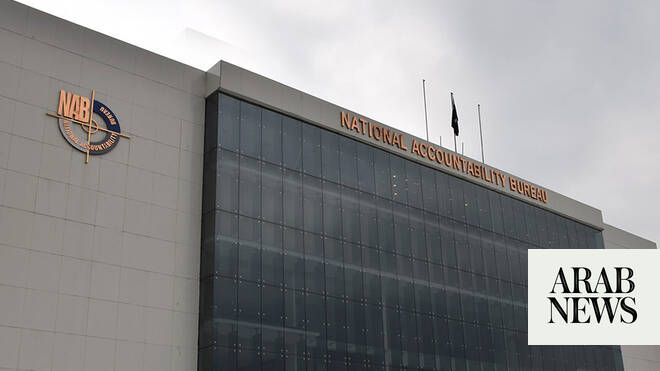
ISLAMABAD: Pakistan’s anti-corruption watchdog on Tuesday raised objections to a recent International Monetary Fund (IMF) report on corruption and governance weaknesses in the South Asian country, describing it as a “perception-driven” assessment and insisting corruption has declined in Pakistan in recent years.
In its Governance and Corruption Diagnostic Assessment (GCDA) published last month, the IMF highlighted weaknesses in key institutions and called for prioritizing a 15-point reform agenda to address vulnerabilities linked to heightened corruption risks in Pakistan.
While acknowledging that Pakistan’s National Accountability Bureau (NAB) had recovered Rs5.31 trillion ($18.8 billion) in 2023–24, the report noted the anti-graft watchdog could only secure 31 corruption convictions between 2022 and 2024, citing NAB’s statistics.
Pakistan’s government has described the IMF report as a “catalyst” for long-overdue reforms, saying the findings would help the government strengthen oversight, plug leakages and improve transparency in the South Asian country.
“The report is not data-driven but perception-driven. Some misleading facts perhaps stem from perceptional conjectures,” a top NAB official, who requested anonymity, told Arab News, adding that NAB’s sustained efforts had brought down corruption in Pakistan by 20-25 percent over the last two years.