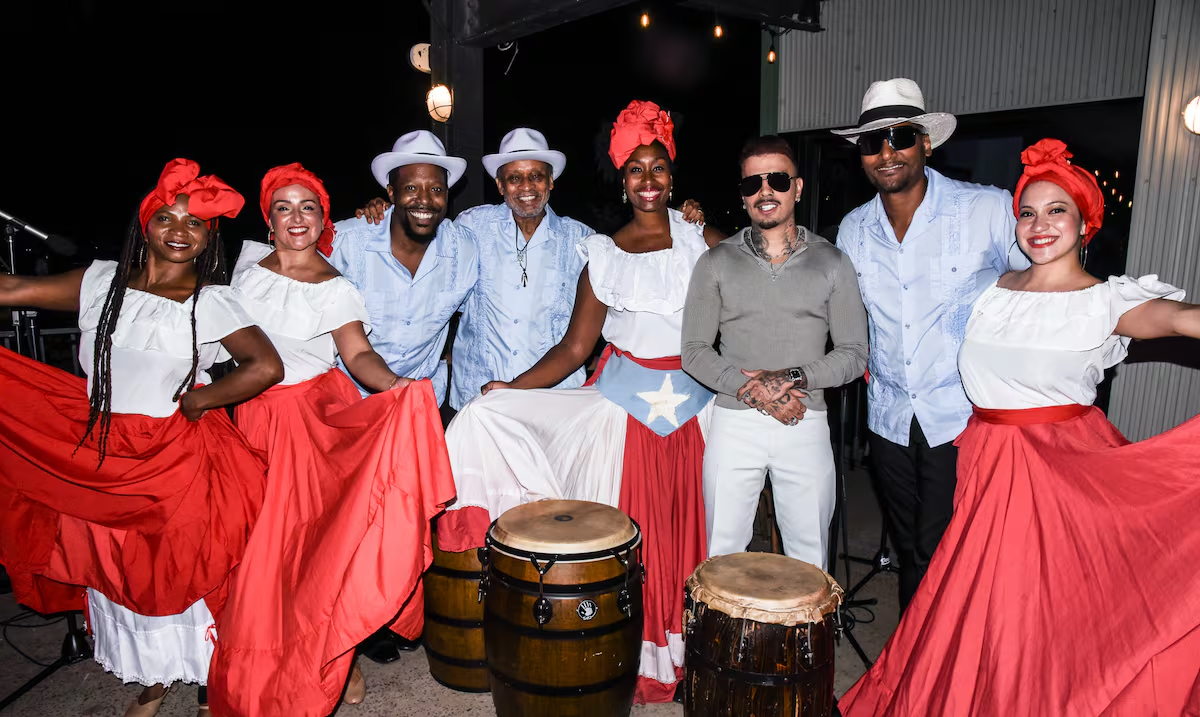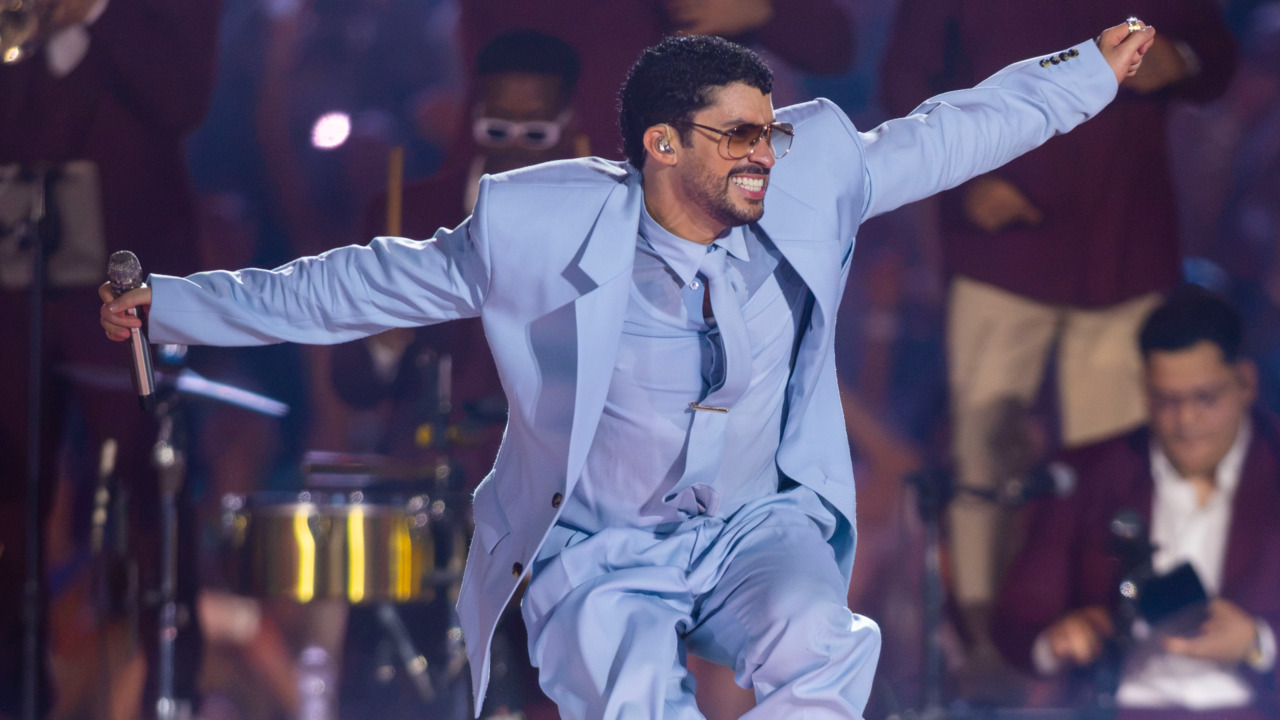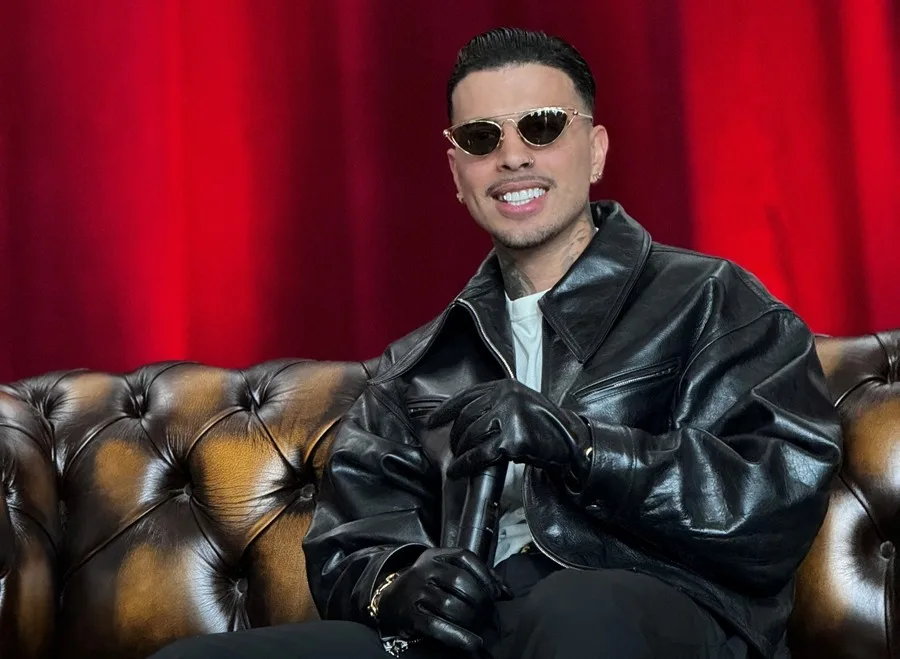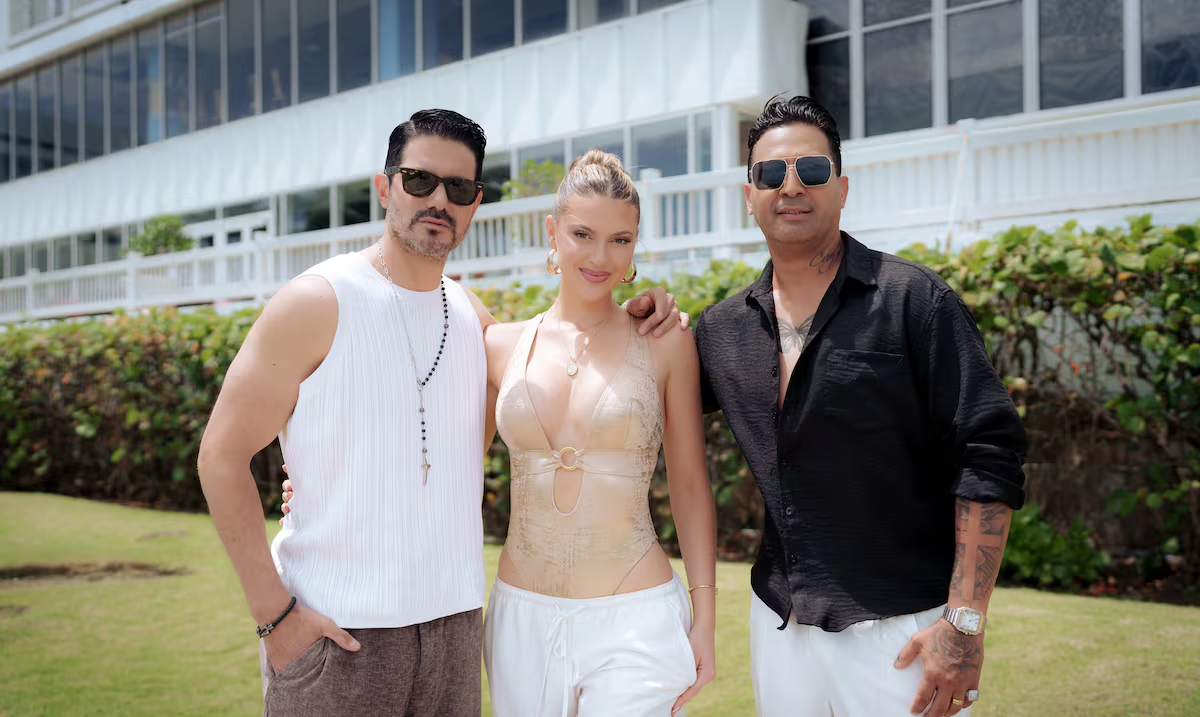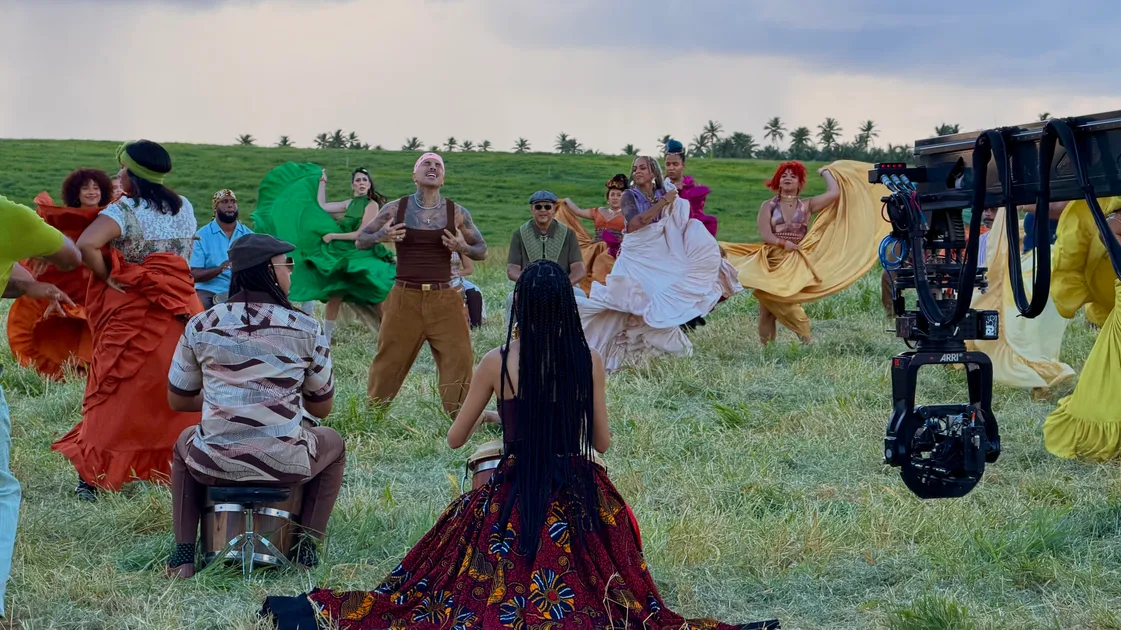
Rauw Alejandro’s futuristic era, once marked by the album releases of “Saturno” and “Playa Saturno,” has now taken a clear turn toward home. With “Cosa Nuestra” and his latest album, “Cosa Nuestra: Capítulo 0,” the Puerto Rican singer/songwriter shifts his gaze from outer space to the island that raised him, grounding his sound and visuals in Afro-Boricua tradition. When he released the music video for “Carita Linda,” the lead single for “Capítulo 0,” fans expected just another sensual pop/R&B hit. What they got instead was something deeper — an homage to Loíza, a town with rich African heritage, from music and dance to cuisine and art. With special appearances from visual artist Samuel Lind and vejigante mask artist Raúl Ayala, the song honored both place and people. But it was only a glimpse of what he had in store.Months later, at the album’s listening party in Mayagüez, I watched as mega fans, influencers and press (myself included) heard the full project for the first time, hours before the rest of the world. Midway through the performance, as he sang “GuabanSexxx,” it began raining. In Taíno mythology, Guabancex is the goddess of “chaotic forces of nature,” the spirit of hurricanes. It felt as if Rauw was truly invoking his ancestors and they responded.In that moment, it became clear that he was moving with purpose, grounding his art in the rhythms and rituals that have always defined Puerto Rican identity. “Besito en la Frente” was immediately one of my favorite songs on the album, a track that carries both heart and history. So when I was invited to witness the filming of its music video a week later, it felt like a full-circle moment, a chance to see how that vision translated beyond the studio. Filmed entirely on the iPhone 17 Pro, the video centers Afro-Caribbean identity through dance, fashion and community. The idea was to “democratize” creativity, proving that a visually stunning production can be achieved with something as accessible as a smartphone, inspiring up-and-coming artists in the Caribbean to create without limits. At the center of the whole production is bomba dancer and Rauw Alejandro’s bomba instructor Rafael Cepeda Rivera.With special appearances from visual artist Samuel Lind and vejigante mask artist Raúl Ayala, the song honored both place and people.Photo: Victoria LeadraCepeda — a direct descendant of Don Rafael Cepeda and Doña Caridad Brenes, two patriarchs of bomba music — told me Rauw’s collaboration with his family began organically. The artist reached out while conceptualizing the album, seeking to learn. But for the Cepedas, this wasn’t just another encounter; it was the continuation of an eight-generation legacy devoted to keeping the island’s Afro-Boricua traditions alive. “For us, bomba isn’t just a rhythm or a dance, it’s a way of life,” Cepeda says, a reminder that the genre was born from enslaved Africans on sugar plantations along Puerto Rico’s coastal towns, most notably Loíza. “It’s a language of resistance, joy, and connection with our Afro-Caribbean roots.”Rauw’s approach came from a genuine desire to connect with his roots, respect and pay tribute to bomba, Cepeda recalls. “From our first meeting, we knew it would be something special, a chance to unite tradition with a new musical generation without losing the essence of Puerto Rican bomba. He came with real curiosity, wanting to understand the dialogue between the drum and the body. There was no ego, only respect.”Being on set for “Besito en la Frente,” now out for everyone to watch, I realized that humility wasn’t just behind the scenes, it shaped every frame of the video, resulting in a visual love letter to Puerto Rican ancestry, featuring bright skirts swirling to the beat of the barril de bomba and dancers communicating through movement echoing stories from more than four centuries ago.The decision to center bomba in a global pop song — and its visuals — carries deep historical resonance. As Cepeda explains, “Every drumbeat and every step is an affirmation of our African identity. In a world that tends to erase what’s ancestral, dancing bomba says: ‘We’re still here, standing proud, and we have history.’ It’s [our] way to heal, educate and unite communities.”Emanuel Acosta, Rauw’s stylist and Patricia Rosado, his costume designer, began shaping the project’s visual identity, not as another music video styling, but as cultural storytelling. “From the start we wanted an image that spoke for itself,” Acosta explains. “The colors of the Caribbean, the volume of the skirts, the gold shine of the jewelry, they all tell our story. For example, the lace represents transparency and the earth tones our connection to the land.”The team collaborated with several Puerto Rican designers, vintage shops and artisans to ensure every element was sourced locally. Authentic bomba skirts were rented from cultural matriarchs Tata Cepeda and Maribella Burgos, whose handmade pieces have graced bateyes for decades.“Each garment carries history,” Acosta notes. “We wanted that energy on screen because fashion is language. It tells the world who we are and where we come from. That’s why we mixed vintage garments with modern pieces, a memory and homage to our ancestors, honoring all Puerto Ricans who came before us.”During the shoot, I noticed a distinct look each bailadora had. Acosta described it as “a subtle gitano air” they incorporated to represent “the historical displacement of Puerto Ricans and the way in which bomba has crossed international borders, even reaching Japan, the same displacement that enslaved Africans endured to reach the island.” This isn’t the first project where Rauw brought Afro-Caribbean traditions to the masses in an informed way. While preparing “Cosa Nuestra,” he and his team delved into the Instituto de Cultura Puertorriqueña, under the guidance of Dr. Carlos Ruiz Cortés and Dr. Hugo R. Viera Vargas.Still, his newest album marks not just an artistic experiment, but a personal evolution: a more mature era where his work further amplifies the culture of his enslaved ancestors while reintroducing them to global audiences through his own creative lens.Filmed entirely on the iPhone 17 Pro, the video centers Afro-Caribbean identity through dance, fashion, and community. The idea was to "democratize" creativity.Photo: Victoria LeadraThe video called for a 160-person crew, directed by Martin Seipel and produced by Rocío Taboada. Their goal was simple: “to prove that stories about Latinidad can be told anywhere, by anyone,” Taboada tells me. Cepeda’s ultimate wish for this project was to teach those unfamiliar about the culture with commitment, respect and love. To see an artist like Rauw use his platform to make bomba visible fills him with hope. Filmed over three days with 20 iPhones on set, the choice was deliberate. By using a device everyone carries in their pocket, Rauw proved that powerful storytelling doesn’t depend on resources, but on intention. It was a choice that reflected where he stands now as an artist, no longer chasing innovation for spectacle, but using it to amplify identity. “Puerto Rico doesn’t just export music, we export culture, history, and spirit,” Cepeda says. “If someone watches this video and asks, ‘What is that sound?’ then we’ve already won.”
I Got To Witness Rauw Alejandro’s Love Letter To Afro-Caribbean Puerto Rico — And It Was Nothing Short Of Magic
I was invited to filming of the singer’s new music video — and it was nothing short of magic.
1,175 words~5 min read