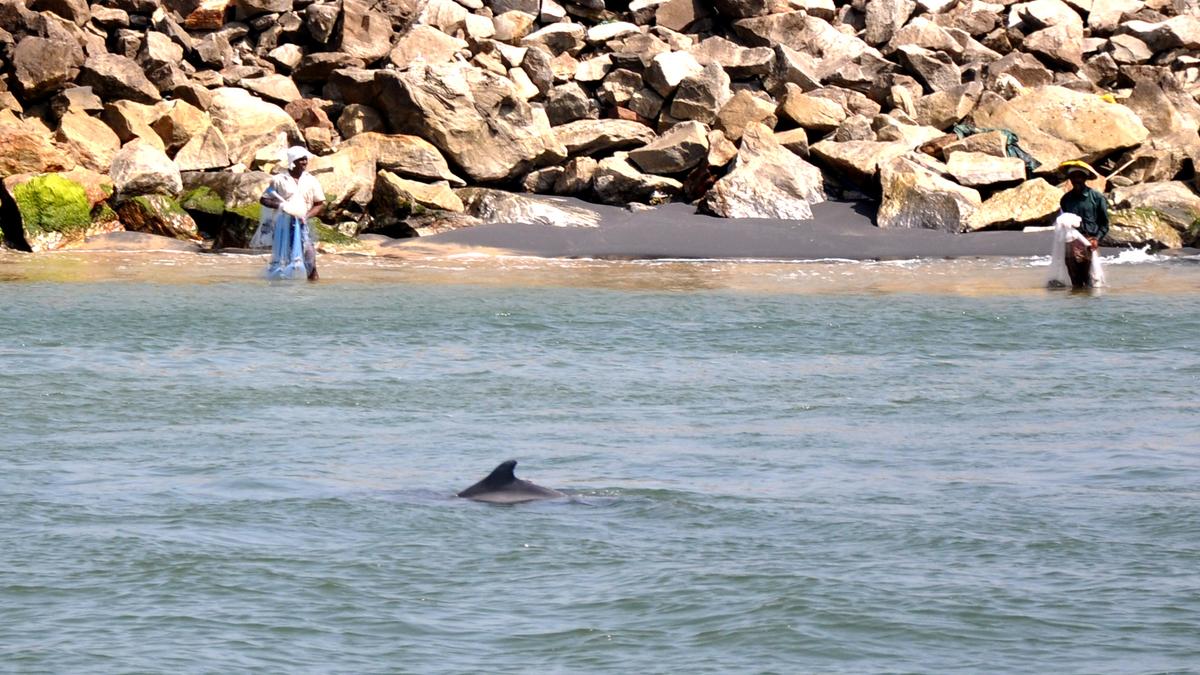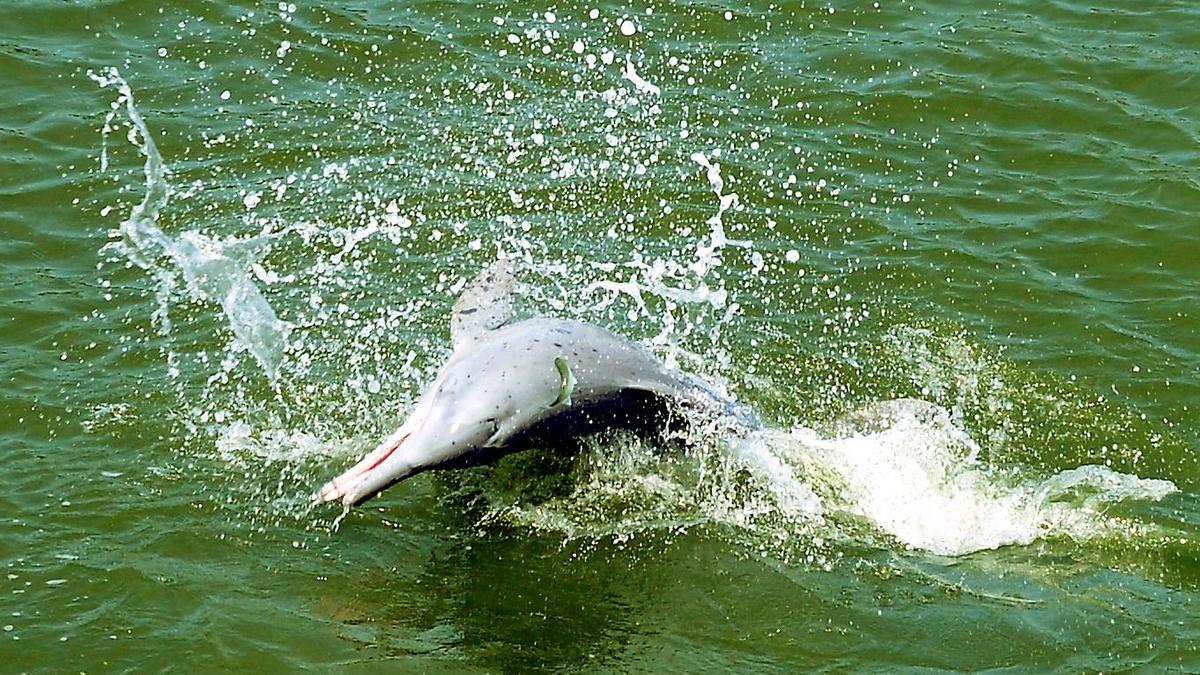
A dolphin in the Ashtamudi lake in Kollam.
| Photo Credit: C. SURESH KUMAR
Standing waist-deep in the turbid waters of Ashtamudi Lake, the artisanal fishers may appear to be solitary figures, patiently attuned only to the tide’s rhythm. But in reality they are waiting for some cue from their allies who are beneath the water. In a classic instance of inter-species collaboration, Indo-Pacific humpback dolphins (Sousa plumbea) drive dense schools of fish to the shallow, shoreline waters and signal the fishers with a dramatic tail-slap or roll. Nets are cast instantly and the catch is mostly great, while the dolphins seize the scatter.This rare strategic cooperation will be now studied as part of an international collaborative research project launched by the University of Kerala and the study will continue up to 2028. The collaborative team includes researchers Mauricio Cantor (Oregon State University, U.S.A.), Fabio Jorge Daura Jorge (Universidade Federal de Santa Catarina, Brazil), Damien Roger Farine (Australian National University, Australia), A. Biju Kumar (University of Kerala) and Dipani Sutaria (Dakshin Foundation, Bengaluru).The Ecology and Evolution of Cultural and Cooperative Behaviour among Dolphins and Humans, a study supported by the National Geographic Society and coordinated globally by the Oregon State University aims to unravel the mechanisms driving the unique cooperation between the wild dolphins and traditional fishers in Ashtamudi Lake.Human–wildlife cooperation“This study examines one of the world’s scant remaining examples of human–wildlife cooperation, analysing the active behavioural coordination utilised by both species to secure reciprocal advantages,” says Prof. Biju Kumar, principal investigator, India, who along with Smrithy Raj of Kerala University first documented the interaction at Ashtamudi.“This project is groundbreaking because it will, for the first time, compare dolphin–fisher cooperation across three continents, including those observed in Brazil and Myanmar. This comparative analysis aims to investigate how such complex interspecies behaviours evolve independently in different cultural and ecological contexts,” says Prof. Cantor, lead global investigator.The research will employ strictly non-invasive methods, utilising detailed photo and video documentation, meticulous behavioural observations, and semi-structured interviews with local artisanal fishers. Crucially, no animals will be captured, handled, or disturbed as part of the research. Since a significant component of this project is capacity building, overseas experts will conduct fieldwork training for Indian PhD and postgraduate students in advanced scientific methods for studying dolphin behaviour and ecological cooperation.“The results are expected to shed light on how these interactions arise and persist, offering valuable insights into the evolution of cooperation, animal culture, and the importance of local ecological knowledge. Beyond research, the project aims to establish a framework for long-term monitoring of dolphin–fishery interactions in India, directly supporting the development of sustainable fishing practices that preserve marine biodiversity,” says Prof Biju Kumar. Published - November 15, 2025 05:20 pm IST