James Earl Jones Theatre
Playwright Bess Wohl looks back on her mother’s activism in a moving and cleverly constructed look at how to balance the personal and the political
T
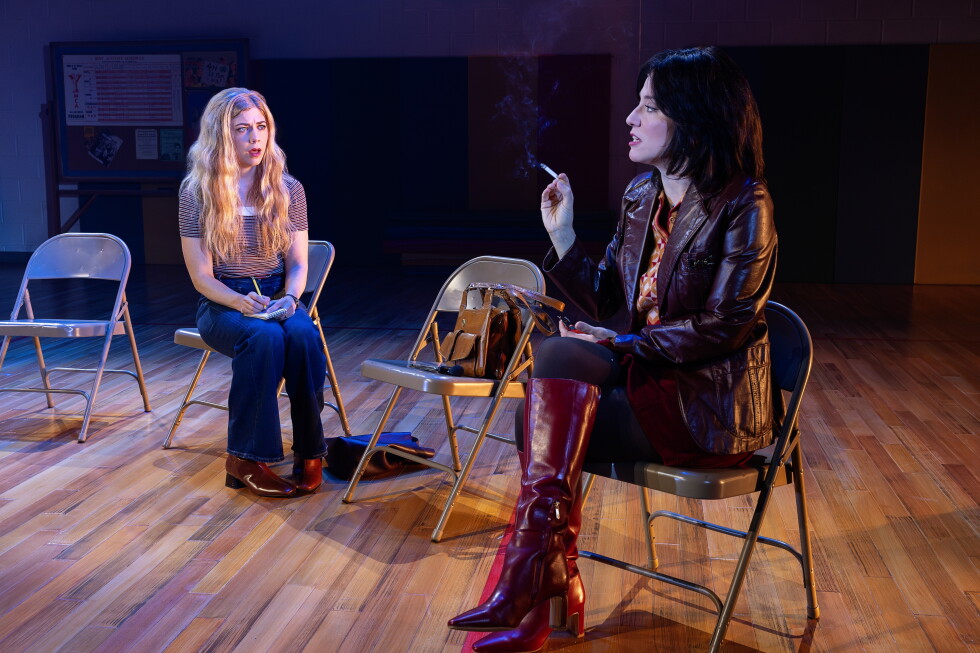
hough not listed in the program, Liberation, an inventive and resonant new play by Bess Wohl, possesses a subtitle: A Memory Play About Things I Don’t Remember. The line presumably refers to the personal nature of the show, based in part on the life of Wohl’s mother, Lisa Cronin Wohl, who worked for Ms Magazine in New York during Wohl’s early years, but it also applies to the conversations at hand, within a women’s lib group in small-town Ohio, 1970. On the basketball court of a local rec center, six women hit the blinkered beats of second-wave feminism – workplace inequalities, consciousness raising, The Feminine Mystique – that many in the audience will only know secondhand, through family histories, re-creations like FX’s superb series Mrs America or inherited cultural shorthand. I, like Wohl – like anyone born after Roe – have only inherited memories of this stage in the fight for sex and gender equality.
There’s often a tone of light derision applied to second-wave feminism, whose white, upper-middle class limitations were glaring even if its aims were noble, albeit tragically fragile. Lizzie, an adult woman of our times, seems to know this. She’s played, by Susannah Flood, as anxious, apologetic, eager to over-explain; she addresses the audience first as a peer, with the lights up, the required sealing of phones acknowledged, the fourth wall unbuilt. Perhaps, to get a restless crowd of New Yorkers to sit for two and a half hours with this circle in Ohio, one must lure them slowly through the back door of theater – here, a resurrection of the group in which Lizzie plays both herself, its chronicler, and her late mother, its founder – with slowly solidifying artifice and the eternally alluring question of who our parents were before us. The mother, according to the daughter, sewed the costumes for every school play, made every family dinner and did all the dishes – how could she have ever been radical?