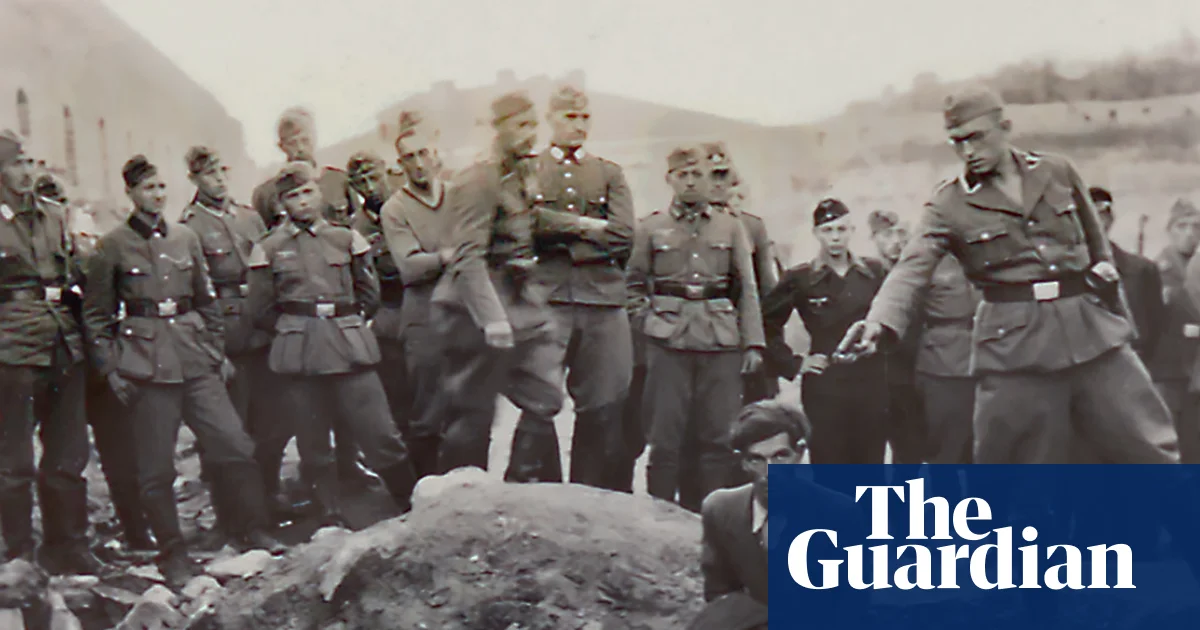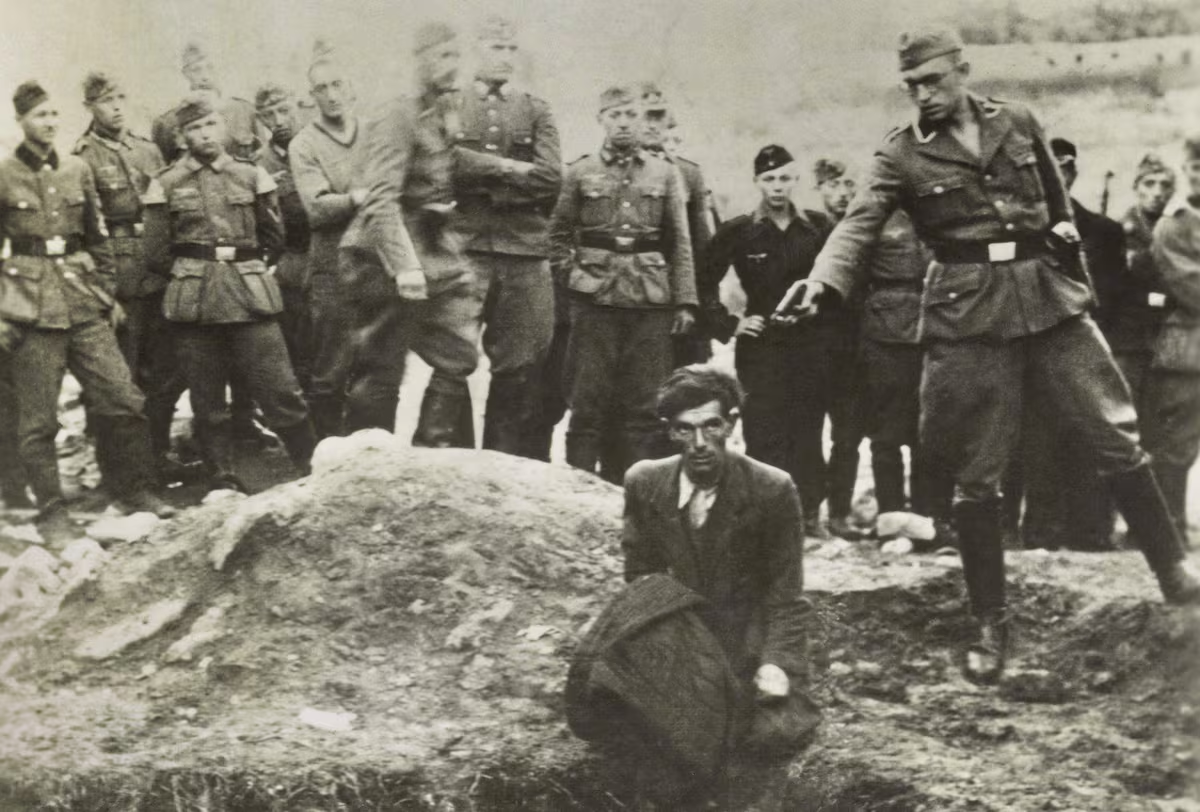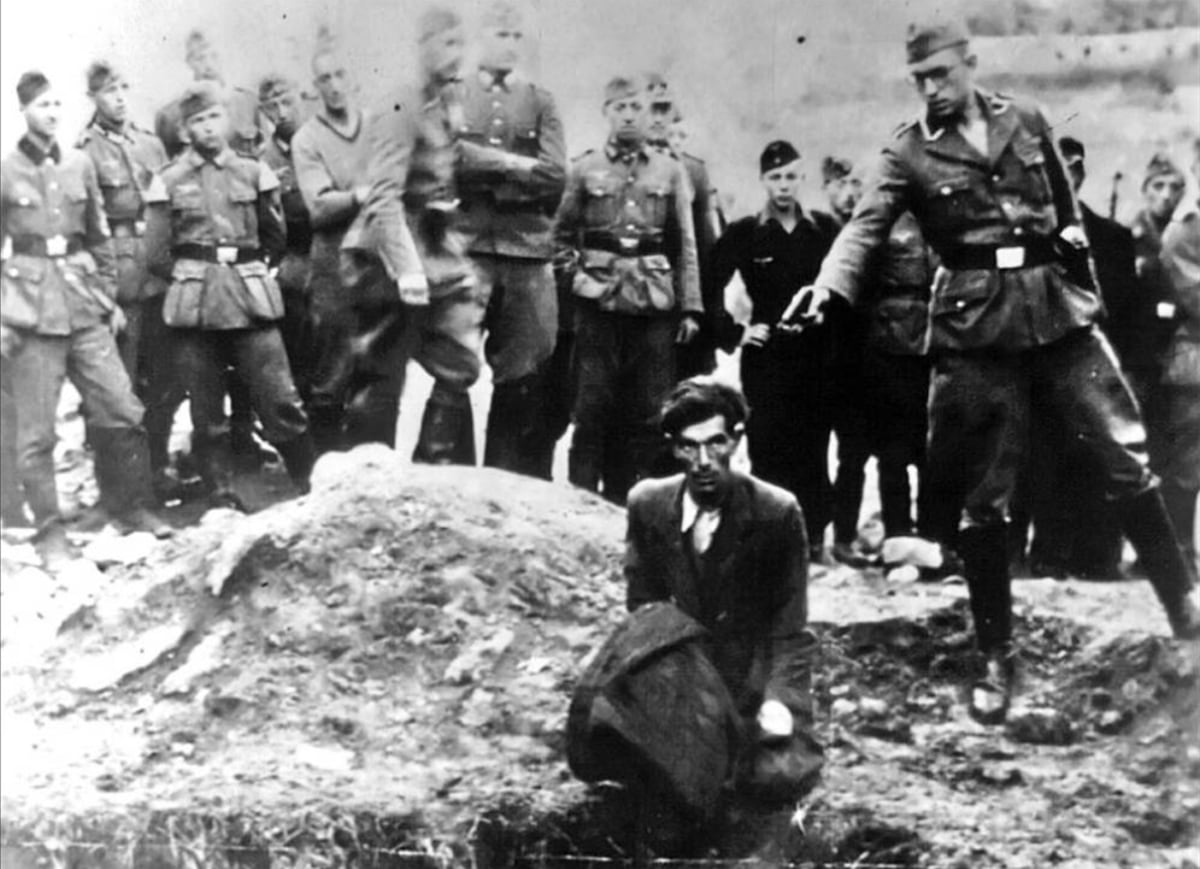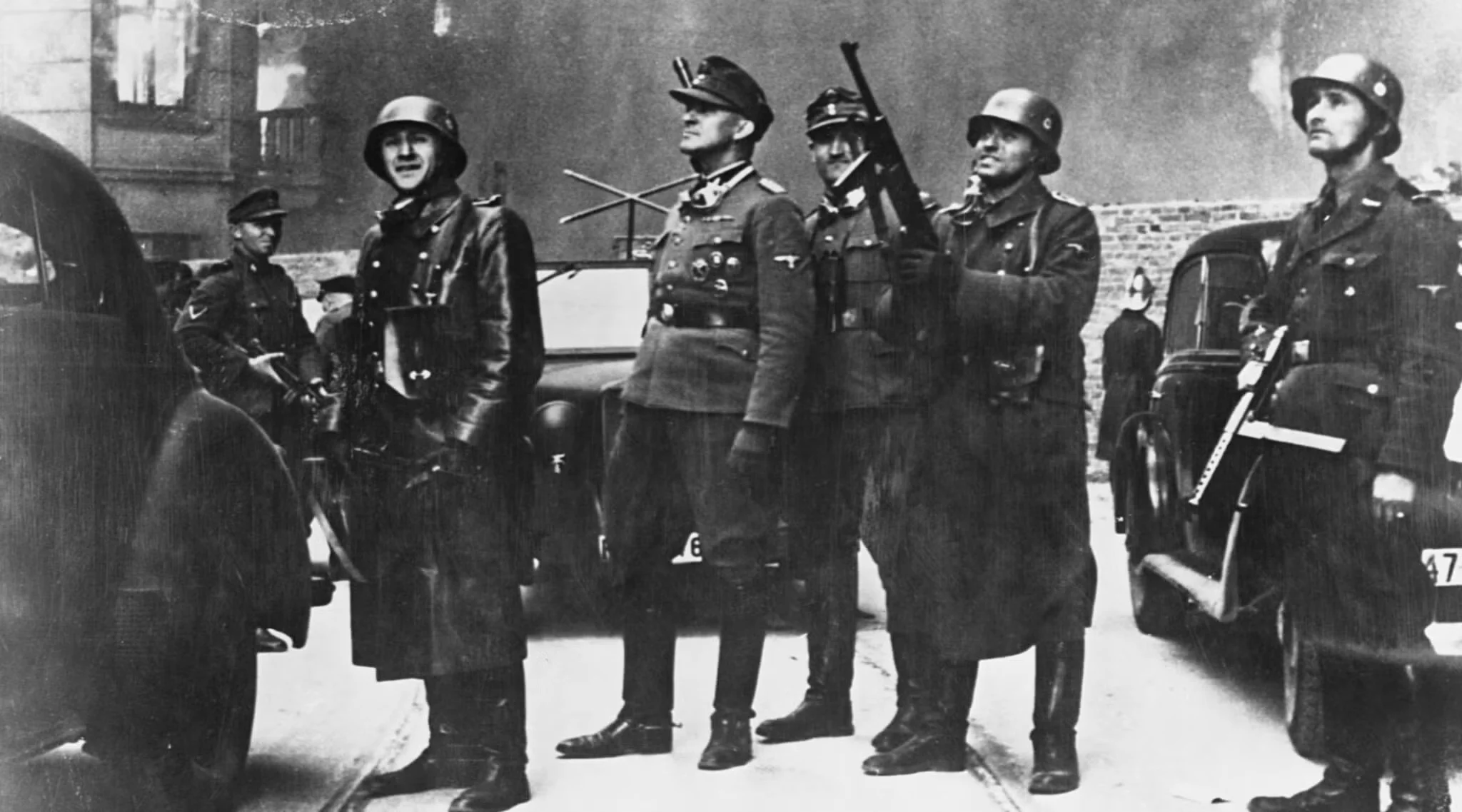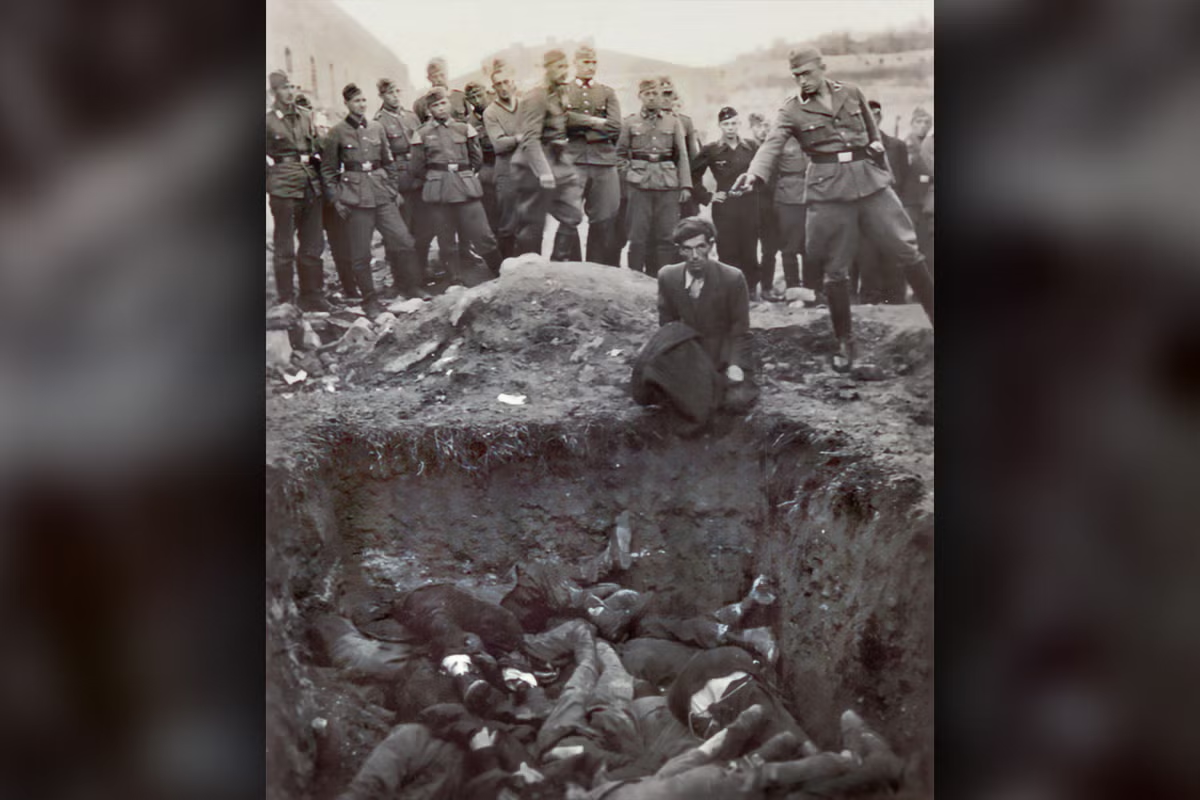
A bespectacled and serious-looking young man is pictured standing, pistol in his right hand, pointing directly at the head of a Jewish man he is about to murder. He is photographed perched on the edge of a pit filled with corpses in the grounds of a fortress in the middle of Ukraine on 28 July 1941. Commonly known as “The Last Jew in Vinnitsa”, the image has become as iconic of the genocide as the entrance to Birkenau, or the piles of bodies being bulldozed at Belsen.After decades of scholarly research and investigation, we now know the man’s name was Jakobus Onnen. He was a teacher of French and English mainly, as well as physical education. Brought up in a small village near the German border with the Netherlands, his father, also a teacher, had died around the time Jakobus turned 18, in 1924. Had it not been for the war, Onnen, who was bright and studious, would have fitted well into the faculty of the German Colonial School near Kassel in central Germany, where he taught from 1932 to 1939. What makes the photograph of Onnen so remarkable is not only the seeming impassivity of the young uniformed men as they watch him murder, but also the haunted and eerily calm expression on the hollow face of the man who is seconds away from becoming another corpse. So much of the photograph suggests routine, another day at work. There is nobody screaming, nobody crying, nobody flinching or turning away. The madness is in the sense of stillness. You can almost hear the shot echo around the courtyard of the fortress, and then the quiet thud of the body as it lands in the pit. And then perhaps the word “next”.Until last week, the name of the murderer – wearing the uniform of a sergeant in the SS – was unknown. But now, thanks to some peerless investigation involving AI facial recognition and Onnen’s family breaking their silence, the German historian Jürgen Matthäus – the head of the research department of the United States Holocaust Memorial Museum – has revealed not only the identity of the killer, but also his background and fate.There are no surprises, because there never are. The story of Jakobus Onnen is yet another tale of an “ordinary man”, who thought he was doing the right thing by murdering people he regarded as his enemies. Let’s not forget – the man was a teacher. He wasn’t, to the best of our knowledge, a rapist or a thug or some other type of monster. He was bright. He was married. He was the personification of ordinary. And yet, there he is, captured for eternity participating in an act of murder, probably wearing the same glasses he wore when he was lecturing his students.It is Onnen’s unexceptionalism that should chill us today, even in modern Britain, or perhaps especially in modern Britain. Damning footage gathered in a seven-month undercover investigation for a Panorama documentary saw one officer, PC Phil Neilson, calling for an immigrant to be shot. A man in a Fred Perry shirt was livestreamed at the Tommy Robinson “day of rage” saying “Keir Starmer needs to be assassinated”. We see ordinary people on marches calling for global uprisings against different groups because of their religion. And when we think of the consequences of living in this febrile atmosphere – as we really, really must – then we end up asking ourselves: Is this how it happens? It is one of the biggest questions of all, and we should be wary of anybody who thinks they can answer it confidently. So what makes an ordinary person do something so monstrous as Onnen? In his article for the academic journal Zeitschrift für Geschichtswissenschaft, Dr Matthäus is sensibly cautious about what motivated him and his fellow genocidaires. As he points out, “the social situation within which the murderers operated was too complex, and the sources from which perpetrator motivation can be inferred were too sparse and unreliable”.However, what we do know about Onnen gives us some clues.Mass book-burnings in Germany in 1933 – by a regime that gave its people ‘an enemy and answers’ (Getty)He was born in 1906 in the village of Tichelwarf, which is about as far northwest as you can go in Germany before it becomes the Netherlands. After studying in Göttingen, he took up his position teaching languages and PE near Kassel. However, it appears that Onnen joined the SA – the Brownshirts – in 1931, and then transferred to the SS the following year. For the rest of the 1930s, he taught, but inspired by a new mood of nationalism, he also published articles in various Nazi journals, mainly about the exploitation of German colonies. One small sample passage should suffice: “The most valuable asset of a productive person is their labour. Only those whose bodies are healthy and resistant to disease remain productive.”Onnen appears to have taken his writing seriously, and when one of his articles attracted some negative feedback, the young teacher challenged the reviewer to a duel with sabres. It required his superiors in the SS to defuse the situation peacefully – an intervention that now seems grimly ironic.As well as having a bit of a temper, Onnen also had a somewhat tempestuous love-life, and he applied for SS marriage permits for three different women in 1935, 1937, and 1938, a series which Matthäus regards wryly as “rather idiosyncratic”. Ultimately, Onnen never received an SS marriage permit, and married another woman in April 1939.At this stage it would be easy to regard Onnen as a bad sort, and the seeds of his later behaviour were all too apparently germinating. This would be glib. Plenty of young men and women in their twenties – especially if they are creative – are highly passionate about their work. Besides, challenging someone to a duel was more a cultural norm in Germany in the 1930s than it would be today. And as for having an “idiosyncratic” love-life? This hardly represents a qualification to conduct genocide.The Duke and Duchess of Windsor at their controversial meeting with German leader Adolf Hitler in Munich, 1937 (PA)But there is no doubt that Onnen evolved into a committed Nazi. In August 1939, just before the outbreak of war, he joined the SS Death’s Head Unit at Dachau concentration camp. By the beginning of 1940, he was working for the Nazi “Order Police” in occupied Poland. It was in June 1941, shortly after the invasion of the Soviet Union, that Onnen would enlist in the unit in which he would be photographed doing his terrible duty – Einsatzgruppe C under SS-Brigadeführer Otto Rasch. The actions of the Einsatzgruppen are, of course, well-known – mobile paramilitary execution units that slaughtered anybody in the conquered territories who was suspected of being an enemy of the Third Reich; be they a Jew, a communist, a Gypsy, or even an intellectual. Einsatzgruppe C would kill nearly 120,000 people.So the question still remains – what precisely was Onnen’s motivation? “The attempt to causally link Onnen’s photographically documented act of murder with the rest of his biography must remain speculative in view of the lack of conclusive sources,” Dr Matthäus writes. “That he had already used deadly violence against Jews before his deployment in the Soviet Union – whether out of antisemitism, regime conformity, or career ambition – is neither documented nor deducible from his biography.”But, if we can be sure of one thing, it is this – that Onnen was undoubtedly radicalised by a nationalistic regime that gave him an enemy and answers. Such radicalisation is all too present in our society today and what makes this process so terrifying, so hard to comprehend, is that by the end of it, such men – and they are usually men – do not regard the people they are killing as being human. This is why the language of nationalism often refers to its targets as being something other than people – they are parasites, cockroaches, bacilli, untermenschen, dogs, waves... You name it, so long as you don’t call them fellow human beings. Stripping your victims of their humanness makes them easier to attack, but it also strips the perpetrators of their humanity, too. What we can be certain about is Onnen’s fate – he was killed fighting partisans some 100 miles west of Kiev in the Zhytomyr region of Ukraine in August 1943. Justice of sorts, but not enough justice for the man kneeling at the edge of that pit – a man whose humanity was stripped from him. A man whose name we still do not know.
The shocking truth about the photo of the ‘ordinary’ Nazi and its chilling message
It is the picture which showed the true horror of the Second World War – a man blithely shooting Jewish prisoners and watching them fall into a mass grave. His identity has finally been revealed and it’s a stark warning about what can happen when we lose our humanity, writes Guy Walters
1,441 words~7 min read