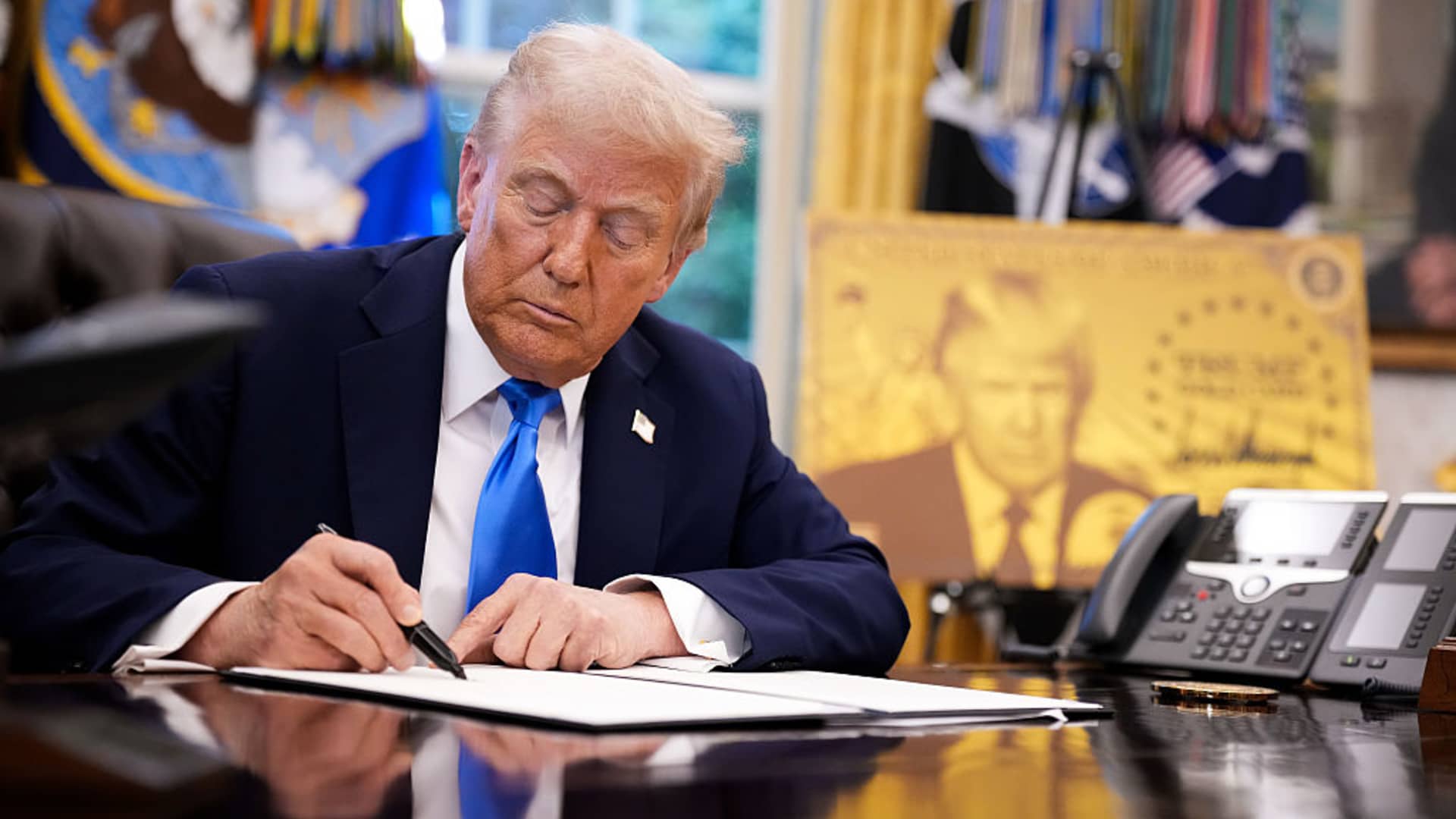
A coalition of labor unions, health care providers, schools, and religious organizations has filed a lawsuit aimed at blocking President Donald Trump’s order that employers pay a one-time $100,000 fee for new H-1B visa petitions.gettyThe American Association of University Professors joined a coalition of labor unions, health care providers, schools, and religious organizations on October 3 and filed a lawsuit to block President Donald Trump’s September 19 proclamation that would require employers to pay a one-time $100,000 fee for new H-1B visa petitions. Previously, according to the American Immigration Council, these petitions cost between $2,000 to $5,000 apiece, depending on the size of the employer.The lawsuit, filed in the U.S. Northern District of California, alleges “the President has no authority to unilaterally alter the comprehensive statutory scheme created by Congress. Most fundamentally, the President has no authority to unilaterally impose fees, taxes or other mechanisms to generate revenue for the United States, nor to dictate how those funds are spent.” The suit challenges Trump’s order as unconstitutional and unlawful under the Administrative Procedure Act, claiming the executive branch failed to go through required regulatory processes. Calling the $100,000 requirement “arbitrary and capricious,” the plaintiffs ask the court to order the Trump administration to continue processing H-1B petitions, without the $100,000 payment condition.In addition to the AAUP, a national organization that has long advocated for the rights of college faculty members, the plaintiffs include the Global Nurse Force; Global Village Academy Collaborative; Society of the Divine Word; the Fathers of St. Charles; Church on the Hill; International Union; United Automobile, Aerospace and Agricultural Implement Workers of America; UAW Local 4811; Committee of Interns and Residents, SEIU (CIR), a citizen of the United Kingdom residing in the Appalachia region, and a citizen of India residing in the Northern District of California. What Are H-1B visas?The H-1B visa is a temporary (nonimmigrant) visa permitting U.S. employers to petition the federal government to hire highly skilled foreign professionals for jobs in “specialty occupations” requiring at least a bachelor’s degree or its equivalent. While the initial duration of an H-1B visa classification is usually three years, it can be be extended up to a maximum of six years.MORE FOR YOUBefore employers can file a petition with the U.S. Citizenship and Immigration Services, they must attest through a labor condition application that employment of an H-1B worker won’t adversely affect the wages and working conditions of similarly employed U.S. workers. In addition, employers must inform existing workers that they intend to hire an H-1B worker.The largest categories of employment for H-1B visa holders are in big tech, engineering, computing, software development, financial services, healthcare and medical research, and academia. According to the suit, about 10% of H-1B visa holders work in health care and academia alone.Universities and colleges are generally exempt from the H-1B cap. As a result, major research universities often employ large numbers of H-1B workers, hiring them into postdoctoral slots, clinical roles, research positions, and faculty jobs. These institutions may average more than 100 or even 200 new petitions per year. At several major research universities, were the new fee to be kept in place, the total expense could surpass $10 million annually, assuming they continued to hire H-1B workers at the same rate as in the past.According to an AAUP press release, the new $100,000 fee demand is problematic on several levels. It: defies Congress: Because the H-1B program was established with a carefully crafted fee and oversight system, the president cannot rewrite it overnight or levy new taxes by proclamation.invites chaos and favoritism: Trump’s order offers a vague “national interest” loophole with no clear standards for exemptions, opening the door to arbitrary, pay-to-play decisions.hurts communities nationwide: “Rural hospitals may be unable to keep needed doctors and nurses; colleges say the unlawful fee is more than many salaries; and nonprofit organizations and research institutions can’t absorb the significant expense. All will lose if they cannot utilize H-1B workers.”undermines the economy: Economists agree that H-1B workers benefit the U.S economy. Discouraging this international talent could result in companies moving operations—and good jobs—overseas.Trump’s proclamation justified the new fee by claiming that the program has been “deliberately exploited to replace, rather than supplement, American workers with lower-paid, lower-skilled labor,” and that “large-scale replacement of American workers through systemic abuse of the program has undermined both our economic and national security.” It accused employers of abusing “the H-1B statute and its regulations to artificially suppress wages, resulting in a disadvantageous labor market for American citizens, while at the same time making it more difficult to attract and retain the highest skilled subset of temporary workers, with the largest impact seen in critical science, technology, engineering, and math (STEM) fields."Many employers, of course, see it differently, and a legal challenge against the order was anticipated. "Without relief, hospitals will lose medical staff, churches will lose pastors, classrooms will lose teachers, and industries across the country risk losing key innovators,” said Democracy Forward Foundation and Justice Action Center, two members of the plaintiff’s legal team, in a press release.
AAUP Joins Coalition Filing Lawsuit Against Trump’s New H-1B Visa Fee
The AAUP has joined a broad coalition filing a lawsuit against President Trump’s order requiring employers to pay a one-time $100,000 fee for new H-1B visa petitions.
841 words~4 min read